Have you heard? Annual performance reviews have been rated ‘needs improvement’.
From CEOs to employees, and from HBR to Fast Company to Deloitte University Press, there is an overwhelming consensus that current approaches to performance management – anchored around the dreaded annual review – are broadly ineffective. According to a Deloitte University Press report, less than 50% of CEOs believed that their performance management approach helped drive employee engagement or business results. Further, less than 10% of HR leaders believe that annual performance reviews result in accurate information, and less than 4% of employees feel that it is the best way to motivate and engage them.
In response to this disappointing data, companies are moving quickly. Most large companies are actively experimenting with performance management systems, and some have eliminated annual reviews entirely. The challenge is that while the data is clear on what doesn’t work, there is no clear consensus on what does.
The inevitable period of experimentation and transition to come will challenge managers – as many of them will be asked to ‘fly the plane while its being built’. Arming them with the skills to thrive during this period of transition will be vital.
Click here to read the whitepaper. Listen up! There is a fundamental difference between simply hearing someone and truly listening to what they are saying –a difference that can cost your company in terms of time, money, and relationships.
If this is not news for anyone, than why is it that so many workplaces are still plagued with poor listeners? Listening, although easy to understand, is a skill that is challenging to master. Using over 2,500 action plans from real Third Factor clients, Director of Training, Peggy Baumgartner, uncovers the secret to successful listening. She will step you through the key factors that distinguish the clients that saw an improvement in their listening abilities from the ones that prioritized listening, yet didn’t achieve results.
It’s time to open your minds (and ears) up to the idea of refining your listening skills.
Click here to download the whitepaper. We are living in the age of pressure. Many businesses are facing disruption from technology, artificial intelligence and automation. At home, many people are caring for children and aging parents simultaneously. And around us, rapid political and environmental changes are creating unprecedented uncertainty.
Yet, some people thrive under pressure. They learn to use it as a source of growth and inspiration. If channeled effectively, pressure can lead to high performance and personal growth – but that’s not always the case. So, how do individuals, leaders, and organizations learn to harness the positives from pressure and mitigate its dark side?
In this whitepaper, Performance Coaching CEO Dane Jensen discusses what causes us to feel pressure, explores what happens to the human body and mind when we experience pressure, and looks at ways to transform pressure into growth.
Click here to download the whitepaper. Performance Coaching Inc., a leadership development firm that helps clients in business, academia and elite sport build resilience, collaboration and coaching skill, is changing its name to Third Factor, effective immediately.
Third Factor CEO Dane Jensen says: “As a pioneer in bringing coaching skills to the business world, the name Performance Coaching has served us extremely well since our founding in 1991. And while we continue to lead in the area of coaching our mandate is broader now. Resilience is a huge focus, as is collaboration. The new name is reflective of that broader mandate and how we see our role in helping others grow and develop.”
The name Third Factor is derived from the psychologist Kazimierz Dabrowski, who believed that beyond nature and nurture there was a ‘third factor’ –the role a person plays in their own growth and development.
Third Factor Founder and author of Ignite The Third Factor, Peter Jensen, says: “As a leader, the third factor is what you are targeting when trying to get someone else to achieve their full potential. This has been the core principle of the work we’ve done as a company over the past 30 years, and Third Factor is a perfect name to represent the past and future of this organization.”
Third Factor Partner Melissa Quinn says: “It is important to us to have a name and visual identity that reflects how we provide skills for the future of work. The Third Factor brand not only speaks to the ideology behind what we teach; it also speaks to our role as innovators who inspire people to make transformational changes in the way they work and lead others.”
For more information, visit thirdfactor.com, and follow Third Factor on LinkedIn and Twitter. Skills allow us to execute. Meta-skills like empathy, resilience, creativity, and self-awareness allow us to evolve.
As organizations and industries face increasingly rapid change and disruption, in which job descriptions are fluid and agility is essential, meta-skills are fast becoming the currency of talent.
In this white-paper, Third Factor CEO Dane Jensen lays out a framework (shown below) for six key meta-skills that allow individuals and organizations to see clearly, move quickly, and stay the course.
 Packed with ideas on how to foster the development of meta-skills for yourself, and for those you lead, this article is a primer for individuals and organizations who want to direct their own evolution and claim an uncertain future.
Click here to download the whitepaper. “I was covering a colleague’s position while she was on maternity leave. She has now returned and we have negotiated shared authority and management roles. Co-management is not easy. Now we have to see where our roles intersect and what makes us distinct. It was so much easier to be the sole operator and know exactly what my role was and what I was accountable for. I think that is the hardest part. How do we decide about accountability?”
In our workshops, we constantly talk about the importance of clarity. Nowhere is this more important than in areas of joint responsibility. My preferred starting point for clarity in these situations is the basic building block of management responsibility: the decision.
Packed with ideas on how to foster the development of meta-skills for yourself, and for those you lead, this article is a primer for individuals and organizations who want to direct their own evolution and claim an uncertain future.
Click here to download the whitepaper. “I was covering a colleague’s position while she was on maternity leave. She has now returned and we have negotiated shared authority and management roles. Co-management is not easy. Now we have to see where our roles intersect and what makes us distinct. It was so much easier to be the sole operator and know exactly what my role was and what I was accountable for. I think that is the hardest part. How do we decide about accountability?”
In our workshops, we constantly talk about the importance of clarity. Nowhere is this more important than in areas of joint responsibility. My preferred starting point for clarity in these situations is the basic building block of management responsibility: the decision.
First and foremost, you and your colleague must be on exactly the same page with respect to what the key decisions are that are made in the course of your work, and then you need to have an open and frank discussion around who has the right to ‘make’ the decision vs. who has an ‘input’ right (I.e. They need to be consulted, but ultimately the decision is not theirs to make), or even just a ‘notify’ right (I.e. They must be notified once the decision has been made).
A lot of the issues in shared roles come when people believe they have a make right, but actually they just have an input right, or vice versa. Agreeing on this up front can diffuse a lot of potential tension.
It is very tempting to establish ‘joint make’ rights for key decisions—i.e. we both need to agree to make the decision. In my experience, ‘joint make’ rights cause some significant issues in the real world, and often lead to paralysis. Even though it can be very painful up front, it is better to align on one person who ultimately has the responsibility for making each decision. These ‘make’ rights would ideally be aligned with the unique knowledge, skills, etc. that you bring to the table. Sometimes this may not be possible, but try to use a “joint make” very sparingly.
One way to think about making this real is in going through the core job responsibilities you’ve outlined in your job description and really honing in on what the choices implied in each. For example, let’s say one element of your job is to “oversee the creation and implementation of a comprehensive communication strategy”. Within this task you might have 3 key decisions: 1) what core messages are we highlighting to which audiences, 2) what budget are we allocating for communications, 3) what media mix are we going to use. What you want to do is isolate the decisions that are likely to be hotly contested, and make sure you have clearly laid out decision rights with your partner. For example:
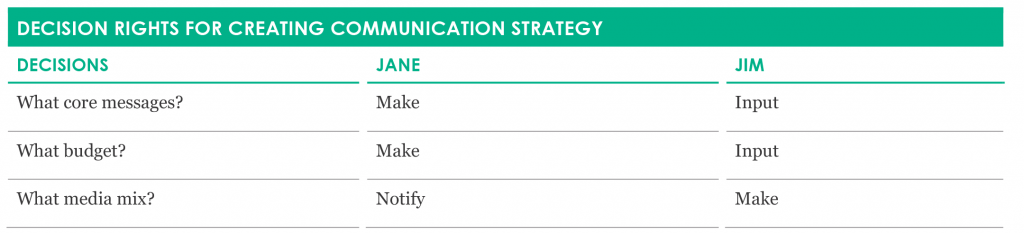
Once decision rights are clarified, accountability is easy: you are accountable to your supervisor for the decisions over which you have a ‘make’ right, and your accountability as colleagues is that you will effectively provide for, and really listen to, input across all decisions where you have agreed that the other person has input rights. Allocating decision rights is an exercise in power. Prepare for the discussion with your colleague to be a challenging one. If you push through it, however, you will have a solid foundation upon which to build a productive, collaborative relationship.
Click here to download this article as a PDF.