
Behind the Scenes: When Effort Becomes the Problem
The start of a bobsleigh race creates a paradox. Athletes must be aggressive and explosive. But if they try to force the moment — if adrenaline turns into tension — they slow down. Timing slips. Co-ordination breaks down. The extra effort meant to improve performance actually hurts it. This became even clearer to Lumsden in Olympic sport. In professional football, games happen weekly. In the Olympics, pressure builds for four years toward one moment. That long buildup can either sharpen performance or overwhelm it. “If you’re not mentally prepared,” he explains, “if you haven’t done the work between the ears as much as you have in the gym, your mind is going to break before your body does.” The answer isn’t to remove pressure or hope it feels manageable. The answer is to make sure pressure never feels new.Lesson #1: Pressure Shouldn’t Be Saved for Game Day
In Olympic bobsleigh, the start is critical. A bad start can cost the race. It also happens in the most intense environment athletes face all year. If that intensity appears for the first time on race day, the nervous system reacts as if it’s under threat. Muscles tighten. Timing speeds up. Focus shifts from execution to survival.So teams train for it. “On the bobsleigh side, we manufacture adversity in our training environment,” Lumsden says. “We’ll throw metaphorical sticks in the spokes to see how people respond. We’ll put a hold on the track and turn the noise up really loud. Manufacturing some adversity in the training environment helps build that resilience.” Unexpected delays. Loud noise. Compressed timelines. Sudden changes. These are added on purpose. The goal isn’t to make practice harder just for the sake of it. The goal is to make high-pressure conditions feel normal. On competition day, the body recognizes the intensity. But instead of reacting to it, athletes focus on execution. So the real danger isn’t pressure. It’s surprise pressure. Listen to Jesse describe how pressure shouldn’t be saved for game day:“We’ll throw metaphorical sticks in the spokes to see how people respond… Manufacturing some adversity in the training environment helps build that resilience.”
Lesson #2: Manufacturing Adversity Builds Confidence
When pressure rises, confidence doesn’t come from positive thinking or motivation. It comes from evidence. Athletes need proof they can perform when things aren’t perfect. In high-performance sport, problems are guaranteed. Equipment fails. Schedules change. Mistakes happen. If athletes only train under perfect conditions, any disruption feels like a threat. Manufacturing adversity changes that, Lumsden says. “You do it not because it’s going to happen, but if it does, you’re more prepared … it becomes not a panic moment, but a moment of ‘I’ve been here. Let’s go do our job.’” When athletes practice amid noise, fatigue, uncertainty, and disruption, competition feels manageable. Emotions stay steadier. Decisions stay clear. Execution stays sharp. That’s real confidence. Not the belief that everything will go well, but the knowledge that you can perform even if it doesn’t. Listen to Jesse describe how manufacturing adversity builds confidence:Lesson #3: Optimal Performance Comes from Controlled Intensity
Under pressure, most people try to push harder. More effort. More urgency. More control. In bobsleigh, that backfires. The start of a race requires maximum power, but it also demands rhythm and coordination. When athletes tighten up or force the moment, their speed drops.The same thing happens in business and leadership. High-stakes moments often cause people to rush, over-control, or narrow their focus too much. They try to raise performance but end up lowering clarity instead. As Lumsden says: “If you’re not mentally prepared… your mind is going to break before your body does.” Elite performers learn to operate with high intensity and low tension. Aggressive but composed. Urgent but controlled. That ability doesn’t come from trying to relax in the moment. It comes from repeated exposure to pressure until the body learns how to stay loose at full speed. Listen to Jesse describe how optimal performance comes from contolled internsity:“If you’re not mentally prepared… your mind is going to break before your body does.”
Practical Tool: Manufacture Adversity
One of the most useful lessons from Jesse Lumsden’s experience is simple: Don’t wait for high pressure to show up. Introduce it on purpose. Manufacturing adversity means building controlled challenges into your preparation. Instead of always practicing in calm, predictable settings, recreate the stress you might face later. For example:- Rehearse with background noise or interruptions to strengthen focus
- Shorten preparation time to simulate urgency
- Ask a colleague to introduce unexpected questions or changes
- Practice recovering from mistakes instead of stopping
01.
Start With Mindset. Then Respond.
02.
Prevent Isolation.
03.
Create A Culture Of Feedback.
01. Start With Mindset. Then Respond.
Nobel-prize-winning psychologist Daniel Kahneman observed something deeply human about surprise. When unexpected events occur, people tend to believe the lesson is that they now know what to do in similar circumstances in the future. We assume the mistake was a lack of information or insight. But this is the wrong conclusion. The real lesson is that the future is inherently surprising. No matter how prepared we are, some events will catch us off guard. That realization changes everything. When leaders shift from asking, “How did we miss this?” to saying, “Of course something unexpected happened,” they build resilience in their teams. They create space for response instead of reaction.Jocko Willink, a former U.S. Navy SEAL commander, trains his teams to respond to setbacks with a single word: “Good.” If a mission is delayed, good — there is more time to prepare. If resources are reduced, good — it forces simplification. “Good” is not meant to dismiss difficulty. It is meant to redirect energy toward action. Serial entrepreneur Brad Jacobs learned a similar lesson in his twenties. When he once presented his mentor, Ludwig Jesselson, with a long list of business problems, Jesselson responded bluntly: “If you want to succeed in business, you must get used to problems. That is what business is all about: solving problems.” Jacobs would later say that this advice shaped every leadership team he built. Still, mindset alone is not enough. Letting go of an outcome people were deeply invested in is not a purely intellectual act. It is emotional. Frustration, disappointment and fear surface quickly when plans unravel. That is why elite performers rely on ritual. Defensive backs in the NFL sometimes use a mental “20-second clock” to feel the impact of a play and then release it. NHL star Connor McDavid, after a difficult shift, removes his helmet, runs his fingers through his hair once, and resets. Performance psychologist Jim Loehr found that elite tennis players use the 25 seconds between points to perform deliberate physical and mental routines that lower their heart rates and restore focus. In business, the ritual will look different. But leaders who help their teams develop a deliberate reset — a clear transition from what just happened to what happens next — build resilience into their culture.“Over three decades of working in high-performance environments, I have learned that while we cannot control the waves, we can control how we respond to them.”
02. Prevent Isolation
When people struggle with change, they rarely announce it. More often, they withdraw. They stop asking questions. They avoid drawing attention to what they do not yet understand. They tell themselves they will figure it out before asking for help. Competent adults do not like feeling incompetent. When change triggers that feeling, the instinct is to work harder in private rather than admit their struggles in public.
Yet isolation slows learning. People move up learning curves faster when they receive feedback, hear about best practices and learn what to avoid. Progress accelerates when difficulties are shared.
A leader’s role, then, is not to rescue but to interrupt the silence.
When someone says, “I haven’t really started yet — there’s so much to learn,” the instinct may be to give them a pep talk. A better move is to ask, “Where could you start?”
That question helps identify a small, manageable step the individual could take. By breaking the overwhelming into bite-sized bits, something important will start to happen. Progress will become visible, and confidence will follow.
And confidence changes how people experience change itself.
Competent adults do not like feeling incompetent. When change triggers that feeling, the instinct is to work harder in private rather than admit their struggles in public.
Yet isolation slows learning. People move up learning curves faster when they receive feedback, hear about best practices and learn what to avoid. Progress accelerates when difficulties are shared.
A leader’s role, then, is not to rescue but to interrupt the silence.
When someone says, “I haven’t really started yet — there’s so much to learn,” the instinct may be to give them a pep talk. A better move is to ask, “Where could you start?”
That question helps identify a small, manageable step the individual could take. By breaking the overwhelming into bite-sized bits, something important will start to happen. Progress will become visible, and confidence will follow.
And confidence changes how people experience change itself.
03. Create A Culture Of Feedback
In The Culture Code, Daniel Coyle depicts one of the most remarkable examples of rapid team problem solving under pressure. On July 19, 1989, United Airlines Flight 232 suffered a catastrophic loss of hydraulic control over Iowa. The odds of that failure were estimated at one in a billion. There was no checklist for it. No training scenario had prepared the crew. The plane’s pilot, Captain Al Haynes, did something critical in that moment. He did not attempt to solve the problem on his own. First, he accepted help from an off-duty flight instructor who was a passenger. Then he asked his crew, “Does anyone have any ideas?” What followed was a real-time exchange of up to 60 pieces of information a minute among the crew – what was working, what was not, what they needed next – solving problem after problem to fly their dying aircraft to an airfield where they had a chance. Together, they crash-landed the aircraft in Sioux City. Of the plane’s 285 passengers, 185 survived. The accident could have been far worse if not for the crew’s actions. Later, experienced test pilots attempted to replicate the landing in simulators. None succeeded. The difference in the landing was not skill alone. It was communication. The crew members who survived weren’t more skilled than the test pilots. They had better information because they asked for it, shared it quickly with one another and integrated it into their operations.For leaders today, the lesson is clear. The familiar phrase, “Do not bring me problems; bring me solutions,” is largely obsolete. The challenges organizations face are too complex and too fast-moving for any one person to solve alone. The capability you need is already inside your team, your colleagues, your organization. As a leader, it’s your job to unlock it. Build a team where giving and receiving feedback is simply part of how work gets done – where people are comfortable bringing problems forward, knowing the group will help solve them.“The challenges organizations face are too complex and too fast-moving for any one person to solve alone.”
There’s only one certainty
We can be certain of one thing: the waves are not stopping. The shore will not always be close. Sometime over the next several months, something none of us anticipated will test our well-laid plans again. The question is not whether uncertainty will appear. It is whether we treat it as a temporary interruption or as the environment itself. Leadership in this era isn’t about having a better crystal ball. It’s about building habits that hold when predictions fail – the habit of coaching your team to reset quickly; helping your people to reach out instead of retreating; and building a culture where feedback and open idea exchange are the norm, not the exception. These practices do not eliminate uncertainty. But they change how we move through it. And sometimes that’s enough to keep us moving forward in turbulent seas.Key Takeaways:
-
Expect the unexpected. The lesson of surprise isn’t that we missed something. It’s that the future will always contain surprises. Build teams that respond quickly instead of searching for blame.
-
Shift to response mode. When plans break down, redirect attention to the next action. Progress starts the moment the team moves from reaction to response.
-
Reset quickly. Elite performers use small rituals to move on from mistakes. Leaders can help teams create deliberate resets that refocus attention on what happens next.
-
Interrupt isolation. Change often causes people to withdraw. Leaders accelerate learning by encouraging small starting points and open conversation.
-
Make feedback normal. Complex challenges require shared intelligence. Teams perform best when problems and ideas move quickly between people.
Meet our expert: Dane Jensen, CEO

“Our organization recently announced 5% across-the-board budget cuts. The CEO indicated that there will be further, deeper cuts coming over the next couple of years – but there is no information about when they will come, who they will affect, or how deep they will be. How do I keep people motivated with all this uncertainty?”
01. Acknowledge reality
While it might seem counter-intuitive, it is important to sit with the team and acknowledge the danger rather than ignoring or dismissing it. The Stoics advocated a technique called ‘negative visualization’ in which we play out potential negative outcomes in advance to rob them of their power to create irrational distress. It is far better to work as a group and process reality– “what are the scenarios we are most worried about here? How would the cuts play out? What would it mean for us?” – than to have members of the team playing their own disaster movies in their heads at night on repeat.02. Keep attention focused on controllables
With reality on the table, the most helpful thing a leader can do is to keep the team’s attention focused on what is within their control. Helplessness is at the root of the negative impact of stress, and the goal here is to feed a sense of agency. There are two parts to this discussion: ‘where can we act to influence how this plays out?’ and ‘what is out of our control that we need to let go of?’ Clarity on what we are not going to focus on is as important as clarity on where we do want to focus.03. Help people find a reason to commit
Motivation is energy, and energy comes from having a good answer to the question ‘why am I doing this?’. For people to lean in and commit they need to be able to answer at least one of two questions:- Can this serve a purpose in my growth?
- How will my effort make a difference for others?
Key Takeaways:
-
Uncertainty is often more stressful than bad news. Leaders must recognize that ambiguity itself is the pressure their teams are experiencing.
-
Name the reality instead of avoiding it. Shared clarity reduces unnecessary psychological strain.
-
Direct attention to what can be controlled. Leaders build resilience by clearly separating what the team can influence from what must be let go.
-
Connect effort to purpose. A clear “why” sustains commitment when circumstances are uncertain.
-
Leadership is attention management under pressure. The role of the leader is to channel energy toward meaningful action.
“We can BE the best, even when we’re not AT our best.”At PyeongChang in 2018, on the other hand, “before our music even started, I felt different. I felt like a high performer, and I didn’t feel like I needed the judges’ results to prove that for me.” And contrary to the feeling after the 2010 Games, after 2018, “there was real joy and satisfaction that came from the hard work, from the pressure, from all of the things that I would’ve found totally depleting two, four, eight or 12 years earlier.” So what changed? In our conversation with Tessa, three evolutions stood out: embracing discomfort rather than focusing on the number of hours spent in training; a deliberate shift in mindset from chasing perfection to pursuing excellence; and – above all else – a reclamation of personal power.
01. Creating discomfort vs. over-training
After the over-use injuries and surgeries that characterized 2010, the comeback in 2018 was built on less training time – three hours a day instead of 12 – more recovery time, and using the limited training hours to deliberately create imperfect conditions to sharpen their resilience. Whether it was leaving the ice unflooded and chipped, pumping in crowd noise, or falling on command to practise recovery, each practice built confidence that, as Tessa says, “we can BE the best, even when we’re not AT our best.” Here’s Tessa discussing that process:02. Pursuing excellence vs. chasing perfection
In Tessa’s words, “We needed to stop chasing perfection and instead pursue excellence … and once we took perfect off the table, we thought excellence was possible.” Their daily goal became showing up at an “8 out of 10”; not in effort, but in execution. Reframing their approach unhooked them from the impossible standard of perfection and freed them to connect with the joy and challenge of consistent excellence. Listen to Tessa talk about this shift:03. Becoming drivers vs. passengers
At the heart of Tessa and Scott’s story behind the story is reclaiming a sense of agency and self-efficacy. After years of being “good little soldiers,” for their 2018 comeback, they stepped into the driver’s seat: assembling their own team, setting their own standards, and “operating as if we were the CEOs of our own business,” she says. “We had agency and autonomy, we really were steering the ship.” That changed their experience leading up to the Games and, she believes, made the ultimate win more fulfilling. Listen to Tessa talk about this shift: Of course, the effectiveness of these shifts is not limited to sports. We can all benefit from:- Increasing short-burst intensity and building time for recovery instead of focusing on hours worked or busyness as a proxy for effectiveness.
- ‘Roughing up the ice’ to build resilience into our projections, targets, pilots, and project plans instead of making plans that rely on perfect conditions.
- Embracing ‘8 out of 10’ efforts that will produce more from consistency over the long haul instead of aiming for the impossibility of perfection.
- Seeing ourselves as the author of our stories instead of allowing ourselves to fall into the mindset of being characters.
Build Resilience In Your Organization
Bring the skills that elite athletes use to build resilience and perform under pressure to your organization. Contact us to learn more about our resilience programs.
 John Wooden with Lew Alcindor, Lynn Shackelford, Kenny Heitz, and Lucius Allen; Los Angeles Times, CC BY 4.0, via Wikimedia Commons.
Wooden was coaching basketball, but he was also dispensing essential career advice. What he understood was that if you want to be future-proof, the steady refinement of one set of skills isn’t enough.
As Kelly Bradley, the CHRO of RBC, Canada’s largest bank, recently shared: “we talk about [acquiring new skills] as building range. Expanding skills and experiences gives individuals more options and the organization more flexibility. In a world where change is constant, range becomes a strategic advantage.”
John Wooden with Lew Alcindor, Lynn Shackelford, Kenny Heitz, and Lucius Allen; Los Angeles Times, CC BY 4.0, via Wikimedia Commons.
Wooden was coaching basketball, but he was also dispensing essential career advice. What he understood was that if you want to be future-proof, the steady refinement of one set of skills isn’t enough.
As Kelly Bradley, the CHRO of RBC, Canada’s largest bank, recently shared: “we talk about [acquiring new skills] as building range. Expanding skills and experiences gives individuals more options and the organization more flexibility. In a world where change is constant, range becomes a strategic advantage.”
“In a world where change is constant, range becomes a strategic advantage.”Now more than ever, a future-proof career hinges on the ability to acquire new skills that allow you to adapt to a new reality. So, can you get better at building range? Well, that’s where meta-skills come into play.
Skills and Meta-Skills in Action: The Pharmacist
Consider someone who has been a pharmacist for the past 20 years. They came out of University with a Chemistry degree and started working in a job that required two primary skills: chemistry to compound the medication and math to count pills and work the cash register. As technology advanced, the compounding and dispensing part of the role became more automated, and the role of pharmacists expanded greatly to include services like medicine reviews for Seniors, diabetic counseling, celiac counseling, flu shots, diagnosing and prescribing, and more. Suddenly, being a pharmacist also required customer service (or even sales) skills, and the process savvy to manage an automated dispensing process. Fast forward, and we can easily imagine the role evolving to require mental health counseling skills, tech savvy to perform diagnostics to deliver personalized medicine, and more.Figure 1 – A Pharmacist’s Journey: Skills vs. Meta-Skills
 These different sets of skills anchor execution at different points in time – but what enables our pharmacist to evolve from one set of skills to another and remain successful over time are meta-skills. These are the capabilities that allow someone to consistently and repeatedly let go of old skills that have anchored their success and acquire and learn new ones.
Getting Better at Building Range: Three Imperatives
The discipline of evolving and building range can be broken down into three imperatives: see clearly, move quickly, and stay the course.01.
See clearly Build self-awareness and empathy.
02.
Move quickly Strengthen flexibility, creativity, and learning capacity.
03.
Stay the course Cultivate resilience
01. See Clearly
Acquiring new skills starts with developing a great radar: Where am I strong? Where am I falling behind? What do I need to work on developing? Self-awareness is half of the battle, but an under-appreciated meta-skill is honing the ability to listen to critique with empathy rather than resistance. When someone points out a gap or limitation in your skill-set – instead of pushing back, consider “what are they seeing that I’m not? How could that help me identify a skill I need to build?”02. Move Quickly
Strengthening learning capacity is at the heart of moving more quickly to build range. The faster you can move up learning curves, the easier it is to acquire new skills. There are many great resources that can help you get better at learning – but one of my favourites (which also happens to be free) is the Learning How to Learn course taught by the wonderful Dr. Barbara Oakley.03. Stay the Course
Finally, the journey of evolution is not a straight line. Adults hate being at the bottom of learning curves, and the journey up those curves is fraught with pressure, discomfort and setbacks. It is much more comfortable to refine one skill set over time than it is to build range. One of the most effective ways to build resilience is to focus on relationships: who else is working towards the same goals as you? Who can you learn alongside? Who will push you, support you, and absolve you of the guilt we all feel from not being enough? Identifying 2-3 people who can be in your ‘training group’ can be a well-spring of resilience.Meta-Skills: Crystal Ball Optional
Jeff Bezos famously said that he built Amazon around the belief that at no point would people want to pay higher prices or have worse product selection. As he stated at the time: “I very frequently get the question: ‘What’s going to change in the next 10 years?’… I almost never get the question: ‘What’s not going to change in the next 10 years?’ And I submit to you that that second question is the more important of the two.” Meta-skills are that rare example of something that will not change. There is no crystal ball required to see that the future will be different than the present, success in that future will require new and different skills, and an ability to spot critical skills, rapidly learn, and stay the course through the learning curve will be an advantage.“Individuals who invest in strengthening their awareness, learning capacity and resilience can become irreplaceable”Investing in meta-skills will pay a guaranteed return for both organizations and individuals. Organizations that invest in building meta-skills at scale will be rewarded with a talent pool that can adapt to new requirements and deploy new capabilities with greater ease and speed. Individuals who invest in strengthening their awareness, learning capacity and resilience can become irreplaceable.
While uncertainty and change present an array of challenges for today’s leaders, a less obvious one is the need to coach for confidence.
Confidence – the inner belief by an individual in their capacity to successfully meet the demands of a performance situation – is an ephemeral quality or state of mind. It’s difficult to observe, quantify or measure, and yet it’s an undeniable performance enabler. When people are confident, they can more fully express their capabilities, and are more willing to make decisions, innovate and take calculated risks.
When the New Zealand men’s National Curling Team undertook a largely self-funded move to Calgary, Alberta to enhance their preparation for the 2024 World Championships, they encountered a frustrating obstacle: rental housing was scarce and expensive. Cassandra Murray, a Retirement Living Consultant with Chartwell, one of Canada’s largest owner-operators of retirement residences, saw their appeal for help on social media and reached out with an offer: the team could stay at the Chartwell Colonel Belcher retirement village during their 2-3 month stay.
Now, having a group of young athletes sharing a living space with a group of retirement residents is not without its risks, but Cassandra saw an opportunity that she was confident could provide huge benefits for all involved. The outcome was not only a heartwarming story, but a win for the team, the residents, the staff and the organization.
 Three-quarters of the New Zealand men’s national curling team in 2023.
And that’s the key thing. When we are truly confident, we think win-win. When we lose confidence, we play not-to-lose.
What follows are two practical approaches that we have seen effective leaders use to support the confidence of their people as they navigate change:
01.
Clarify strengths AND how to apply them in the new environment.
02.
Focus on progress, not perfection.
Clarify strengths AND how to apply them in the new environment
During times of significant change, people sometimes lose sight of their strengths or are unsure of how to apply them in new circumstances. As a leader, you may not have all the answers about how things will operate in the future, but you can help your team regain a sense of direction by reconnecting them with their core strengths and how to leverage them in a new environment.
Start by revisiting familiar ground. Encourage your team members to reflect on their past successes and identify the strengths that contributed to those achievements. Ask them specific questions that prompt introspection:
- Where have you been most successful in your current role?
- What skills or abilities helped you achieve those outcomes?
By guiding them through this process, you help them rebuild a foundation of confidence based on what they already know about themselves.
Once individuals have reconnected with their strengths, the conversation should then shift to the new environment. Discuss how their roles are changing, what challenges they anticipate, and what aspects of the new setup feel most daunting. From there, work together to identify ways their existing strengths can be applied to these new challenges. This process of translation—helping individuals see how their strengths remain relevant—creates a bridge between the past and the future.
Focus on progress, not perfection
The second coaching tool you can apply is to help people see progress. A proven track record of accomplishments is a huge source of confidence to rebut doubts, fears and voice of your inner critic. One of the challenges we face when we go through significant change is that we lose that track record. We’ve been successful in the environment and conditions of the past – but have a blank slate moving forward. And so, building a new track record becomes vital.
Start by creating a roadmap that identifies where they want to be six months or a year down the road, and then add-in markers of progress along the way. When our founder, Dr. Peter Jensen, works with a team one of the first things he does is create a visual staircase in which the bottom is the current moment, the top is the target (e.g., “Make the Paralympic team” or “win an Olympic Medal”) and the individual stairs are the key milestones. These can be skill-building initiatives, for example holding week-long winter training camp, or important accomplishments, such as finishing in the top 2 at a qualifying tournament.
It is remarkable how often high performers take for granted how much they know and have learned along the way. The goal for the coach is to highlight that growth and make it visible to the performer.
Once the staircase has been created, get them moving forward with a singular focus on the next step. The smaller the better. When a technical expert with a large US wealth management firm described how she got seasoned investment advisors to be comfortable using Zoom technology for client meetings during the Covid-19 pandemic, she replied “one meeting per day”. She scheduled a daily 15-minute zoom meeting with some of her veteran advisors to get them comfortable being onscreen and to allow them to play around with the technology in a safe, non-judgmental environment.
The value in having the overall framework is twofold. First, it helps the individuals embrace a learning mindset. Peter often reminds teams that “we’re going back to school” and that the key objectives are learning, practice, and improvement – all of which are under our control.
Second, having the roadmap allows the coach to periodically help the individuals and team step back and connect with the progress they have made. This can be particularly useful during a tough slog when it feels like nothing is getting done, or when a set-back occurs to help the team get past the disappointment by reminding them of how much has already been accomplished. It is remarkable how often high performers take for granted how much they know and have learned along the way. The goal for the coach is to highlight that growth and make it visible to the performer.
In Summary
Confidence is essential to sustaining courage through change, but confidence is ephemeral – and building it can be tricky: coaching for confidence requires empathy and a willingness to meet people where they are. With a twin focus on helping people see how their strengths can be applied in a new environment, and helping them connect with progress and small wins as they adapt, you can help them remain the bold, adaptable go-getters you know them to be.
It’s 2:15 pm, and a calendar notification pops up: “Check-in with Leo.” My heart immediately starts to beat faster. Leo is one of my top performers. He delivers great results and is seen as a future leader in the organization. But there’s a problem: Leo has a habit of shutting down his peers in meetings – dismissing ideas he thinks are weak and pushing back aggressively when challenged. I’ve tried to address the issue, but it always goes sideways – tempers flare, and we both leave frustrated without resolving anything. I’ve been walking on eggshells for the past two weeks, but I can’t avoid this conversation any longer. Am I even capable of getting through to him? What if I lose my cool in the process? Will he still respect me afterwards? It’s 2:30 pm. Time to brace for impact.Confronting is a Coaching Conversation
Confronting is a coaching conversation. It doesn’t fit neatly with the popular notion that coaching is just about asking good questions, but watching Olympic coaches operate, as we have for 30 years, makes one thing very clear: having the courage to have a direct conversation when needed is vital to helping someone reach their highest potential. In fact, avoiding a difficult conversation about something that’s preventing a person’s success is the opposite of good coaching. That’s why confronting is one of the four core communication skills in our 3×4 Coaching model, and one that builds on the other three communication skills – questioning, listening, and feedback. It’s not the first or most frequent approach that coaches reach for, but it’s an important part of the overall coaching skill set. Knowing that you can navigate complex, high-stakes conversations is part of what underpins your confidence as a leader.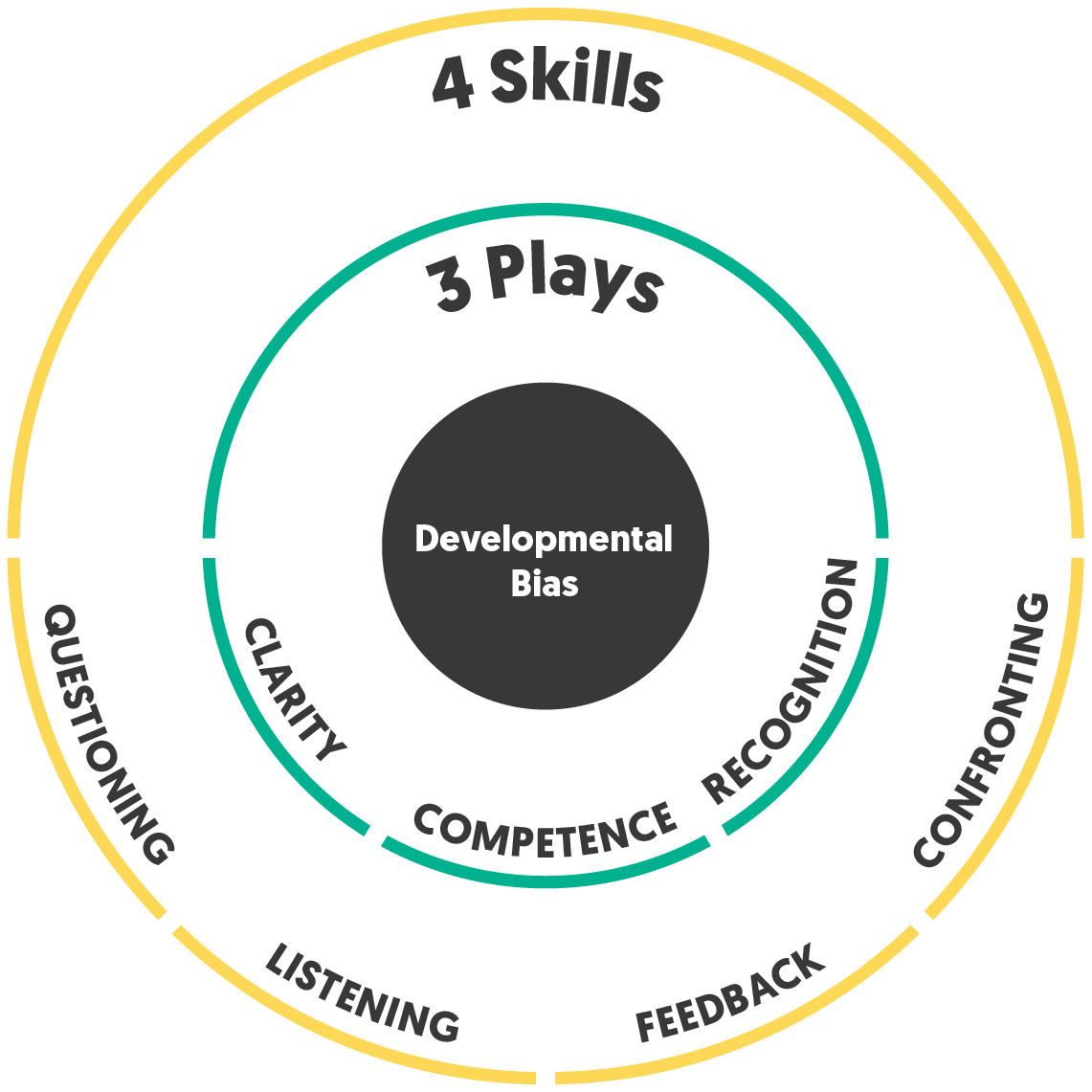
Choose Your Challenge
Having a confronting conversation with Leo is going to be challenging because I don’t want to damage our relationship. It doesn’t take tremendous courage to call up the airline after my flight was delayed and demand a refund because I only care about getting compensated, not my relationship with the customer service representative. But Leo is one of the strongest performers on my team and I want to have a good relationship after this conversation. It’s also going to be challenging because Leo has been resisting making this change and now it’s getting in the way of his success. This isn’t just a straightforward piece of feedback anymore. There are real stakes. If Leo’s behaviour continues, we could end up in the realm of more formal performance management channels.“When done effectively, these conversations can resolve the issue at hand, build the other person’s commitment to making progress, and strengthen the relationship.”It’s easy to see the threats in these conversations but there are also potential benefits. When done effectively, these conversations can resolve the issue at hand, build the other person’s commitment to making progress, and strengthen the relationship if they see you as someone who holds them to a high standard yet cares about them and respects them. So, I choose my challenge: I can avoid the conversation and deal with the fallout – Leo’s behaviour continues, our relationship becomes strained as my frustration seeps out, and I lose credibility with other people who see me allowing this behaviour to continue. Or I can face the discomfort of addressing the issue head-on and put my coaching skills to the test.
Connection Before Correction
Once I decide to address the issue, how do I have this conversation in a way that not only protects our relationship but gets Leo committed to making a change? It starts before I even enter the conversation. Often, we fall into the trap of thinking that we need to emotionally distance ourselves from the other person in order to be “tough” or objective. But it’s our relationship with the other person that’s the foundation for coaching them. I cannot coach Leo if I lose my connection to him. So rather than distancing myself, I start by strengthening my connection to Leo. I put myself in his shoes and explore the most generous, plausible story I can come up with for why he might be acting this way. Maybe he’s under a lot of pressure that is leaving him with little patience. Maybe I’m not aware of some underlying tension with his teammates. Or maybe Leo is so enthusiastic about his ideas that he doesn’t realize he’s shutting down other people. I choose the story that most strengthens my connection to Leo because it puts me in a mindset to engage in this conversation in a direct but caring way. I also need to get clear on the specific change I want to see – not all the ripple effects of Leo’s dismissive behaviour, or the fact that I’m also irritated because he was late for our team meeting yesterday – but the specific gap between what I need to see from him and what I’m currently getting.Open Strong
Next, I need to prepare my opening statement. This will set the tone and direction for the conversation. Without carefully crafting and practicing my opening, things can go sideways quickly. I could fall into the trap of starting with a sneak attack, “Well Leo, I guess you know why we’re having this conversation…” Or I might unleash my pent-up frustration and anger, leaving Leo like a deer in the headlights trying to respond. Or I might revert to the classic “feedback sandwich”, muddying my message and leaving Leo guessing at what I really mean. An effective opening is short – less than 60 seconds – and clearly articulates the specific behaviour that needs to change, the impact of that behaviour, what’s at stake if it doesn’t change, and my desire to work together to reach a resolution. “Leo, I want to talk to you about a pattern of dismissing input from your peers. For example, in yesterday’s meeting, Sarah raised a concern about the project timeline. You interrupted and said, ‘That’s not really an issue.’ I felt worried that you dismissed her question because I’ve noticed people hesitating to speak up in front of you. This can affect your ability to get the information needed to make good decisions and manage the concerns of staff. Advancing in this organization depends on your ability to build relationships and collaborate effectively. I haven’t been entirely clear on the importance of this, and that’s on me. I want to find a way to modify this behaviour. What are your thoughts?”Drop Your Agenda
After delivering my opening, it would be great if Leo said, “got it boss, no problem.” But that’s not what typically happens. I’m likely to get resistance – anger, excuses, deflection, or awkward silence. Counter-intuitively, that resistance is not something to fight against or try to “objection handle”; instead, I need to recognize that the path to a solution is through the resistance. So instead of defending my position, I drop my agenda and lean in to explore the resistance I’m getting from Leo. Questioning and listening are the critical coaching skills at this stage of the conversation. Questions to deepen and clarify my understanding of his story: Can you say more about that? Could you give me an example? What is significant about that? And active listening to draw the person out and check for understanding: So, what you’re saying is…, Let me see if I have this right… I stick with asking questions and listening until I can summarize what we call “the third story.” The third story represents all of what is true for me and what is true for Leo. It’s like I have a bucket, and I keep adding things into the bucket. I don’t take anything out and try to solve it yet. I just add things until we’ve collected all of what is true for both of us.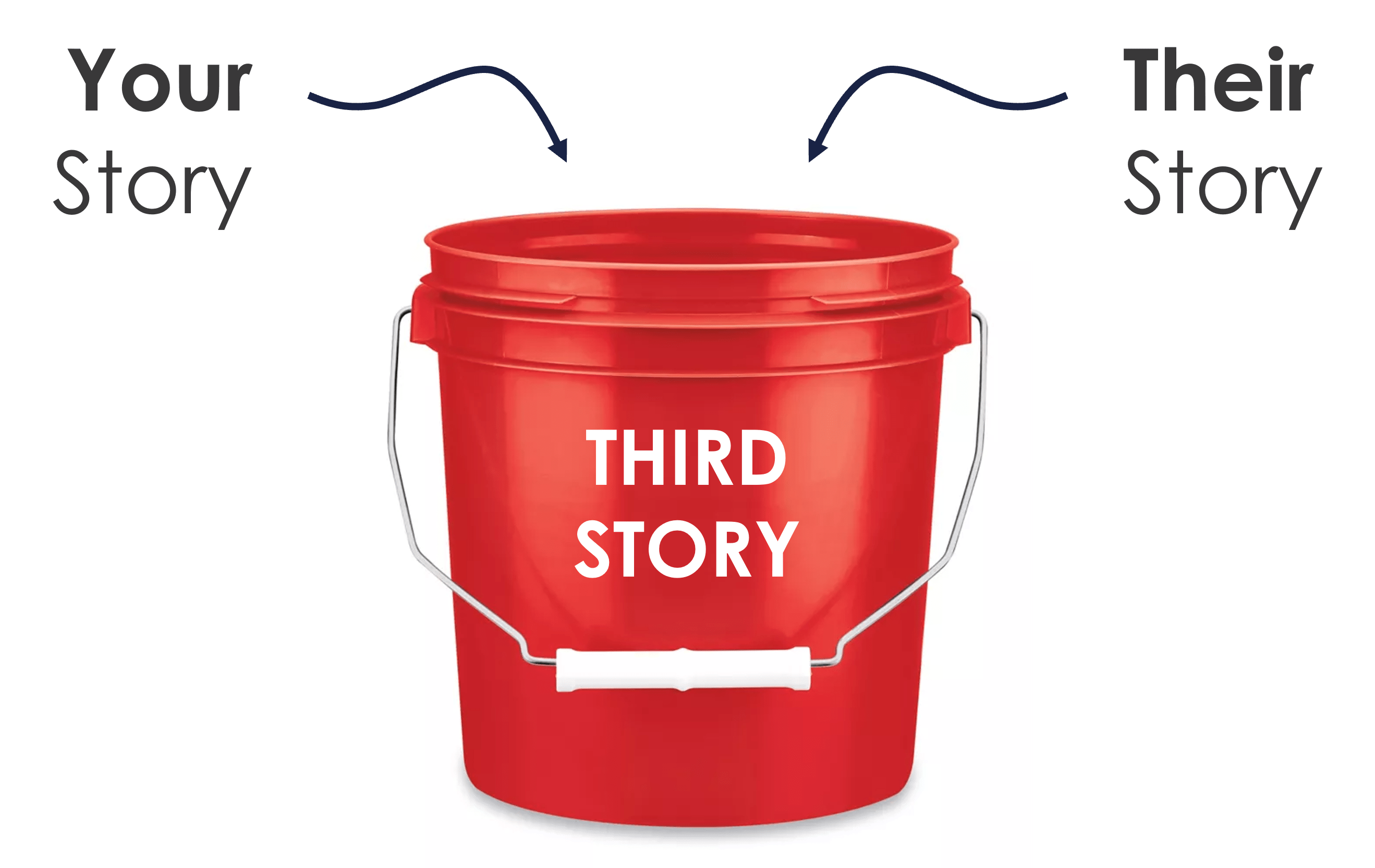 “So, to summarize, I need you to listen to the concerns and questions of your teammates and address them. It’s frustrating for you to have to consider other people’s concerns as you’ve already thought it all through. Further discussion is unnecessary, slows you down, and may interfere with you hitting your numbers. Do I have that right?”
I don’t necessarily have to agree with Leo’s perspective, but I need to get to a place where I understand him, where I can summarize his point of view in a way that he says, “yes, that’s it.” And if that’s not it, then I keep asking questions until we get to the core of the issue. It’s not until we reach that point that we can start problem solving.
It’s this final stage of the conversation that is often more comfortable and familiar – generating options and agreeing on a path forward. It’s best if most of the options come from Leo so that he owns how he wants to move forward but I can offer ideas as well. Together we can agree on a plan and next steps. Be sure to build in support and accountability. “What do you need from me to put this plan into action?” “Let’s schedule time to check-in and see how it’s going.”
“So, to summarize, I need you to listen to the concerns and questions of your teammates and address them. It’s frustrating for you to have to consider other people’s concerns as you’ve already thought it all through. Further discussion is unnecessary, slows you down, and may interfere with you hitting your numbers. Do I have that right?”
I don’t necessarily have to agree with Leo’s perspective, but I need to get to a place where I understand him, where I can summarize his point of view in a way that he says, “yes, that’s it.” And if that’s not it, then I keep asking questions until we get to the core of the issue. It’s not until we reach that point that we can start problem solving.
It’s this final stage of the conversation that is often more comfortable and familiar – generating options and agreeing on a path forward. It’s best if most of the options come from Leo so that he owns how he wants to move forward but I can offer ideas as well. Together we can agree on a plan and next steps. Be sure to build in support and accountability. “What do you need from me to put this plan into action?” “Let’s schedule time to check-in and see how it’s going.”
Manage Yourself
Now, is it ever that easy? Of course not. While it’s helpful to have a map for these conversations, no matter how prepared we are, it never goes exactly how we expect. People are complicated and will almost always throw a wrench into the conversation that we never saw coming. Or they’ll do something that seems perfectly designed to get under our skin – raise their voice, roll their eyes, or say that one thing that touches our most sensitive nerve And so, a big part of the discipline of these conversations is having a plan for how we will manage ourselves in the face of the triggers that could knock us off our game. First, we need to be aware that we’re triggered in the first place. Often, we become our irritation, or our anger. Instead, we need to notice it by tuning into our internal signals – I might notice myself thinking “here we go again with the excuses,” or that my breathing has accelerated, or that I’m starting to feel impatient. These signals are like lights on your car’s dashboard. When the “check engine” light comes on, you don’t smash the dashboard – you check under the hood. The same goes for triggers in tough conversations. Get curious about what the signal is telling you and take corrective action to get yourself back on track before you respond. If we don’t notice and manage our triggers, all sorts of unintended behaviours appear, and we can become the worst version of ourselves. Things start to escalate, or the other person withdraws, and we get further and further from a resolution.The Courage to Coach When it Matters Most
Being effective in these conversations requires the very best of us. It takes self-awareness and being a big person. But the 3×4 Coaching model provides everything we need to succeed. We need to enter the conversation with a generous mindset and clarity on our objective. We deliver a clear opening statement to get the conversation off on the right foot and then drop our agenda to explore the other person’s perspective before we jump into problem solving. It isn’t always comfortable, but the goal of coaching isn’t comfort. It’s about challenging someone to reach their highest potential. It requires the courage to speak up, the patience to wade through the discomfort, and the belief that the people you’re coaching are capable of more.New manager development programs are often a surprising “problem child” in the Learning & Development portfolio.
The recent Association for Talent Development (ATD) report sponsored by Third Factor, “New Manager Development: Building a Foundation for the Future,” highlights a critical gap: while 70% of organizations have new manager development programs, most fail to realize their full potential with 77% reporting only moderate success or worse.
Helping new managers transition from individual contributor to people leadership roles is vitally important for the performance of not only those managers but everyone that reports to them as well. But with the large population of managers in most organizations, Learning & Development (L&D) is often tasked to execute these programs at scale and on a shoestring budget. Add in the time pressures on new managers, and it can feel near impossible to deliver impactful leadership development programs for this audience.
We know how challenging this mandate can be, so we’ve collected some practical strategies from leading organizations that we partner with to help get the value out of your investment in new manager development.
Leadership at the Helm: Building Top-Down Support
The ATD report underscores the importance of senior leadership in new manager development. Most of the organizations surveyed indicated that a lack of either resources, senior leadership support, and/or prioritization were challenges to training new managers. So how do you build that critical support at the top of the house?
01.
Pick your moment and leverage business needs to advance new manager training.
02.
Enlist your partners to sell your vision for new manager training internally.
03.
Get senior leaders directly involved in training to underscore its importance.
First, pick your moment. When organizations make significant investments in new manager development, it typically comes at a time when there is a clear business need – for example, a new strategy, a culture transformation, declining engagement scores, or high turnover. Use these windows of opportunity to demonstrate how Learning & Development can help turn conceptual business plans into real action by driving the right behaviors in managers.
Second, enlist your partners. You need every tool in your arsenal to build the strongest business case to senior leaders for investing in new manager development. Involve HR or internal business partners as well as your third-party vendors to help demonstrate to senior leaders the value and expected outcomes of these programs. Hearing directly from your leadership team about a strategic transformation they are driving from transactional to advisory services, for example, will enable your vendors to design programs that directly support those needs.
Finally, start small and get senior leaders directly involved. One L&D team that we work with is driving a multi-year rollout of a two-day in-person program to help managers build coaching skills – a significant investment of time and resources. But it all started with just one session focused on the C-Suite team. Through that firsthand experience, the CEO and his team became passionate champions of the program. They not only committed to funding a broad program rollout, but the CEO now speaks directly to every cohort of managers that goes through the program. His involvement sends a strong message about his commitment to manager development and also reinforces the connections between the content and their business priorities.
Balancing Learning Formats
Training a large population of new managers can be costly. For many organizations, it’s just not feasible to offer in-person experiential learning programs to all new managers.
In fact, the ATD report notes that asynchronous learning channels are the most common offering made available to new managers. We often hear from L&D leaders about the benefits of asynchronous learning for creating custom learning pathways and offering flexible programs that work around the busy schedules of new managers. Yet there is always a desire to incorporate some of the benefits of live, in-person learning experiences as well.
Increasingly, organizations are looking at blended learning formats to provide the scale and cost effectiveness of asynchronous learning but with some of the human connection and energy of live or in-person programs.
A financial services company that we partner with offers an asynchronous program that enables managers to learn coaching skills through a series of self-paced videos. But to enhance the experience through peer support and live discussions, managers are placed into learning cohorts that proceed through the program as a community. A live virtual kickoff provides context about the program, introduces managers to others in their cohort and builds energy around the learning journey they are about to start on. Midway through the program, cohorts reconvene for a live application lab to work through any questions and challenges as they start applying the skills in their work environment. And upon completion of the program, managers have access to 1:1 coaching and a library of resources to support ongoing skill development and application.
“The most successful new manager development programs that we see always place a strong focus on practical application.”
Whether asynchronous, in-person, or a blended format, the most successful new manager development programs that we see always place a strong focus on practical application. New managers are often completely underwater balancing their priorities of delivering results while also developing their people.
In fact, time constraints on new managers were the most common challenge cited in ATD’s report. Most new managers simply don’t have the time, energy, or interest to dive deep into theories on motivation and performance. Instead, they need a few practical tools that they can implement immediately, opportunities to practice new skills, and strategies to focus on actions that will have the greatest impact so that they see immediate results and build confidence.
Measuring What Matters: The Art of Success Metrics
You’ve heard it a million times – “how are we measuring the impact of this program?” When it comes to reallocating investment or cutting costs, new manager development programs are an easy target if they can’t demonstrate impact. Effective metrics not only demonstrate program effectiveness but also ensure the program remains relevant, impactful, and aligned with evolving business priorities.
ATD’s report highlights a similar issue: 87% of respondents cite a lack of metrics to track the program’s results as a challenge to new manager training. While most organizations do assess program effectiveness, many focus on participant satisfaction and use informal conversations rather than quantitative or outcomes-based measures. So how can you incorporate impactful metrics without creating an overly complex science project?
Most important is systematizing and quantifying participant feedback with a short, standard feedback form for every participant to complete. In our experience, taking a few minutes to do this at the end of sessions before participants return to their other work is the best way to drive response rates and specific feedback. In addition to participant satisfaction, include one or two questions tied to target outcomes – for example, participants’ confidence in their ability to apply the skills in their daily work.
With a basic feedback system in place, start looking at longer-term metrics and impacts. A large energy organization that we work with administers a final survey approximately three months after leadership development programs on how participants are applying their learnings and the resulting business impact of those actions. These concrete examples offer powerful impact stories that are highlighted to the company’s most senior leaders.
Another financial services organization surveyed the direct reports of program participants and found that more than 85% noticed an improvement in their leaders after completing the manager development program – a metric that helped build ongoing support and expansion of the program.
Transforming Insights into Impact
As the ATD report highlights, new manager development programs are a critical aspect of the L&D portfolio and yet there are very real challenges to making them effective and impactful. These strategies offer a blueprint to help ensure the investment in these programs delivers real value for the business and for your people.