Register for updates
Enter your information below to be notified when this breakfast event is rescheduled.

🏷 Label the negative emotion and engage. Right or wrong, giving it a name helps uncover important information that can be used for moving forward. 👏 Feed the self-coach, not the self-critic. Encourage them to look for the opportunity in the crisis. 🛴 Channel energy to action. Use the moment to build a vision of a better future and build clarity around what it takes to get there.
Strong leaders don’t shy away from negative emotions. They lean into them and help their people use them to recover and grow. Click here to read the article on hbr.org. Editor’s note: This article was first published on April 14th, 2020, just a few weeks into the COVID-19 pandemic. While the context may have changed, your plays as a leader are still the same.“We can’t go back, only forward.”Ask yourself what your team needs for their new playbook. Do your people know what the work expectations are today? Timelines are different. Things change quickly so clarity is always evolving. Think short term and help them find focus. Do they know what other people need from them? Are they aware of how your goals have shifted? Especially if your team is working differently than they’re used to, over-communication is impossible when it comes to these things. Your team also needs clarity on what your organization’s values look like in this reality. Not just the vague, nice-sounding words – what they actually look like. If you value safety, how are you acting on that value? If you value team, how are you making sure that no one’s feeling isolated? Get together as a team to discuss your values and think through how you’re living up to them at this time. Through all of this, recognize that as a coach you need to meet your people where they’re at. Some team members might be juggling kids and other family constraints. They may even be caring for someone who is sick. Give them real clarity on how your team can work well together in a way that’s not going to make anyone feel criticized, judged or guilty. Have empathy for what they’re going through and use humour to help people feel at ease. Some team members (and perhaps even you) may be thinking they just need to hold on for a little bit longer until things get back to normal. That thinking will not serve them or the organization well. When companies face disruption, the ones who try to ignore it or find a way to hang on to their old ways of doing things don’t fare well – think Blockbuster. We can’t go back, only forward.
“When loss isn’t acknowledged, it feels like it’s been dismissed.”This is true on both sides of the relationship. In Sheryl Sandberg’s book, Option B: Facing Adversity, Building Resilience, and Finding Joy, she talks about how the hardest part of going back to work after losing her husband was the silence. When loss isn’t acknowledged, it feels like it’s been dismissed. And a significant loss being dismissed feels really bad. You don’t need to be a counsellor or have all the answers, and there’s no secret formula for how to deal with these times. Your job as a coach is to bring things to the surface and give people permission to talk about it if and when they want.
“We stand ready to support our athletes, coaches and leadership organizations through the coming months and in Team Canada’s inevitable return to Olympic competition.”By withdrawing Team Canada from the Tokyo Games, the COC and CPC have made an important statement that this crisis is bigger than the Olympic and Paralympic Games and that our collective health and safety should be our only priority over the coming months. They have also given a clear answer to the athletes who have been tortured by uncertainty and were wondering whether they would have a chance to compete and, if so, whether they would have to risk their health in order to do so. We join the COC and CPC in calling on the International Olympic and Paralympic Committees to postpone the Tokyo Games by one year so that all members of the international community may focus on their physical, mental and financial health, caring for loved ones, and doing their part to stop the spread of COVID-19. For the last three decades, our organization has been proud to support the Olympic community in Canada. We stand ready to support our athletes, coaches and leadership organizations through the coming months and in Team Canada’s inevitable return to Olympic competition. Signed, Dane Jensen, Peter Jensen, Sandra Stark, Peggy Baumgartner, Garry Watanabe & Cyndie Flett on behalf of the entire team at Third Factor.
“L&D teams can provide unique value and directly influence how the organization weathers the storm”Connecting pressure to personal growth is vital for resilience over the long haul. If, as a leader, I feel like the pressure is just a weight on my shoulders that I must endure, it will have a significantly more negative impact than if I see how rising to this challenge can help me become stronger and better. Growth gives meaning to pressure – and our ability to help people see this tough period as a growth experience is a significant imperative for maintaining engagement at work.
“Think deliberately about a learning journey that is designed to sustain energy and support application”Depending on the measures in place in your organization, this may include continuing to run in-person programming in small-medium sized groups – perhaps modified to focus on local attendees. In many cases, however, policies will necessitate the conversion of regularly scheduled programming into virtual delivery. Speaking from the perspective of an organization focused entirely on the development of leadership, collaboration and resilience skills – there are two imperatives we see to getting this right:


“In times of challenge, what’s often most challenging is that the old pressure doesn’t go away”In our Building Resilience program, we do this by giving participants an understanding of how uncertainty and pressure impact their performance and health, and then grow their awareness of the choices they have and skills they can use to enhance their resilience under pressure. I led a 90-minute virtual session on resilience for leaders at a major cruise line last week. As you can imagine, the pressure they are facing is immense. In our opening exercise, I asked them to identify the things that make this “interesting times” for them. Here is a random sample of the 46 responses I received:
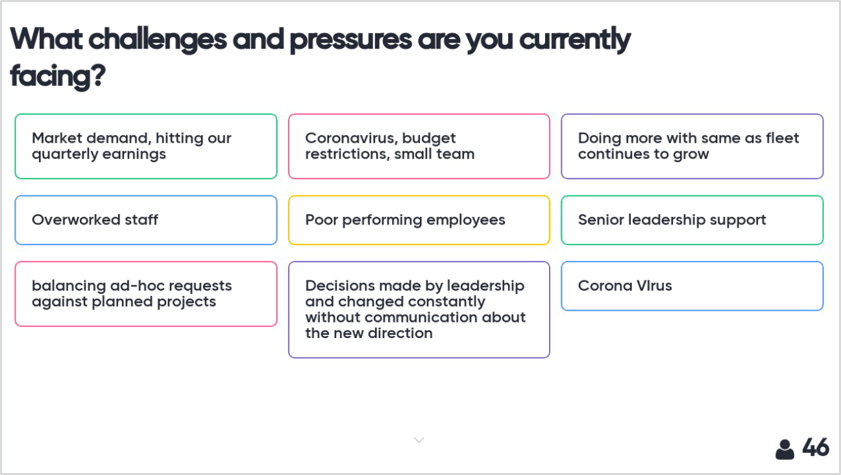 What’s most interesting to me is that the responses weren’t simply “coronavirus” 46 times. In times of challenge, what’s often most challenging is that the old pressure doesn’t go away – we simply add more to the pile, further compounding our already high-pressure lives.
In acute scenarios such as this one, people need to have a clear sense of:
What’s most interesting to me is that the responses weren’t simply “coronavirus” 46 times. In times of challenge, what’s often most challenging is that the old pressure doesn’t go away – we simply add more to the pile, further compounding our already high-pressure lives.
In acute scenarios such as this one, people need to have a clear sense of:

“The next few months provide a real opportunity for learning organizations to invest in the 1:1 learning that people crave”All of the research into learning tells us that providing individualized, coaching is among the best ways to help people learn, achieve their goals, and feel satisfied with their progress. And yet, the cost of providing individualized coaching is often prohibitive at scale. The next few months provide a real opportunity for learning organizations to invest in the 1:1 learning that people crave. The travel challenges posed by the COVID-19 threat will mean a dramatic reduction in travel expenses, and 1:1 coaching is uniquely suited to virtual delivery. Taken together, this provides an opportunity to invest in personalized coaching for your high potential talent at a cost that’s similar to what you would spend on a per-person basis to bring people together for a workshop. Depending on how your organization calculates the overall cost-benefit of leadership development, reduced time away from the field for participants can also support your case for making this kind of investment. So, how do you do this effectively? Two ideas:
“Canada’s challenge wasn’t producing world-class athletes; it was producing world-class athletes who could perform with all the distractions and pressure of the Olympics”In other words, Canada’s challenge wasn’t producing world-class athletes; it was producing world-class athletes who could perform with all the distractions and pressure of the Olympics. Brian Orser was one of Canada’s star athletes at the Calgary Games in 1988, and he spoke to us about the pressure of competing in front of a home crowd. To help Canada’s performers prepare for the pressure of Olympic competition, the not-for-profit organization Own the Podium was formed to provide and fund support structures designed to give Canadian athletes the preparation that would allow them to access their best performances in the face of Olympic pressure. Own The Podium was a spectacular success. At Vancouver, Canadian athletes won 26 medals, including a record-setting 14 gold medals, placing Canada third overall. Since that time, Canadian athletes have been ‘converting’ at a rate of around 70% and Canadians now enter Olympic Games with an expectation that they could indeed, be the best in the world.
“Peter had to keep the information from the team so as not to become an enormous distraction”Peter had to notify the leadership at Hockey Canada and, with their blessing, continued to support the mental performance of the Women’s Olympic Hockey Team. As they headed into their most important competition of the four-year cycle, Peter had to keep the information from the team so as not to become an enormous distraction while simultaneously teaching skills, being at his best and dispensing regular doses of his usual sense of humour. Peter is currently cancer-free and maintains a crazy busy schedule delivering keynote speeches to audiences big and small around the world. Peter wrote about his experience in his own words in his whitepaper, When Health and Performance Converge: What I (re)Learned From Cancer. It’s a great read if you’re curious to learn more about how he was able to stay resilient through such a difficult time. To those of us at Third Factor, the 2010 Vancouver Games are a reminder that Peter doesn’t just teach people how to handle pressure, he lives and breathes the content. Great leaders coach their people by teaching, giving feedback, mentoring, and asking questions. And, when necessary, they confront problem behaviours. When done right, challenging conversations can lead to positive behaviour change and strengthen the relationship between the leader and team member. How you begin the conversation is the best predictor of the outcome. In this practical and motivating keynote address, Third Factor Associate Trainer and Olympian, Karyn Garossino, will introduce a map for challenging conversations and guide you through the process of effectively initiating a difficult discussion. By gaining a better understanding of the internal conversation that precedes the external one, you will leave the keynote with a better understanding of the positive aspects of challenging conversations and a new confidence in your ability to speak up when change is not negotiable and resistance may be high.
What can you expect at this event? Take a look at this recap from our last executive breakfast.
 Olympian Karyn Garossino, BA, M. Ed., brings a combination of insight and grit from 40+ years of being coached and coaching others. Her experience at the highest levels of elite sport, Master’s Degree in psychology and adult education, and experience working with thousands of leaders in business and government bring huge depth to her understanding what it takes to thrive under pressure—and to lead others to do the same.
 Just minutes from Union Station on Toronto’s waterfront, OCAD U CO is a state-of-the-art 14,000 square foot studio designed specifically for collaborative innovation work. The space features is home to 20 resident design-led startups, a suite of formal and informal meeting spaces, and is the setting for our program, How To Lead Innovation, which we run in partnership with OCAD U CO and the Smith School of Business at Queen’s University.
This event has been postponed. Be the first to know when it’s rescheduled by entering your information below.
“We realized that a lot of what was happening was the blame game.”Through a frank, players-only discussion the team was able to come together, but the conversation could have gone a number of different ways. It stayed on track because the team was prepared – mentally and emotionally – to have performance conversations under pressure and surface a number of issues the team needed to resolve. And that preparation turned out to be an important stepping stone to winning gold in Salt Lake City.
“The biggest opportunity for meaningful growth is often to increase self-awareness and strengthen their ability to communicate productively when under pressure.”We’ve worked with hundreds of teams in elite sport and business, including the last four medal-winning Canadian women’s hockey teams. One of the things we’ve learned is that when teams are already operating at a high level, the biggest opportunity for meaningful growth is often to increase their self-awareness and strengthen their ability to communicate productively when under pressure. To support this, we’ve developed a process to help teams become more aware of their tendencies, develop systems and practice performance conversations anytime. At the heart of this process is a tool called the TAIS – The Attentional and Interpersonal Styles inventory. The TAIS was developed for use by Navy SEALs and Olympic athletes, and we’ve found it to be an incredibly valuable tool for diagnosing communication challenges on all kinds of teams. When the pressure is on, when teams are in the midst of setbacks and failure, individuals will fall back on their default communication styles.
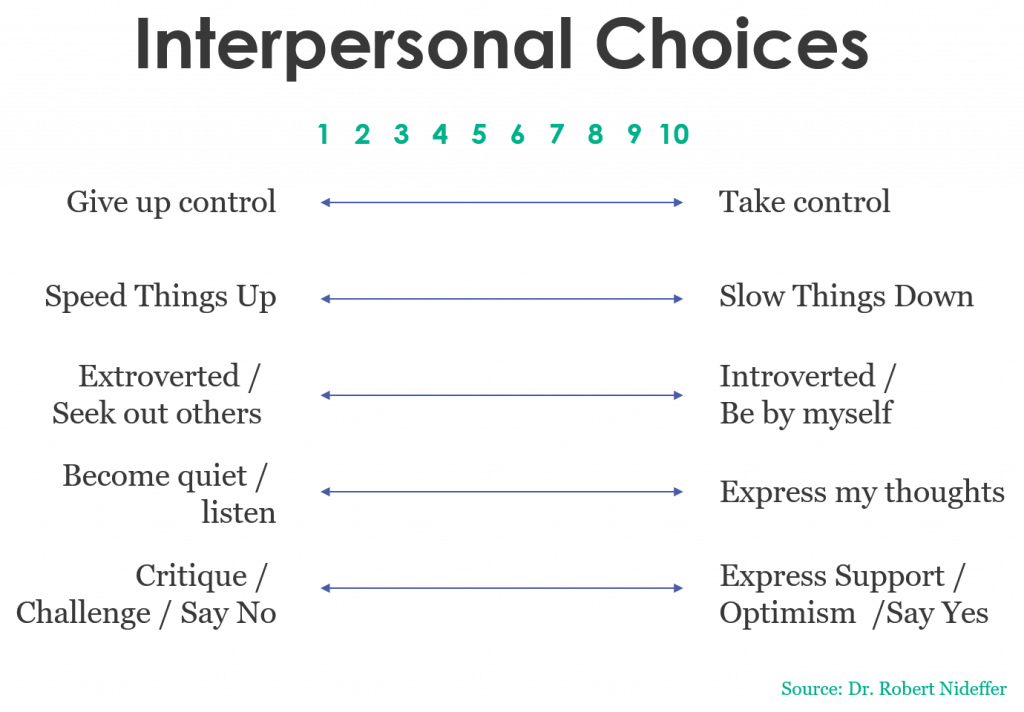
The next time you’re headed into a potentially high stakes conversations, use the five choices below to carry out a short 3-step preparation exercise:
1. Plot your default tendency on each of the five scales – given your past history, where are you most likely to fall?
2. Where would you ideally like to be as you head into this specific interaction?
3. What are the gaps between your ideal and default style? What actions will you take to ensure you are at your ideal?