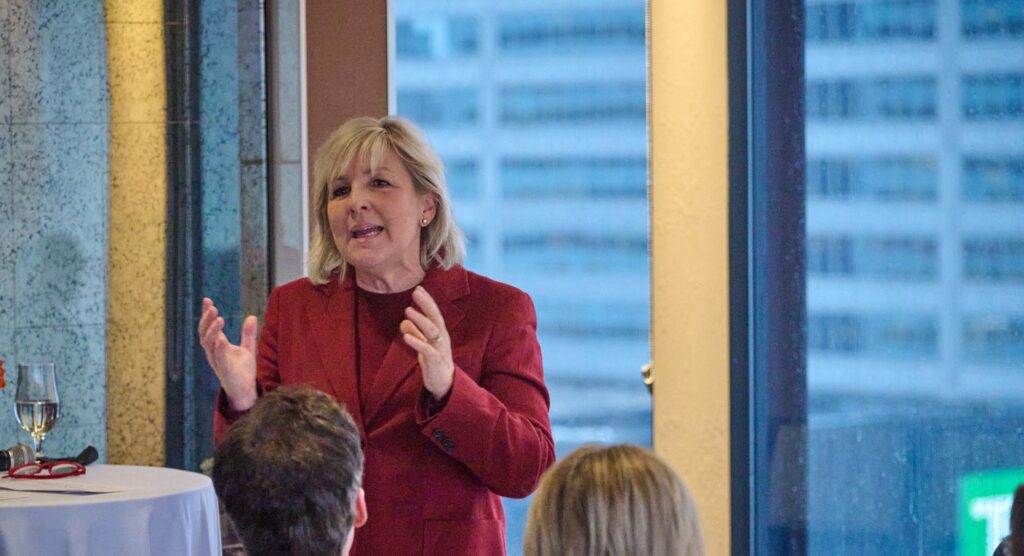


Meet our expert: Peggy Baumgartner, Chief Learning Officer

“How Do I Keep My Team Focused and Engaged When Change Won’t Stop And We Are at Capacity?”
Some people think that when things get crazy busy, holding it together means looking invincible, projecting strength, and appearing like you can do it all. But that’s not authentic, and it doesn’t improve performance. If we want our people to be real and vulnerable in the face of uncertainty, we must model that behaviour. That means making it safe for people to share their real experiences.
I once watched Third Factor founder Peter Jensen work with Canada’s Olympic synchronized swimming team. It was just prior to the Olympic Games, and this team had medal potential, so the media started to take notice. Suddenly, athletes who rarely saw cameras were surrounded by them.
The coach used the opportunity to sit down with her athletes: “I don’t know about you, but with all this media presence, I’m feeling really nervous,” she told them. That one admission gave everyone else permission to say the same thing. And then she added: “This is going to feel like the Games. So what do we want to do with what we’re feeling?”
During tough periods, we need to harness our emotions. That’s because people don’t change based on logic; they change based on emotion. As leaders, our job is to make it safe for real emotions to surface so we can work on them together and use the energy beneath our emotions to move forward. And to accomplish that, you need to focus on the relationships you have with your people.
Building, maintaining, and deepening relationships
The deeper your connection with your team, the greater your influence. That relationship is the pipeline through which all communication flows. If that pipeline is clogged or doesn’t exist, it means that when you need strong communication the most, it won’t happen.
Which brings me to energy. We often frame the feeling of being overwhelmed as a time management problem. And so we ask ourselves: Where do I find additional time? But many leaders are already great at time management, and that question won’t get you far. The better question is: Where can I find the energy? Pay attention as you move through your day. When does time seem to fly? What fills you up? What are your strengths? You will have far more energy working on things you feel you do well, and it’s remarkable how much gets done when energy is high and how little when it’s depleted.
And this isn’t just about you. A big part of your job right now is making sure your people have the energy to do what they need to do. They need to believe in themselves and believe they have the trust and relationship with the person who matters most to them: their leader.
And finally, when things do get hard, here is the one habit worth picking up: Stop listening to yourself and start talking to yourself. During hard times, the inner critic gets loud. This is so hard. I’m not on top of things. I can’t do this. The best performers don’t silence that voice by ignoring it. They pause and ask: Is it true? Yes, work is often hard. But does hard mean you’re not good at it? No. It might mean a task is new or difficult. It might mean you’re doing something no one has figured out yet. Get clear on what’s actually true and lead from there.
Sustainable leadership for the long haul
Leading through relentless change is genuinely hard. And somewhere in the middle of keeping your team focused, your strategy on track, and your organization moving, it is easy to forget that you are also a person who needs to take care of themselves.
The most effective leaders right now are not the ones who have it all figured out. They are the ones who stay honest with themselves, invest in the relationships that matter, manage their energy with the same intention they bring to their calendar, and extend to themselves the same patience and encouragement they would offer anyone on their team.
Change will keep coming. The question is not whether you can outrun it. The question is whether you are leading in a way that is sustainable for you and the people counting on you.
Be kind to yourself. That is not soft advice. It is how you stay in the game.
This question and answer are adapted from a webinar hosted by Queen’s Executive Education featuring a panel led by Dr. Laurence Ashworth (Chair of Queen’s Executive Education), and panelists Peggy Baumgartner (Chief Learning Officer, Third Factor), Dr. Julian Barling (Smith School of Business Professor and Borden Chair of Leadership), and Dr. Lobna Chérif (Royal Military College’s Chair in Resilience).
To watch the full Queen’s Executive Education Webinar, click this link.
Key Takeaways:
-
Vulnerability is a leadership tool, not a weakness. When leaders model honesty about what they’re experiencing, they give their teams permission to do the same.
-
Overwhelm is an energy problem, not a time management problem. Ask where you can find energy, not where you can find more hours.
-
Relationships are your pipeline. The deeper your connection with your people, the more effectively communication flows when it matters most.
-
Stop listening to yourself and start talking to yourself. When the inner critic gets loud, pause and ask: is it true? Get clear on what’s actually true, and lead from there.
-
Sustainable leadership requires caring for yourself, not just your team. The leaders who last are the ones who manage their own energy with the same intention they bring to everything else.