
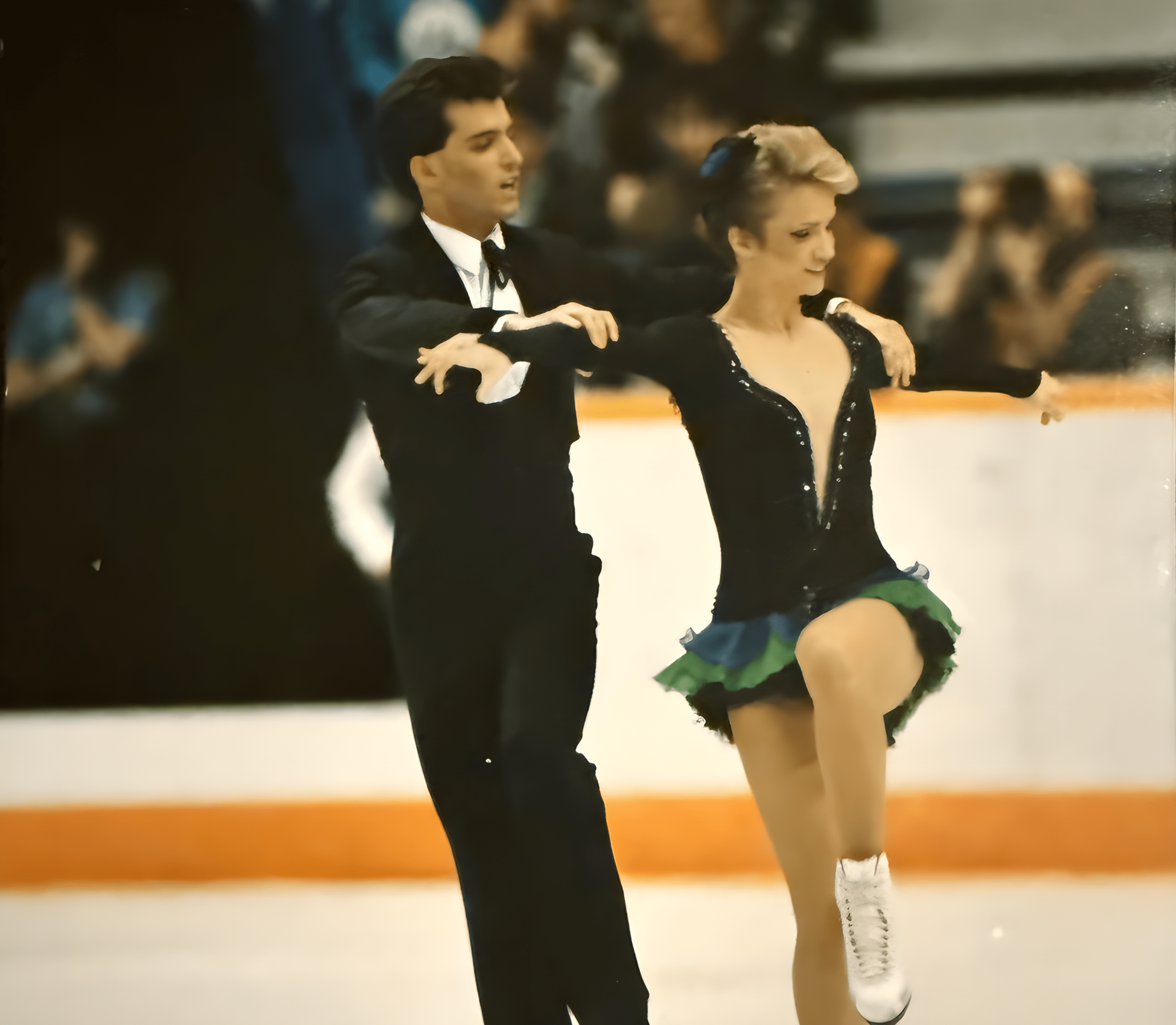

This article is part of Third Factor’s Story Behind the Story series, in which we unpack the stories behind both iconic and under-the-radar Olympic and Paralympic moments. In this feature, Olympian and Third Factor Associate Trainer Karyn Garossino discusses the importance of control and how it shaped her approach to competing at the Olympics.
–
“In high-performance sport, and in fact much of all high performance, consistency is the holy grail.”
–Karyn Garossino
From the outside, Karyn and Rod Garossino’s ice dancing performance at the 1988 Calgary Olympics looked like a hometown dream. A brother and sister from rural Alberta. Competing for Canada. An Olympics on home ice. Five flawless performances on the biggest stage in sport.
What people saw was excellence.
What they did not see was how hard it was to stay steady enough to deliver it.
For Karyn, the Olympics were shaped by two moments she could never have predicted. One came before the competition even began, while athletes waited to enter the opening ceremonies. The other came standing at centre ice, when a roaring hometown crowd would not stop cheering.
Together, these moments revealed something essential about high performance: preparation matters, but so does an ability to adapt when things do not go as planned.
From Carstairs to the Olympic Stage
Karyn and her brother Rod grew up in Carstairs, Alberta, where skating was simply part of Prairie life. What started as a love of the sport became a serious pursuit, supported by strong coaching, family commitment, and years of disciplined training.
In 1981, the pair won junior ice dance gold at the Canadian National Skating Championships, and throughout the decade, they competed at the highest level in Canadian, international and World Championships.
Then Calgary won the bid to host the 1988 Olympic Games.
Suddenly, the idea of competing at a hometown Games became real. As that moment got closer, so did the pressure. Like many athletes facing a once-in-a-lifetime moment, Karyn prepared not only physically but mentally for what it would feel like to perform under a global spotlight.
Different Fabric. Same Cloth.
One of Karyn’s most vivid Olympic memories came before the competition started. Athletes from around the world gathered in a staging area ahead of the opening ceremonies. Each team was dressed in its country’s colours. But as the wait stretched on, things got a little playful: jackets were briefly traded, hats and scarves were exchanged, and the differences between teams started to fade.
“We were wearing different fabric, but were cut from the same cloth.”
What Karyn felt in that moment was a deep sense of connection and the awe of belonging to the historic Olympic movement. These athletes represented different nations, but they shared similarities – years of sacrifice, discipline, routine, and the pursuit of excellence. In her words, “we were wearing different fabric, but were cut from the same cloth.”
One by one the nations left to join the ceremonies saving the host country to march in last. Then Team Canada entered the stadium. The sound of 85,000 people thundered through the building. In that instant, she realized something else: This was not just her Olympics, or even just the athletes’ Olympics
It was our Games.
The moment belonged to everyone who had made it possible: athletes, coaches, families, volunteers, organizers, sponsors, and an entire country. What she expected to feel as an individual competitor became something much bigger: the incredible honour of wearing red and white and representing the extraordinary collective effort of a nation.
The Crowd Wouldn’t Stop Cheering
If the opening ceremonies created awe, the competition brought a different kind of pressure.
When Karyn and Rod were announced onto centre ice, the crowd erupted. That part was expected. What was not was that the cheering didn’t stop.
Normally, once skaters take their position, the arena quiets and the music begins. But this audience kept cheering, waving flags, and feeding even more energy into the building. The music could not start until the arena settled, so Karyn and Rod stood in position and waited. And waited.
For a brief instant, they felt the weight of what was happening. They exchanged a smile and a shared realization: Oh my God, we’re at the Olympics. It was a deeply human moment. But it was also risky.
Because even positive energy can get in the way of performance. The challenge was not only handling fear or adversity. It was managing excitement, emotion, and the significance of the moment.
Karyn knew they had to get back to what they had trained for. They turned to breathwork, a skill they had practised for years to steady themselves under pressure.
Within three exhales, they were back in form.
Their activation level dropped. Their focus returned. Their physiology settled. The crowd eventually quieted, the music began, and they performed brilliantly. They achieved a 12th-place Olympic finish. The next year, they would win gold at the senior Canadian Championships.
Looking back, what lessons did Karyn learn from her Olympic experience that are helpful to anyone facing high-performance situations? Here, she helps us understand three practical takeaways:
Lesson #1: Consistency Is Built Before the Moment
Karyn describes consistency as the holy grail of high performance: the ability to deliver what you are capable of in any condition, not just ideal ones.
That consistency was built long before the moment arrived. Karyn and Rod prepared not only their skating but also their mindset. Through imagery and planning, they anticipated the noise, emotion, and pressure of the Games so they would not be overwhelmed.
That is a critical lesson for any high achiever – whether in sports or business. The goal is not to hope everything goes perfectly. It is to be ready when it doesn’t.
Consistency is not about controlling the environment. It is about training how to respond to it.
Listen to Karyn describe how consistency is built before the moment:
Lesson #2: Control What You Can Control
One of Karyn’s clearest lessons from Calgary is simple: high performers must learn to distinguish between what they can control and what they cannot.
She could not control the crowd. She could not make the audience quiet down. She could not change the scale of the moment.
What she could control was her own internal state.
That distinction matters because pressure grows when we fixate on things we cannot change. Recovery begins when we return to what we can manage: our breathing, our attention, our preparation, and our next move.
In that moment on the ice, the solution for Karyn was not to fight the environment. It was to return to the training that brought her to the Games.
Listen to Karyn distinguish what you can control and what you cannot:
Lesson #3: Breathwork Is a Performance Skill
Karyn is clear that the breathing exercise she used in Calgary was not improvised. She had practised it for years. Its purpose was to manage the body when the outside world became overwhelming. Slow, controlled breathing gave her a direct way to regulate her physiology and recover focus.
Her method was simple: breathe low and breathe slow.
Under pressure, breathing rises high into the chest and speeds up. But when breathing starts lower in the body, from the diaphragm, and the exhale lasts longer than the inhale, the body begins to relax.
That matters because physiology drives performance. If your body is overstimulated, thinking narrows and execution suffers. When your physiology settles, your trained skill improves.
In Calgary, three breaths were enough because Karyn and Rod’s skills were already there. That is what makes breathwork so powerful: it is not just a calming technique; it is a trained performance tool.
Listen to Karyn provide insight into how breathwork is a performance skill:
Practical Tool: Return to Centre in Three Breaths
When pressure rises unexpectedly, use this simple reset:
- Notice the surge: Pay attention to the moment when your energy starts to spike. Maybe your chest tightens, your focus narrows, or your thoughts speed up.
- Breathe low: Drop the breath lower into your body rather than keeping it high in the chest.
- Breathe slowly: Lengthen the exhale so it is longer than the inhale.
- Repeat for three breaths: Use three deliberate breaths to regain control.
- Return to the task: Ask: What can I control right now? Then put your attention there.
This is not about becoming calm for its own sake. It is about executing what you’re capable of and meeting the moment with excellence.
Build Resilience In Your Organization
Bring the skills that elite athletes use to build resilience and perform under pressure to your organization. Contact us to learn more about our resilience programs.