I learned the power of recognition not in a boardroom, but as an Olympic ice dancer. Reaching the highest levels of ice dance is tough. It takes years of hard work, with incremental improvements that can barely feel like progress.
Learning a routine, for example, takes months. I remember one stretch of choreography that took me six weeks to skate without falling. That was six weeks of going to the rink knowing the day would be full of failure. There was no evidence of accomplishment. No sign that success was even possible.
What kept me going wasn’t the promise of a medal at the end. It was my coach who noticed the number of attempts I made, how quickly I got up after each fall, how closely I was listening to feedback. Those were the behaviours the moment required, so that’s what my coach recognized.
That recognition told me the impossible thing was possible. Without it, I would not have stayed on the path. Nobody does, for long, unaided.
Recognition answers the question: are they willing?
In Third Factor’s 3×4 coaching model, leaders focus on three things: Clarity, Competence, and Recognition. Clarity makes sure people know what to do. Competence confirms they can do it. Recognition, however, responds to a different question: Are they willing to bring their full effort – even when things get hard?
Leaders tend to spend a lot of time on clarity and competence. But recognition gets less attention. That’s a mistake. Neither clarity nor competence creates the willingness to keep giving your best, day after day.
Motivation fails when effort stops registering
Being seen is not a soft need. Family systems research has long shown that a surprising number of relational breakdowns trace back to people feeling invisible.
Relationships at work are no different.
Employee recognition is a genuine intrinsic motivator. It’s not just a courtesy. University researchers Mussie Tessema, Kathryn Ready, and Abel Embaye found that recognition is a stronger driver of job satisfaction than pay or benefits alone. A study by Schrita Osborne and Mohamad Hammoud, meanwhile, identified recognition as a critical workplace resource for engagement.
Wilmar Schaufeli’s “Job Demands-Resources Model” explains why. Recognition counterbalances the demands that wear people down, protecting the emotional and psychological well-being on which engagement depends. Frederick Herzberg identified recognition as a motivator, distinct from factors like salary.
In other words, recognition doesn’t just prevent dissatisfaction. It encourages stronger performance.
Teresa Amabile and Steven Kramer’s research in The Progress Principle gets at why recognition matters in the day-to-day work of a team. Managers create a sense of progress by acknowledging effort and small wins. That recognition is a clear signal that someone’s work matters.
The evidence gets even more specific. Research cited in Harvard Business Review found that employees whose managers excel at recognition are more than 40% more engaged than those whose managers don’t. They’re also more confident, better informed, and far less likely to quit. The lever isn’t a bigger paycheck. It’s whether a manager takes a moment to notice and say something.
People are hungry for that acknowledgment. Sometimes it feels as though we can’t fully register the value of our own contribution until someone else says it.
Why leaders withhold recognition
Leaders don’t skip employee recognition out of malice. They skip it because of what they believe it will cost: “If I recognize this once, they’ll expect it every time, and then they’ll get needy,” “compliment them and they’ll coast,” or “if I recognize one person, I’ll have to recognize everyone, or it isn’t fair.”
Beneath all these blocks sits flawed math: one that fails to recognize the opportunity cost that comes from untapped effort as a result of failing to recognize.
Even the most committed performers respond to the environment that a leader creates around them. High performers are not exempt from needing to be seen. If anything, the bar they’ve set for themselves makes the silence louder.
In workshops that we run – even those with very seasoned employees and leaders – two-thirds of people tell us that recognition has a positive impact on their performance.
Three moves for employee recognition
Third Factor’s 3×4 curriculum breaks effective recognition into three principles. Each has its own logic, its own supporting research, and its own story from practice.
01.
Make it Personal. What feels meaningful is as individual as the person receiving it.
02.
Recognize the behaviour that produced the result. Acknowledging effort and incremental progress helps sustain motivation.
03.
Notice what’s right, and say so. Recognition needs to be time-sensitive, specific and personal.
01. Make it personal
Generic recognition barely counts as recognition. Herzberg’s distinction between motivators and other factors, such as salary, matters here: a motivator functions only if it’s meaningful to the individual receiving it. A drawer full of identical gift cards, for example, satisfies a policy, not a person. Real recognition is specific to the human in front of you.
I remember a leader who once sent a papaya to a team member because it was a fruit from that person’s home country. The papaya cost almost nothing. But it meant more than any gift card ever could because it showed the leader was paying attention to who this person was, not just what they produced.
That’s the standard. What feels meaningful is as individual as the person receiving it. Finding out what that is requires the kind of attention most leaders reserve for performance problems, not for people.
02. Recognize the behaviour that produced the result
When leaders only reward outcomes – the sale closed, the deadline was met – people naturally focus on getting the result. The behaviours that produced it can quietly disappear.
Amabile and Kramer’s research makes an important point here: acknowledging effort and incremental progress, not just the finish line, helps sustain motivation. Recognize only the win and you teach people to chase wins by any method. Recognize the behaviour and you reinforce the route that actually works.
I coached a director of procurement at a global manufacturing company through exactly this gap. His employee (let’s call her Yvonne) had carried the team through a reorganization, a return-to-office mandate, and a short-staffed department without a word of acknowledgment from him.
When we worked through the 3×4 model, clarity was there and competence was there. Recognition was the missing play.
In our meeting, the director named three specific things he genuinely respected in Yvonne’s work: her attention to detail, her cross-functional relationships, and her compliance with the return-to-office policy when others resisted.
The shift was immediate. Yvonne told him that she had assumed he didn’t care.
The relationship didn’t fix itself overnight, but forward movement started the day he named the behaviours he’d been watching all along, not just the results they produced.
03. Notice what’s right, and say so
Leaders default to gap analysis. The squeaky wheel gets the grease, while the steady, reliable performer who never causes a problem goes unrecognized for months.
Gallup and Workhuman tracked more than 3,400 employees over two years and found that those who received high-quality, frequent recognition were 45% less likely to have left their job. The recognition that moved the needle wasn’t an annual review. It was personal, specific, and delivered close to the moment it was earned.
The CEO of a construction company that my colleague Peggy Baumgartner worked with took this idea on directly. He called it, only half-joking, his 2×4 method: two people recognized, every day, at 4 p.m.
At first, he needed an alarm to remember. Within a week, he wasn’t waiting for the alarm. He was noticing good work before noon and couldn’t wait to say something.
He told Peggy afterward that he wasn’t going back to how he had led before. Not just because his team’s energy had risen (though it had), but because of what the practice had done to his own energy.
Tessema, Ready, and Embaye’s finding that recognition alleviates dissatisfaction while building satisfaction shows up here. The effect benefits not only the person receiving the recognition but also the person giving it.
Make employee recognition part of how you lead
“You get more of what you reward.” That line came from the construction CEO’s story and captures the whole point of this article in seven words.
Employee recognition isn’t a nicety layered on top of good leadership. It’s a strategic lever, as concrete as clarity of expectations or investment in skills development. Yet it’s the one most leaders don’t use.
The challenge isn’t complicated. Pick one behaviour you want to see more of on your team this week. Notice it. Say something specific, close to the moment it happens. Do it again tomorrow.
Recognition works as a habit, not an event. And leaders who build that habit find they get exactly what they were hoping for all along.
Key Takeaways:
Recognition answers a different question than clarity or competence. Clarity tells people what to do. Competence confirms they can do it. Recognition tells them their effort is worth continuing.
Effort stops registering long before people stop caring. Motivation doesn’t fail from a lack of commitment. It fails when nobody notices the work it took to get there.
Reward the behaviour. When leaders only acknowledge outcomes, people learn to chase the finish line. Naming the specific effort behind it reinforces the route that actually works.
Generic recognition barely counts as recognition. A gift card satisfies a policy. Knowing what actually matters to the person in front of you is what makes it land.
Recognition works better as a habit. Pick one behaviour you want to see more of, name it close to the moment it happens, and do it again tomorrow.
You’re giving a presentation. You’ve just shared an idea you’ve been preparing for weeks. Then you notice someone in the room cross their arms, lean back, and furrow their brow.
The instinct, for most of us, is immediate: They don’t like what I’m saying. Maybe they’re angry. Maybe they’ve stopped listening. Maybe I should wrap up and get out.
But here’s the thing: When it comes to reading nonverbal cues, you almost certainly have no idea why that person is reacting the way they are. And your assumptions are probably wrong.
When Reading Nonverbal Cues, the Trigger and the Reason Are Not the Same Thing
Research from Dr. Paul Ekman, the psychologist behind the Facial Action Coding System (FACS), identifies seven universal emotions that we can read on the human face across cultures: anger, disgust, surprise, fear, contempt, sadness, and happiness.
Each of these emotions has a universal trigger. Anger is triggered by the obstruction of a goal. Sadness comes from the loss of something we value: a job, our credibility, or an opportunity. Fear comes from a perceived threat. These triggers are reliable enough that behavioural analysts, credibility experts, and coaches use them as a framework for understanding what someone might be experiencing.
But here’s what that research doesn’t tell you: why someone is feeling this emotion right now.
Why is the person crossing their arms in your meeting? They could be angry because your idea threatens a project they’ve spent months building. They could be sad because you just reminded them of a missed opportunity. Their shoulder could be sore. They could have gotten a text from their vet this morning about their pet and be carrying grief they have nowhere to put. Or they might love what you’re saying and be comforting themselves because they wish they’d known it sooner. They might also just be cold!
Physical reactions to emotions do tell you something. They just don’t tell you everything. And when we assume they do, we risk getting it wrong.
Single Nonverbal Cues Are Routinely Misread, Even by Experienced Leaders
The crossed arms example isn’t hypothetical. It’s one of the most misread nonverbal cues in professional settings, largely because people feel so certain what it means.
We’ve absorbed a cultural shorthand: arms crossed equals closed, resistant, defensive. But a self-hug (which is what crossing your arms actually is) is often a self-soothing response. We do it when we need comfort, when we’re processing something, or when we’re cold. Sometimes it can even signal confidence: I don’t need to open myself up to you. You need what I have. Other times, it may simply mean someone is deep in thought, taking in what you’re saying.
Eye contact is another commonly misread nonverbal cue. Conventional wisdom says people avoid eye contact when they’re lying. Research suggests the opposite may be true. Skilled deceivers sometimes use more eye contact, watching your reaction carefully to calibrate their story. Meanwhile, someone avoiding your gaze might be doing so because they feel shame, they’re overstimulated, neurodiverse, or anxious for reasons that have nothing to do with you.
A single cue tells you almost nothing. Behavioural analysts look for a cluster: multiple changes that deviate from what’s normal for that person. Not one crossed arm or one averted glance, but a constellation of variations that together suggest something worth paying attention to. That’s not because those cues clearly reveal what someone is experiencing. Instead, they signal that it’s time to ask questions and better understand what the person is experiencing in that moment.
Why Baseline Is the Key to Reading Nonverbal Cues Accurately
This is where relationships matter. The better you know someone, the more useful nonverbal cues become. That’s not because you know what they mean, but because you know what’s different from that person’s normal, or baseline, behaviour.
One example: an engineering supervisor with a prominent eye twitch. His team learned quickly that the twitch was simply part of who he was. It was his baseline, constant and unremarkable. What they eventually noticed was that when things weren’t going well, the twitch stopped. That departure from his norm became a meaningful signal. Not because they knew what was wrong, but because they knew something was wrong.
That’s the distinction worth making. A variation from baseline is an invitation to ask a question, not a conclusion to jump to. It tells you something may be happening, not what that something is.
Cultural, demographic, and individual differences matter here, too. Someone who grew up in a culture where sustained eye contact is considered disrespectful or confrontational will behave differently from someone for whom it’s expected. Someone who fidgets constantly isn’t displaying anxiety. That just may be how they regulate. Or it could be something else entirely. Learning someone’s baseline is an ongoing process, and it pays off most when a conversation is at its toughest.
How Coaches Can Use Nonverbal Cues to Have Better Conversations
It’s easy during difficult conversations (giving feedback, talking about performance, or managing up) to make assumptions about why the other person is reacting the way they are.
Their face flushes and you think: they’re angry at me. They go quiet and you think: I’ve lost them. They cross their arms and you think: they’re shutting down.
Knowing that emotional triggers are universal and that a single nonverbal cue can have a dozen different causes gives you somewhere else to put your attention. Instead of monitoring yourself through their reactions, try becoming genuinely curious about them:
What are they experiencing?
Where is it coming from?
What does it mean for them?
That shift from self-monitoring to curiosity is where coaching begins.
When you notice a cluster of changes from someone’s baseline, you don’t need to interpret it. Simply use it as an opening. Ask a neutral, open-ended question. Keep them talking. Let the emotional state they’re in – whatever it is and whatever caused it – become information you’re gathering, rather than a verdict.
You don’t have to dig for the reason or try to “out” them in the moment for experiencing an emotion they’re not ready to share. It’s simply another data point. Be gentle and curious. Don’t force the conversation. Sometimes people need time to process what they’re feeling before they’re able to articulate or share their experience.
The emotion isn’t about you. Or at least you don’t know that yet. And that uncertainty, once you’re willing to sit with it, isn’t a weakness. It’s the beginning of a real conversation.
This article draws on the work of Dr. Paul Ekman, the Emotional Intelligence Academy’s partnership with Manchester Metropolitan University, and former FBI investigator Joe Navarro.
Key Takeaways:
A single nonverbal cue tells you almost nothing. Crossed arms, avoided eye contact, or a flushed face can mean a dozen different things — look for a cluster of changes, not one isolated signal.
The trigger and the reason are not the same thing. Emotions like anger or sadness have universal triggers, but the specific reason behind someone’s reaction in the moment is almost never obvious.
Baseline matters more than the cue itself. Knowing someone’s normal behaviour helps you notice meaningful deviations — it doesn’t tell you what those deviations mean.
A variation from baseline is an invitation to ask, not a conclusion to jump to. Treat it as an opening for a neutral, curious question rather than a verdict.
Curiosity is where coaching begins. Shift your attention from monitoring yourself through someone’s reaction to genuinely wondering what they’re experiencing and why.
Peggy Baumgartner is an expert in developing top performers across business and sport. A master-level certified TAIS coach and Third Factor’s Chief Learning Officer, Peggy has spent 25+ years helping leaders and athletes build self-awareness and perform at their best — including four Olympic cycles with the Canadian Women’s Hockey Team. She teaches in executive programs at Queen’s Smith School of Business and UNC Kenan-Flagler, has published in Harvard Business Review, and leads the design of Third Factor’s flagship coaching programs.
“How Do I Keep My Team Focused and Engaged When Change Won’t Stop And We Are at Capacity?”
Some people think that when things get crazy busy, holding it together means looking invincible, projecting strength, and appearing like you can do it all. But that’s not authentic, and it doesn’t improve performance. If we want our people to be real and vulnerable in the face of uncertainty, we must model that behaviour. That means making it safe for people to share their real experiences.
I once watched Third Factor founder Peter Jensen work with Canada’s Olympic synchronized swimming team. It was just prior to the Olympic Games, and this team had medal potential, so the media started to take notice. Suddenly, athletes who rarely saw cameras were surrounded by them.
The coach used the opportunity to sit down with her athletes: “I don’t know about you, but with all this media presence, I’m feeling really nervous,” she told them. That one admission gave everyone else permission to say the same thing. And then she added: “This is going to feel like the Games. So what do we want to do with what we’re feeling?”
During tough periods, we need to harness our emotions. That’s because people don’t change based on logic; they change based on emotion. As leaders, our job is to make it safe for real emotions to surface so we can work on them together and use the energy beneath our emotions to move forward. And to accomplish that, you need to focus on the relationships you have with your people.
Building, maintaining, and deepening relationships
The deeper your connection with your team, the greater your influence. That relationship is the pipeline through which all communication flows. If that pipeline is clogged or doesn’t exist, it means that when you need strong communication the most, it won’t happen.
Which brings me to energy. We often frame the feeling of being overwhelmed as a time management problem. And so we ask ourselves: Where do I find additional time? But many leaders are already great at time management, and that question won’t get you far. The better question is: Where can I find the energy? Pay attention as you move through your day. When does time seem to fly? What fills you up? What are your strengths? You will have far more energy working on things you feel you do well, and it’s remarkable how much gets done when energy is high and how little when it’s depleted.
And this isn’t just about you. A big part of your job right now is making sure your people have the energy to do what they need to do. They need to believe in themselves and believe they have the trust and relationship with the person who matters most to them: their leader.
And finally, when things do get hard, here is the one habit worth picking up: Stop listening to yourself and start talking to yourself. During hard times, the inner critic gets loud. This is so hard. I’m not on top of things. I can’t do this. The best performers don’t silence that voice by ignoring it. They pause and ask: Is it true? Yes, work is often hard. But does hard mean you’re not good at it? No. It might mean a task is new or difficult. It might mean you’re doing something no one has figured out yet. Get clear on what’s actually true and lead from there.
Sustainable leadership for the long haul
Leading through relentless change is genuinely hard. And somewhere in the middle of keeping your team focused, your strategy on track, and your organization moving, it is easy to forget that you are also a person who needs to take care of themselves.
The most effective leaders right now are not the ones who have it all figured out. They are the ones who stay honest with themselves, invest in the relationships that matter, manage their energy with the same intention they bring to their calendar, and extend to themselves the same patience and encouragement they would offer anyone on their team.
Change will keep coming. The question is not whether you can outrun it. The question is whether you are leading in a way that is sustainable for you and the people counting on you.
Be kind to yourself. That is not soft advice. It is how you stay in the game.
This question and answer are adapted from a webinar hosted by Queen’s Executive Education featuring a panel led by Dr. Laurence Ashworth (Chair of Queen’s Executive Education), and panelists Peggy Baumgartner (Chief Learning Officer, Third Factor), Dr. Julian Barling (Smith School of Business Professor and Borden Chair of Leadership), and Dr. Lobna Chérif (Royal Military College’s Chair in Resilience).To watch the full Queen’s Executive Education Webinar, click this link.
Key Takeaways:
Vulnerability is a leadership tool, not a weakness. When leaders model honesty about what they’re experiencing, they give their teams permission to do the same.
Overwhelm is an energy problem, not a time management problem. Ask where you can find energy, not where you can find more hours.
Relationships are your pipeline. The deeper your connection with your people, the more effectively communication flows when it matters most.
Stop listening to yourself and start talking to yourself. When the inner critic gets loud, pause and ask: is it true? Get clear on what’s actually true, and lead from there.
Sustainable leadership requires caring for yourself, not just your team. The leaders who last are the ones who manage their own energy with the same intention they bring to everything else.
Meet our expert: Tracy Wilson, Olympic Figure Skater, Broadcaster & Third Factor Sport Advisor
Tracy Wilson is an Olympic bronze medallist and one of Canada’s most respected figure skating coaches and broadcasters. Alongside her late partner Rob McCall, she won seven consecutive national titles and made history as the first Canadian ice dancers to reach the Olympic podium. Following her competitive career, Tracy coached world-class athletes including Olympic champions Yuzuru Hanyu and Javier Fernández, and became a trusted voice for audiences on CBC, NBC, and TSN. As a member of the Third Factor Sport Advisory Board, she brings invaluable perspective on the mindset and methods that help athletes thrive under pressure.
“How do you support someone after failure, especially when the stakes are high and the moment has already passed?”
Knowing how to support someone after failure is one of the hardest things a coach, leader, or mentor has to do. There is no rewind button. The moment has passed, the result is set, and the person in front of you is somewhere between devastated and numb. What do you do?
At the recent Third Factor Client Appreciation Dinner in Toronto, Tracy Wilson was asked how she handles an athlete who has just fallen apart in a big moment. Her answer was honest, grounded in decades of experience in high-performance sport, and it applies just as much in the boardroom as it does on the ice.
Here are six principles drawn from that conversation.
01. There is no one right way to respond
The first thing Tracy will tell you is that there is no script for this. Knowing how to support someone after failure starts with understanding who is in front of you and where they are emotionally before doing or saying anything else.
She acknowledges the complexity directly: “It does depend on the athlete. And at my age, watching what I’ve watched, sometimes these big failures can turn you around and get you going in a better direction. You learn things about yourself. If you can hang in there, it can shoot you right up.”
But she is equally clear-eyed about how difficult it is to communicate that truth in the moment. The insight that failure can become fuel is real, it just can’t always be delivered right away. The job isn’t to rush in with a lesson. It’s to figure out what this person needs, right now.
02. Be present
In the immediate aftermath of a big failure, Tracy’s instinct is not to talk, it’s to listen. Or simply to be there.
“So then it’s really hearing them out. Asking questions, or actually being okay just to sit. And sometimes I have moments where you’re sitting with somebody and it is super uncomfortable, and you’re just focusing on your breath, because you just want to be there. You just want to be a calm presence.”
That phrase, “a calm presence” is worth pausing on. The temptation for coaches, leaders, and mentors is to fill silence with solutions. But in the immediate wake of failure, what most people need is not a fix. They need to feel that someone is with them in it.
03. Help them find what else is true
Once the initial storm has passed, people often start telling themselves a catastrophic story: it’s over, I blew it, I’ll never recover. Tracy’s most consistent move is to gently challenge that narrative. Failure has a way of narrowing our vision, and part of a coach’s or leader’s job is to widen it again.
She pointed to a specific example: someone close to her who failed a major school medical exam by a single point and was convinced his path to medicine was over. Tracy’s role was to help him find a more complete picture of reality.
“It was just trying to help somebody find the truth, because oftentimes it’s exaggerated. When they said to themselves, “This is the worst thing. I can never do this now. It’s over.” And all I am really helping them find is what else is true.”
That simple question, “what else is true?” doesn’t dismiss the failure or minimize the pain. It creates a little space around the story, space where possibility can re-enter. It helps them remember what else is true about themselves: “I am knowledgeable. I am tenacious. I really care about this. I work really hard.” It works just as well in a performance review debrief as it does rinkside.
04. Use hindsight and your own failures
One of Tracy’s most effective tools is perspective: using the person’s own past, and her own.
“The other thing I try to remind them of is hindsight. Have you seen this completely different in the past? And then I try to use examples of past failures I’ve had.”
There is something disarming about a coach or leader who has failed. It signals that failure is not disqualifying but part of the path. When Tracy draws on her own failings, she is not being humble. She is demonstrating that high performance and setback co-exist in every serious career – in sport and in business alike.
05. Help break the spin
After a setback, people tend to replay it over and over. That loop can be hard to break. For anyone caught in that circular thinking, Tracy often recommends something simple.
“Sometimes journalling helps, just to sort of write it down. For me, that would get the spinning out.”
The goal isn’t deep reflection or insight, it’s simply to externalize what’s churning internally so it stops consuming all available bandwidth. For leaders supporting a team member after a setback, even encouraging someone to write down what happened can be enough to shift them out of the spiral.
06. Hold the belief for them
Ultimately, Tracy’s message to anyone supporting someone after failure is one of belief in their resilience, even when they can’t access it themselves.
“You’re stronger than you know. Hang in there, and you’re gonna get to the good stuff.”
Alongside that: question the negativity. Ask whether the catastrophic narrative is actually true. Ask what else is true. Hold both. And when the person in front of you can’t find their own footing yet, your job is to stand on solid ground for them.
Key Takeaways:
There is no script. How to support someone after failure depends on who they are and where they are in the moment. Read the person before reaching for the playbook.
Presence over prescription. In the immediate aftermath of failure, a calm, quiet presence is often more valuable than advice. Being comfortable sitting in discomfort is a leadership skill.
Ask “what else is true?” Failure narrows vision. The role of a coach or leader is to gently widen it again – not by dismissing the pain, but by creating space for a more complete picture.
Draw on your own failures. When leaders and coaches share their own setbacks, they signal that failure is survivable and that the path forward is real.
Help break the spin. Writing things down can interrupt the circular thinking that often follows a high-stakes failure.
Hold the belief for them. Sometimes people can’t access their own resilience. That’s when a coach or leader holds it for them, until they can hold it themselves.
This article is part of Third Factor’s Story Behind the Story series, in which we unpack the stories behind both iconic and under-the-radar Olympic and Paralympic moments. In this feature, Third Factor Partner Sandra Stark shares the mental performance work she and Peter Jensen did with Canadian figure skaters Brian Orser and Tracy Wilson ahead of the 1988 Calgary Winter Olympics to help them manage pressure and perform when the stakes were highest.
—
The 1988 Winter Olympics in Calgary were one of the most pressure-filled environments Canadian athletes had ever faced. Canada had never won an Olympic gold medal on home soil, the expectations were immense, and national attention was relentless. Nowhere was the spotlight brighter than on figure skating.Brian Orser entered the Games as the reigning world champion and the central figure in what the media called the “Battle of the Brians,” a highly publicized rivalry with American Brian Boitano. He was Canada’s flag bearer and one of the country’s best hopes for gold. Everywhere he went, strangers reminded him what the country expected – “don’t let us down.”At the same time, ice dancers Tracy Wilson and Rob McCall were carrying a different kind of pressure. Canada had never won an Olympic medal in ice dance, and breaking the long-standing dominance of the Soviet teams was widely viewed as unlikely.What the public saw was composure under extraordinary pressure. Orser delivered a near-flawless performance to win silver by the narrowest of margins, and Wilson and McCall captured an unexpected bronze, part of a remarkable showing in which figure skaters won three of Canada’s five medals. What most people didn’t see was the internal challenge both athletes were managing. Whenever something important is on the line and the outcome is uncertain, arousal – the body’s activation level – increases. The heart rate rises. Muscles tighten. Attention narrows. Up to a point, this activation improves performance. But when arousal climbs too high, execution suffers. Timing slips. Decision-making tightens. Small errors multiply.This is why elite performers don’t just train physically. They train to manage their activation level so they can perform at their best when the pressure is highest. The goal isn’t to eliminate nerves – that isn’t possible when something really matters – but instead to keep arousal within a functional range.In service of this, two years before the Games, the Canadian Figure Skating Association made mental preparation a priority. They brought in Peter and I to help athletes identify the moments that would elevate their arousal and develop specific plans for managing their arousal when those moments arrive. Here are two of the techniques that we used, as relayed in conversation with Brian and Tracy.
Lesson #1: Plan for Reality Instead of Avoiding It
After the World Championships in Geneva, where Brian was not happy with how he skated, Peter asked him how he was preparing mentally before skating. Brian explained that he “had all the showers turned on in the dressing room so he wouldn’t hear how the Russian skater [who went ahead of him] had done.” Standing in the noise of the shower, Brian imagined the Russian had skated brilliantly. In reality, the Russian had fallen on both triple axels. In trying to avoid reality, Brian instead magnified his anxiety.“That was the turning point,” Peter explains. From then on, Brian’s training approach shifted: instead of trying to shut out uncertainty, Peter worked with Brian to plan for it. Together they laid out exactly what he would do after warm-up: walk through his program, rehearse key jumps, and – most importantly – rehearse the opening segment he was about to skate.In figure skating competitions, skating order matters – and skaters don’t learn their order to skate until the day before they skate the short program. If you skate late, you may have an agonizing half-hour wait after your warm-up to compete. If you skate early, you may not even leave the ice – which feels incredibly rushed.Brian hated skating first – but instead of hoping it wouldn’t happen, Peter helped him normalize it by creating a plan for each scenario: “We developed a routine that worked for me,” Brian explains. “A skating-first routine, a skating-sixth routine. We were prepared for any scenario.” The plan removed the uncertainty and second guessing that could creep in. Once Brian had clarity on what he was going to pay attention to and practised it; he could maintain control over his arousal level. This wasn’t about calming down, it was about restoring control.In particular, they agreed that if Brian drew his dreaded skating-first slot, he would skate only part of the warm-up, step off the ice, and walk through the opening of his program – physically and mentally – with skate guards on. He would mentally rehearse through to his first major jump, then return to the ice once his warm-up ended. At the Olympics, that exact scenario played out. Brian skated first in the short program – and won it convincingly. Anyone watching would never have known how uncomfortable that situation was for him.Listen to Brian talk about the steps that lead to a great performance:
Lesson #2: Train For High Arousal Instead of Trying to Eliminate It
Tracy Wilson knew exactly when her arousal would spike: the moment she stepped onto the ice and heard her name announced in a packed Calgary arena. “Nothing would get me more jazzed up than hearing ‘Tracy Wilson, Rob McCall, Canada,’” she recalls.Instead of trying to suppress that reaction and stay calm, she trained for it.Tracy used vivid mental imagery, rehearsed repeatedly in everyday moments: driving to the rink or lying in bed at night. “I hear the announcement and I observe how I feel,” she explains. Then she ran a specific attentional cue: “I hear the noise … I’m going to go under the noise. It’s there. It’s going to go over. It’s going to go behind my back and down.”This wasn’t intellectual visualization. It was sensory and physical. Because the body responds to imagery as if it’s real, repetition trained her nervous system to respond automatically. Peter and I saw this pattern repeatedly: performers assume the goal is to eliminate nerves. But when something matters, high arousal is inevitable. The skill is learning to perform with it and keeping it within a functional range by directing attention to where it belongs.Tracy’s imagery did exactly that. It kept her focus on skating to centre ice, waiting for the music, and entering the opening movements, rather than drifting toward outcomes, judgments, or expectations.Listen to Tracy discuss training and preparation for emotional moments:
What This Means for You
The more important something is, and the more uncertainty it contains, the higher your activation will rise. The question isn’t whether you’ll feel pressure but rather how you will respond to it.And how you respond in the moment is a function of how you’ve trained and what you’ve practiced: Orser used structure to manage waiting and uncertainty. Wilson used imagery to regulate the surge that came with public introduction. Different methods, same objective: directing attention toward controllable actions and away from the thoughts and feelings that lead to overwhelm.Whether you’re stepping onto Olympic ice or into a high-stakes meeting, the principle is the same: you don’t rise to the occasion, you default to what you’ve trained. Here are four ways to apply the principles of mental preparation to your reality:
Know your optimal arousal level When you need to perform – where do you want your energy level to be? A 6 out of 10? An 8 out of 10? In order to manage arousal, you need to have a goal.
Identify your triggersWhat moment will increase your arousal? For Brian it was the wait, for Tracy it was the introduction. Once you identify where you are likely to get thrown off, now you can plan.
Create a strategy You can use routine like Brian, a mental image like Tracy that directs your focus, or a tool that works best for you to anchor your attention where it will serve you.
Practice it repeatedly When the moment arrives, your attention will go where it has been trained to go.
Build Resilience In Your Organization
Bring the skills that elite athletes use to build resilience and perform under pressure to your organization. Contact us to learn more about our resilience programs.
Bring skills that elite athletes use to build resilience to your organization. Contact us to learn more.
The nature of work has changed. And for many, things won’t be going back to “normal” – ever. As people adapt to their new realities, the mix of new responsibilities, new communication systems, changes to meetings and protocols and the associated ambiguity can lead to friction, anxiety and stress.
When we think about collaboration, we often go straight to tools and technology. But guess what? Your organization is full of human beings, and as humans our ability to work together begins with our individual interactions. Before any technology can enable effective collaboration, the people using it need skills to understand, engage and appreciate the people they work with.
In this interactive, 60-minute online session,Cyndie Flett will explore the mindsets and behaviours that lead to productive and collaborative interactions, break down how individual interactions set the tone and influence how effectively a group works together, and look at a few practical tools you can use to manage relationships and enhance collaboration so you can achieve more of the results you want, and manage your own health and wellbeing along the way
You should attend if:
You are a senior leader, learning & development practitioner, or HR professional responsible for enabling collaboration at an organizational level
Rapid change to when and how you work is causing friction within the teams you lead
You need solutions for enabling effective collaboration that transcend modes and methods of work
You want to build your own capability for working more productively with others
SORRY WE MISSED YOU
This event has passed, but it won’t be the last. Be the first to know about future webinars from Third Factor by entering your information below.
About the presenter:
Cyndie Flett is one of Canada’s leading experts on coaching. As the former Vice President of Research and Development for the Coaching Association of Canada, and Director of the National Coaching Certification Program, Cyndie has dramatically impacted the way that literally millions of coaches are educated across the country.
In 2002, the Canadian Women’s National Hockey Team entered the Olympic Games in Salt Lake City in an unfamiliar position: as underdogs. They had not hit their stride as a team, their confidence had taken a hit, and emotions were at risk of boiling over. In eight head-to-head games against the Americans leading up to the Olympics, Canada had lost all eight. For many players, it was hard to avoid memories from four years earlier when the team had lost to the Americans in the gold medal game.
Jayna Hefford, who was playing in the first Games of her Hall of Fame career, recalls the point when the stress and emotion came to a head: “There was an intense conversation in the dressing room with the team. A lot of people had a lot to say about things we needed to do and how we were going to get better, and we realized that a lot of what was happening was the blame game.”
“We realized that a lot of what was happening was the blame game.”
Through a frank, players-only discussion the team was able to come together, but the conversation could have gone a number of different ways. It stayed on track because the team was prepared – mentally and emotionally – to have performance conversations under pressure and surface a number of issues the team needed to resolve. And that preparation turned out to be an important stepping stone to winning gold in Salt Lake City.
Training the bomb squad
Handled poorly, team communication under pressure can lead to combustion. And just like you wouldn’t get success as a bomb disposal technician going in without their toolkit, you won’t find success in communicating through tense situations if your team isn’t prepared. The advantage the women’s team had that allowed them to emerge from that conversation united was a deep awareness of their communication tendencies and systems to counteract the counterproductive ones. They had laid the foundation for performance conversations in good times so that they could happen and be productive when the difficulty hit.
In other words: they had a tool kit and they knew how to use it.
“The biggest opportunity for meaningful growth is often to increase self-awareness and strengthen their ability to communicate productively when under pressure.”
We’ve worked with hundreds of teams in elite sport and business, including the last four medal-winning Canadian women’s hockey teams. One of the things we’ve learned is that when teams are already operating at a high level, the biggest opportunity for meaningful growth is often to increase their self-awareness and strengthen their ability to communicate productively when under pressure. To support this, we’ve developed a process to help teams become more aware of their tendencies, develop systems and practice performance conversations anytime.
At the heart of this process is a tool called the TAIS – The Attentional and Interpersonal Styles inventory. The TAIS was developed for use by Navy SEALs and Olympic athletes, and we’ve found it to be an incredibly valuable tool for diagnosing communication challenges on all kinds of teams. When the pressure is on, when teams are in the midst of setbacks and failure, individuals will fall back on their default communication styles.
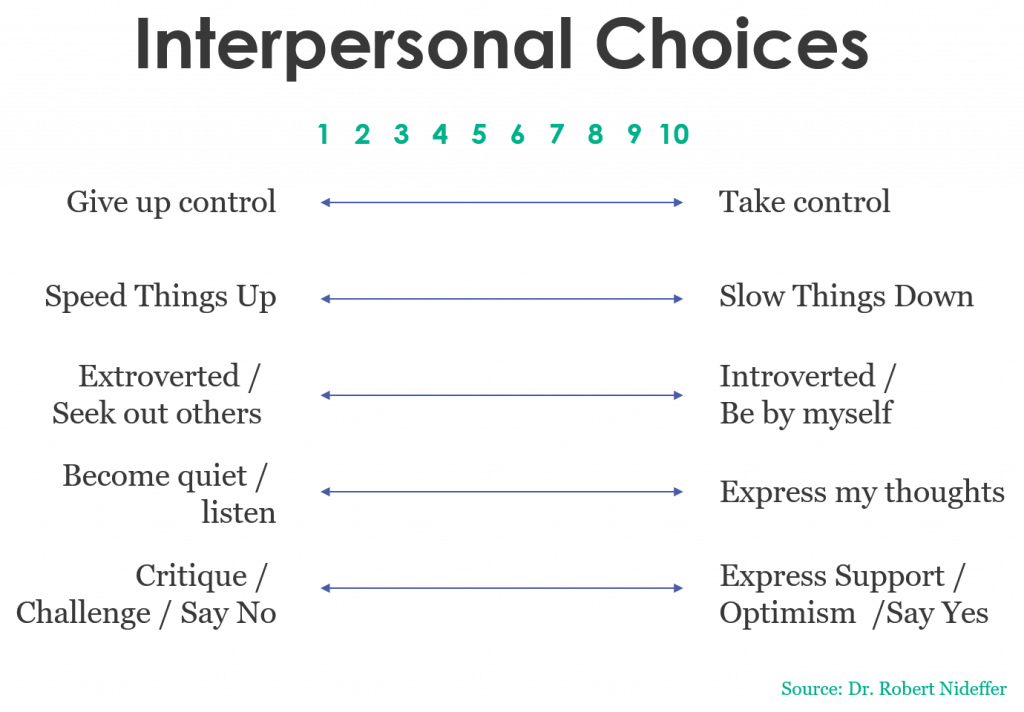
Five communication choices
The author of the TAIS, Dr. Robert Nidefer, showed that people make five choices over and over in the course of a conversation. These choices are informed by their tendencies on five dimensions.
Give up/take control – are you more likely to try to take control, or cede control to someone else?
Speed up/slow down – are you more likely to force action or a decision, or encourage more thought and consideration?
Extroverted/introverted – are you going to seek out others, or try to solve the problem yourself?
Become quiet/express thoughts – are you going to become quiet and try to understand, or advocate for your position?
Critique/express support – will you say no and become more critical, or will you say yes and express support?
Cut the right wire
Every team will have members with different tendencies. Ultimately, it’s not the tendencies that matter; it’s the level of awareness team members have of their tendencies, and the systems they put in place to leverage their strengths and weaknesses in the heat of the moment. The highest performing teams we work with take three critical steps in preparing for productive communication under any circumstances.
Acknowledge the “I” in team
Great coaches know that the phrase “there is no I in team” is a myth. Every individual makes their own contribution – and without self-awareness, people can’t adjust. That’s why the first step in your team’s communication action plan is to encourage every individual to build self-awareness across these five choices. By knowing and understanding their default tendencies, team members can begin to recognize their behaviour and course-correct when necessary for the good of the team.
Connect to the “we” of the team
It’s advantageous to know your individual tendencies, and the value is multiplied when that information is shared with everyone on the team. When you raise the waterline of team awareness, everyone can work on the same communication system. Team members can see the intent behind the behaviors their teammates exhibit. The process can be incredibly difficult; Team Canada Captain Hayley Wickenheiser called sharing her profile with her team-mates, “the most stressful part of the 4-year [Olympic] quadrennial.”
Come together as a team
Armed with knowledge of self and others, teams can come together and translate self-awareness into action. When pressure hits, if everybody on the team has the tendency to get louder, express their thoughts and try to take control of the conversation, the team can make decisions in advance to decide who’s going to take control when issues arise. By having these conversations earlier, teams can build systems to fall back on when the pressure is turned up.
Preventing detonation
The next time you’re headed into a potentially high stakes conversations, use the five choices below to carry out a short 3-step preparation exercise:
1. Plot your default tendency on each of the five scales – given your past history, where are you most likely to fall?
2. Where would you ideally like to be as you head into this specific interaction?
3. What are the gaps between your ideal and default style? What actions will you take to ensure you are at your ideal?
Repurpose the fuel for growth
We’ve said before that negative emotion is volatile fuel. Improperly handled, it can lead to combustion. Used properly, it can lead to high performance.
Team communication must go beyond just staying cool during difficult times. Teams must use communication to understand and lean in to their negative emotions, uncover what the emotions are telling them, and frame it as an opportunity for growth. This is what happened with the women’s team in 2002. They prepared to have productive communication at all times, and used the tools they learned to find the opportunity for growth at a moment when it could have blown up. Jayna Hefford explains:
By understanding your individual communication style, sharing your tendencies with the team and proactively planning to address potential faults, your team can find its way through difficult times and not just safely diffuse difficult situations but find new strength and opportunity for higher performance in the process. What do elite athletes know about resilience? They know that it is largely an inside job.
In the face of adversity, disappointment, and set-backs, Olympic athletes take on the role of Power Converters: they harness the energy inherent in pressure to enhance their own performance. Here’s the good news: you too can learn to leverage pressure in order to generate better results. The necessary skills are not innate genetic gifts, but rather, abilities that can be consciously learned and practiced.
Peter and Dane Jensen introduce the four skill sets that make up the personal resilience tool-kit used by elite athletes and high performers in business to gain control over how pressure and stress will impact performance.
Click here to download the whitepaper.



 Cyndie Flett is one of Canada’s leading experts on coaching. As the former Vice President of Research and Development for the Coaching Association of Canada, and Director of the National Coaching Certification Program, Cyndie has dramatically impacted the way that literally millions of coaches are educated across the country.