JOIN US FOR OUR NEXT LEARNING BREAKFAST
Be the first to know about upcoming learning opportunities from Third Factor by entering your information below.

Be the first to know about upcoming learning opportunities from Third Factor by entering your information below.
First and foremost, you and your colleague must be on exactly the same page with respect to what the key decisions are that are made in the course of your work, and then you need to have an open and frank discussion around who has the right to ‘make’ the decision vs. who has an ‘input’ right (I.e. They need to be consulted, but ultimately the decision is not theirs to make), or even just a ‘notify’ right (I.e. They must be notified once the decision has been made).
A lot of the issues in shared roles come when people believe they have a make right, but actually they just have an input right, or vice versa. Agreeing on this up front can diffuse a lot of potential tension.
It is very tempting to establish ‘joint make’ rights for key decisions—i.e. we both need to agree to make the decision. In my experience, ‘joint make’ rights cause some significant issues in the real world, and often lead to paralysis. Even though it can be very painful up front, it is better to align on one person who ultimately has the responsibility for making each decision. These ‘make’ rights would ideally be aligned with the unique knowledge, skills, etc. that you bring to the table. Sometimes this may not be possible, but try to use a “joint make” very sparingly.
One way to think about making this real is in going through the core job responsibilities you’ve outlined in your job description and really honing in on what the choices implied in each. For example, let’s say one element of your job is to “oversee the creation and implementation of a comprehensive communication strategy”. Within this task you might have 3 key decisions: 1) what core messages are we highlighting to which audiences, 2) what budget are we allocating for communications, 3) what media mix are we going to use. What you want to do is isolate the decisions that are likely to be hotly contested, and make sure you have clearly laid out decision rights with your partner. For example:
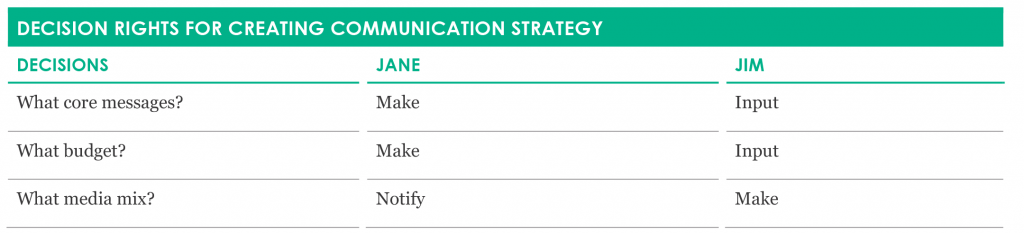
Once decision rights are clarified, accountability is easy: you are accountable to your supervisor for the decisions over which you have a ‘make’ right, and your accountability as colleagues is that you will effectively provide for, and really listen to, input across all decisions where you have agreed that the other person has input rights. Allocating decision rights is an exercise in power. Prepare for the discussion with your colleague to be a challenging one. If you push through it, however, you will have a solid foundation upon which to build a productive, collaborative relationship.