Rosie MacLennan is a powerhouse: she was the first Canadian athlete to defend a gold medal at a summer Olympics by winning back-to-back golds in trampoline in 2016 and 2020, she served as the Chair of the Athletes Commission at the COC and fought tirelessly for safe sport, and she has an MBA from Stanford.
We were fortunate enough to have Rosie join us at our annual Third Factor client dinner a short time ago, where she shared a behind-the-scenes look at her path to Olympic triumph, the significant challenges she faced on the journey, and the tools she used to help overcome them.
Here are three lessons from Rosie’s talk that can help anyone striving for their own version of a gold-medal performance.
1: Confront failure head-on
One of Rosie’s most interesting insights was slightly counter-intuitive: when the fear of failure is strong, don’t shy away from it – lean into it. Ahead of the Olympics, Rosie consciously worked to confront the possibility of failure directly, and work through her worst-case scenario in vivid detail.
“By confronting the possibility of failure, you can free yourself from its grip.”
In partnership with her mental performance coach, Rosie sat down and played out two scenarios: what if things go well and I win? And, what if I stumble and fail? With these two scenarios in mind, she vividly worked through how she would feel and what her life would be like: 1 day after, 1 week after, 1 month after, 1 year after, and, eventually, 5 years post-Olympics.
Rosie’s realization? Ultimately, the outcome at the Games would have little impact on her life 5 years down the road. Regardless of the outcome she would be okay.
This mental exercise allowed Rosie to remove the distraction of fear from her preparation. By confronting failure head-on, she could redirect her energy from worrying about what could go wrong to focusing on what she could control.
Whether you’re preparing for a major presentation, launching a new business venture, or pursuing a personal goal – instead of trying to avoid thinking about failure, take the time to visualize the negative scenario. When we “play out the full movie” what we often find is that the fear comes from the fact that we are just imagining a moment in time – an incomplete thought or image that doesn’t reflect the fullness of time. By confronting the possibility of failure, you can free yourself from its grip and focus entirely on performing at your best.
2: Embrace direct feedback
Rosie’s coach, Dave Ross, is known for a style that is extremely candid. While some athletes balked at his bluntness, Rosie saw something deeper: a genuine commitment to helping her succeed. She understood that behind his straightforward critiques was a profound belief in her potential. Instead of resisting his feedback, she consciously worked to lean into it, using it as information to unlock higher levels of performance.
This ability to harness the value in blunt feedback came from her taking the time to understand Dave as a person. She took the time to look beyond personality and style to understand his values and ultimately his character. These insights didn’t just unlock her own performance, they also allowed her to help other athletes shift their perspective on Dave’s feedback by sharing her insights into what was behind his style.
When you find yourself chafing at direct feedback, consider the intent of the person delivering it. Where are they coming from? What are they trying to help you accomplish? Often, others are trying to help – even when their wording or approach might trigger some reactivity.
3: Use visualization to overcome obstacles
In the lead-up to the Tokyo Olympics, Rosie faced a daunting challenge: a series of serious ankle injuries that left her unable to perform her trampoline routine for weeks. In fact, she was unable to practice her full routine until one day before leaving for the Games.
“When we imagine something with enough vivid detail – to our body, it’s real.”
Rather than letting this setback derail her preparation, Rosie turned to the power of imagery and visualization. Unable to train physically, she trained mentally.
This started with simply imagining herself bouncing on the trampoline again. She shared that, initially after the injury, every time she would close her eyes and visualize jumping on the trampoline – she would see herself falling. With effort and (mental) practice, she was able to start to imagine herself jumping with confidence, and eventually to visualize her entire routine in vivid detail.
Remarkably, Rosie finished 4th at the Tokyo Olympics— less than a single point off of the podium featuring the best athletes on the world, all of whom had been training regularly, despite having been unable to physically practice until a single day prior to travel.
When we imagine something with enough vivid detail – to our body, it’s real. Some studies estimate that for elite athletes, mental rehearsal delivers roughly 85% of the benefits of physical rehearsal. Rosie’s experience certainly backs up that research.
Visualization isn’t just for elite athletes. It’s a tool anyone can use to prepare for high-stakes situations —whether it’s a speech, negotiation, or exam—spend time visualizing your performance. Imagine every detail: the environment, your actions, and the desired outcome. This mental preparation can help you feel more confident and prepared when the moment arrives.
Bringing it all together
Rosie MacLennan’s journey to Olympic success is more than a story about athletic achievement. Her approach to confronting failure, embracing feedback, and harnessing the power of visualization provides lessons that can help all of us.
Here’s a challenge: think about your own version of a “gold medal performance.” What are you striving for in your career, relationships, or personal growth? Now, consider how you can apply Rosie’s three strategies:
Confront failure head-on: What’s holding you back? Imagine the worst-case scenario to start to rob it of its power.
Embrace direct feedback: Who in your life is pushing you to be better? How can you listen with an open mind and use their insights to grow?
Use visualization to your advantage: What mental rehearsals can you do to prepare for your big moment? Coaching is, at its core, a deeply human endeavor. It’s a skill that requires empathy, curiosity, and an ability to connect with others on a personal level. Effective coaching demands patience, insight, and adaptability, making it a uniquely human process. Yet, as artificial intelligence (AI) tools like Copilot and ChatGPT become increasingly advanced and widely used, the potential to integrate AI into the coaching process is becoming more apparent. Rather than viewing AI as a replacement for human coaches, we see it as a complement—a tool to augment the learning experience and extend the reach of coaching.
Our approach, inspired by our company’s founder Dr. Peter Jensen, is rooted in the idea of AI as “the coach’s coach.” Instead of attempting to replicate the nuanced human interactions of coaching, we’re leveraging AI to sustain learning and assist leaders as they progress toward coaching mastery. AI becomes a tool that helps leaders get comfortable with coaching and sharpens their skills, rather than replacing the critical role of a human coach.
Drawing inspiration from “The Coach’s Coach”
Dr. Peter Jensen has been known for decades as “the coach’s coach.” Over 35 years, his focus has been on empowering coaches rather than stepping into their shoes. He works to help them improve their craft and support their teams more effectively, offering guidance, insights, and tools to help them reach their potential. His role isn’t to be the head coach, but instead to act as a mentor and resource for those who are.
This philosophy guided us as we considered the potential of AI in leadership and coaching development. What if every leader had access to an AI-powered coach in their pocket—one they could turn to for advice, guidance, and practice whenever they needed it? This vision drives our integration of AI as a tool that complements and supports, rather than competes with, human coaches.
Understanding AI’s role in the learning curve
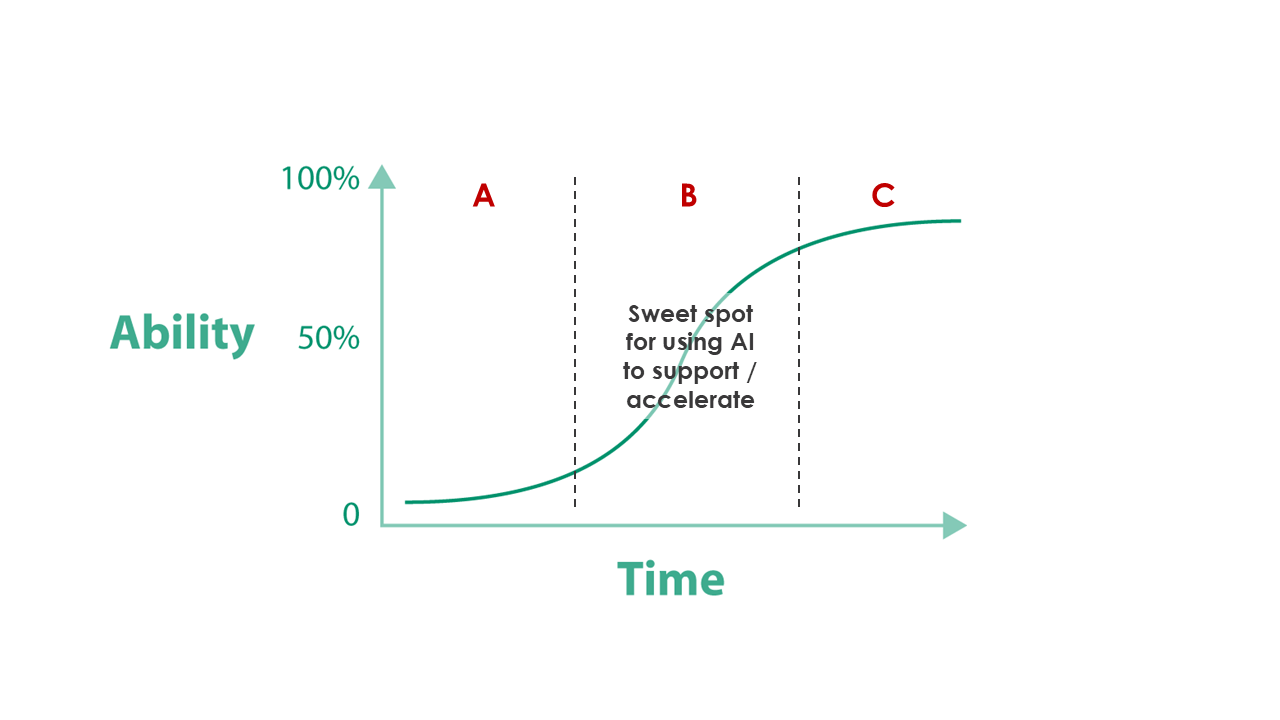
The learning curve is a familiar concept in skill development. It illustrates how people acquire new skills over time, beginning with an initial uncomfortable phase of struggle and slow gains, progressing through steady improvement, and then hitting the final grueling ascent to achieve true mastery. AI’s role is most valuable in the intermediate stages, where learners have built a foundation and consistent practice and support can help them to make big leaps up the curve.
High touch to learn
At the beginning of the learning curve, learners are stepping into unfamiliar territory, and progress can be slow and frustrating. At this stage, motivation, encouragement, and a safe environment to make mistakes are critical. This is where the presence of a human coach is indispensable. Human interaction provides the emotional support and expert guidance that learners need to build confidence and take those first steps.
“The goal of this high-touch phase is to equip learners with a solid foundation and prepare them to apply their new skills independently.”
For example, in our 3×4 Coaching program, leaders regularly report discomfort with delivering corrective feedback and therefore delay or outright avoid it. In the classroom, we are able to set them up in pods with their peers and, through a triad exercise, show that giving “negative” feedback can be a positive, developmental experience. With the encouragement (and accountability) of their peers, participants take the first steps up the learning curve and start to build confidence.
This is not much different than learning to ride a bicycle. Initially, the learner needs someone to hold the bike steady, provide feedback, and offer reassurance. This hands-on support is essential for achieving balance and overcoming the fear of falling. Similarly, in leadership development, learners benefit greatly from in-person workshops or coaching sessions where they can practice new skills, ask questions, and receive real-time feedback. The goal of this high-touch phase is to equip learners with a solid foundation and prepare them to apply their new skills independently.
High tech to transfer
As learners move past the initial hurdles, they enter the middle phase of the learning curve. This is the growth phase, where they’ve gained a basic understanding but need consistent practice to refine their skills and build confidence. At this stage, AI can play a crucial role in supporting learners’ development.
AI tools excel at providing scalable, consistent support during this phase. They can simulate real-world scenarios, offer constructive feedback, and serve as a resource for learners to practice and refine their skills. Our pilot programs have confirmed the value of this approach. Leaders who have used our AI tools report that these tools help them apply what they’ve learned in their training programs. For example, our AI tools have been instrumental in helping leaders simulate coaching conversations, deliver feedback effectively, and prepare for performance reviews. By practicing in a non-judgemental, low-stakes environment, they gain confidence and improve their skills before applying them in real-world situations.
AI as sustainment
AI is particularly effective at supporting sustainment. To understand this, it’s helpful to distinguish between two types of motivation in the learning process: the motivation to learn and the motivation to transfer.
“People are motivated to learn when they encounter new ideas, engaging experiences, or compelling stories.”
The motivation to learn is rooted in intellectual curiosity. People are motivated to learn when they encounter new ideas, engaging experiences, or compelling stories. This type of motivation often requires a human touch—someone who can inspire and captivate learners, sparking their interest in the subject matter. These are areas where human coaches excel. They can create dynamic, interactive learning experiences that draw learners in and motivate them to engage with new concepts.
The motivation to transfer, on the other hand, is about applying what has been learned in a real-world context. This requires an environment where learners feel supported and confident in their ability to succeed. Motivation to transfer comes from having access to resources, someone to turn to for advice, and a sense of accountability. These are areas where AI shines. By providing tools and guidance for application, AI helps learners bridge the gap between theory and practice.
AI can simulate coaching conversations, offer tailored feedback, and provide reminders to keep learners accountable to their goals. It creates an environment where learners can experiment, refine their skills, and build confidence in their abilities—all while supporting their long-term growth.
The future of coaching
The integration of AI into coaching enhances rather than replaces the role of human coaches. While human coaches inspire curiosity, build foundational skills, and connect on a personal level, AI excels at providing scalable, consistent support during the critical growth phase of skill development. This complementary relationship allows learners to benefit from both personalized guidance and accessible tools for practice and refinement.
By blending the strengths of human connection and technological capability, we create a sustainable, accessible coaching model. Human coaches can focus on motivation and expertise, while AI supports learners in applying and mastering new skills. This balanced approach ensures coaching remains effective and widely available, fostering a culture where both learners and coaches thrive in an evolving landscape. 15,000 athletes will compete in 878 events across 54 sports at the Paris Olympic and Paralympic Games. To help you narrow in on what to watch, we asked our network of elite athletes, coaches and influencers to share the stories they’re most excited for. Here’s what they said.
Martha McCabe
3x Olympic swimmer, Founder, Head to Head
It might sound silly but one of the things I’m most excited about is for the athletes to experience a ‘normal’ Olympic Games.
After an extremely challenging, delayed and socially distanced, Tokyo Games in 2021, this will be the first chance for summer athletes since 2016 to experience that real Summer Games feel. From socializing in the athlete village, to getting out into Paris after they compete to soak up the Games energy, it’ll be incredible!
On the performance front, Summer McIntosh is the one to watch in swimming. She’ll have stiff competition with Australia’s Ariarne Titmus, and USA’s Katie Ledecky (among others!), but she’s proved she belongs with the best, and I think she’s got a great shot at some seriously well earned Olympic medals.
I’m also really excited to see Josh Liendo lead a quickly improving men’s swim team. He, along with a few other young Canadian men (like Ilya Kharun) have proven that they’re not afraid of the big boys on the world stage, so I think they’ll be ready to leave their mark for Canada too.
When to watch
Summer McIntosh: July 27 – August 4
Josh Liendo: July 31, August 3, August 4
Ilya Kharun: July 31, August 3, August 4
Karen O’Neill
CHIEF EXECUTIVE OFFICER, CANADIAN PARALYMPIC COMMITTEE
There is incredible momentum leading into the Paris Paralympic Games.
It signals to many Paralympic athletes a competition post-COVID, whereby their planning and preparation have been more within their control. For many, it is a chance to come back following the Summer Games in Tokyo with focus and determination to perform.
Athletes heading into these Games are now in the final qualification period to secure a nomination to Team Canada. There are many exciting stories, with numerous first-time athletes heading to Paris. For some veterans, like the Women’s Goalball Team, it means securing a nomination for Team Canada.
Let’s all cheer on Team Canada in this fierce and exciting competition from August 28 to September 8!
When to watch
Paralympic Games: August 28 – September 8
Women’s Goalball: August 29 – September 5
Debbie Low
CHIEF EXECUTIVE OFFICER, CANADIAN sport institute ontario
For me, one of the most exciting sports to watch at the Paris Olympic Games will be Women’s Beach Volleyball, featuring the Team Canada duo of Melissa Humana-Paredes and Brandie Wilkerson.
I worked with Melissa’s dad at Ontario Volleyball when I was starting my career in sport management, and these two talented athletes have been supported by Canadian Sport Institute Ontario (CSIO) throughout their careers.
Paris 2024 will be Melissa and Brandie’s second Olympic appearance, having both competed at Tokyo 2020 with different partners. Melissa and Brandie teamed up in 2022 and have since made the podium at numerous international and professional beach volleyball tournaments. They are currently ranked 4th in the world.
Melissa is also a former World Champion and a two-time Commonwealth Games Champion, having won the FIVB Beach Volleyball World Championship in 2019 and the Commonwealth Games in 2018 and 2022, all with her former partner Sarah Pavan.
When to watch
Women’s Beach Volleyball: July 27 – August 9
Anne Merklinger
CHIEF EXECUTIVE OFFICER, Own The Podium
Canada Basketball is set to make history at the 2024 Olympic and Paralympic Games.
For the first time, Canada has earned Olympic qualification for the women’s team, the men’s team, and the 3×3 women’s basketball team. This milestone highlights the growing strength and depth of basketball in Canada.
The women’s, men’s, and 3×3 women’s basketball teams are heading into Paris with significant momentum. Each team has demonstrated exceptional skill, determination, and teamwork throughout the qualification process, providing a strong foundation as they prepare to compete on the world stage.
Additionally, both the men’s and women’s wheelchair basketball teams will compete at the Paralympic Games. Known for their competitive spirit and resilience, these teams add to Canada’s robust presence in basketball.
With no regrets and a steadfast focus on winning, Canada Basketball is poised to make a substantial impact at the Paris Olympics and Paralympics, representing Canada with pride and inspiring future generations.
When to watch
Men’s Basketball: July 27 – August 10
Women’s Basketball: July 28 – August 11
Women’s 3×3 Basketball: July 30 – August 5
Men’s Wheelchair Basketball: August 29 – September 7
Women’s Wheelchair Basketball: August 29 – September 8
Mel Davidson
4x gold medal winning coach
Canada has recently become a basketball nation.
Five teams will represent Canada in Paris: three Olympic teams (Men’s, Women’s, and Women’s 3×3) and two Paralympic teams (Men’s and Women’s). The Women’s 3×3 team, featuring the top three FIBA Women’s 3×3 players, won a nail-biter in their final Olympic qualifying game to secure their spot.
The Men’s team, qualifying for the Olympics for the first time in over two decades, is riding high after beating the USA to win bronze at last year’s world championships. With their most talented roster ever, the big question is whether they can build on the team approach developed over the past four years.
The Women’s Wheelchair basketball team has an experienced and talented roster capable of medaling in Paris. However, after three coaching changes in three years, the question is whether their current stability will allow them to gel in time for a deep run at the 2024 Paralympics.
When to watch
Men’s Basketball: July 27 – August 10
Women’s Basketball: July 28 – August 11
Women’s 3×3 Basketball: July 30 – August 5
Men’s Wheelchair Basketball: August 29 – September 7
Women’s Wheelchair Basketball: August 29 – September 8
Rosie MacLennan
2x gold medal winning trampoline gymnast
Jacqueline (Jackie) Simoneau is an artistic swimmer heading into her third Olympic Games.
Known for her grace and precision in the water, Jackie has been a key figure in Canadian artistic swimming for years. After competing in the Tokyo Olympics, she decided to retire and pursue a doctorate in podiatric medicine, demonstrating her dedication and versatility both in and out of the pool.
In 2023, Jackie made the surprising decision to put her studies on hold and rejoin the national team. Her return has been nothing short of remarkable. At the 2024 World Aquatics Championships, she played a pivotal role in helping Canada qualify a full team and a duet for the Paris 2024 Olympics. Her leadership and experience have been invaluable to the team, inspiring her teammates and contributing to their overall success.
Jackie’s most significant achievement came when she made history by becoming the World Champion in the free solo routine. This victory marked the first time a Canadian had won the title in 33 years, cementing her legacy in the sport. Her comeback and subsequent triumphs have not only elevated her status but also shone a spotlight on Canadian artistic swimming on the world stage.
When to watch
Artistic Swimming: August 5 – August 10
Garry Watanabe
Principal trainer & sport lead, Third Factor
I’ll be watching the team rowing events, where brief yet intense races unfold in just 5-7 minutes.
These events are a captivating showcase of teamwork, skill, and endurance, as athletes push themselves to their absolute limits in the pursuit of victory. The synchronization and power displayed by the rowers create a thrilling spectacle that never fails to inspire.
Rowing demands both physical strength and mental resilience, with athletes enduring massive pain and exhaustion while maintaining perfect coordination. This combination makes rowing one of the most challenging and compelling sports to watch, drawing viewers who appreciate the dedication required to excel.
For a deeper insight into the preparation and commitment involved in rowing, I highly recommend The Four-Year Olympian by Jeremiah Brown. This book provides a gripping account of Brown’s journey and the immense effort needed to compete at the highest level, offering an inspiring story of perseverance and achievement.
When to watch
Rowing: July 27 – August 3
What could you achieve if every leader in your organization had a coach in their pocket – one they could access at any time to craft the perfect piece of feedback, prepare for a difficult coaching conversation, or get personalized advice for coaching their team?
“PJ” is our AI coaching companion that helps leaders apply their coaching skills by offering customized support whenever needed. Developed in partnership with The Modern Office Company, this intuitive and friendly chat bot is the latest advancement in sustainment for our flagship 3×4 Coaching program.
What is PJ?
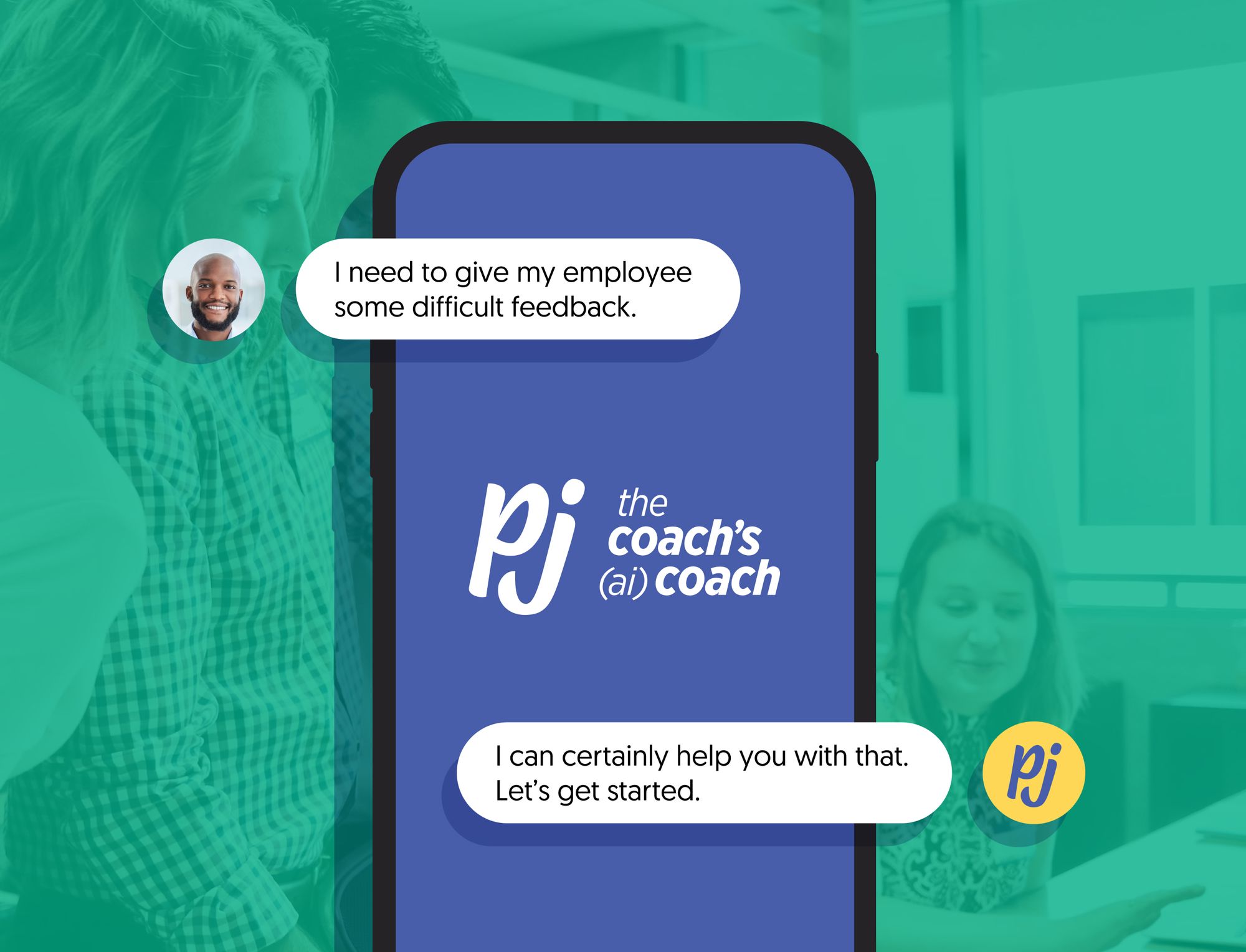
We’re calling PJ The Coach’s Coach. It’s a tool designed to help leaders work through coaching challenges and get advice on applying the 3×4 Coaching model, our framework of 3 plays and 4 skills that exceptional coaches use to deliver results and build commitment.
At its heart, PJ is an AI chat bot developed by Third Factor and The Modern Office Company. With a license, you can ask PJ questions and discuss just about anything related to coaching. PJ has been trained in the 3×4 Coaching model and can help you use questions, listening, feedback and confronting to build clarity, improve competence or give recognition.
What really excites us is that PJ is a true coach. Unlike other chat bots that jump straight into giving advice, PJ first listens to understand and asks clarifying questions to get to the heart of every issue. A conversation with PJ flows like a conversation with a real coach – acknowledging the very real challenges of leadership, building clarity about what’s really going on, and generating practical strategies for applying the coaching skills.
What can PJ help with?
PJ is designed to help with just about any coaching challenge. Whether you need help building clarity around an issue, delivering difficult feedback, or finding the right way to recognize a team member’s efforts, PJ is there to help.
Here is a list of sample prompts you might give PJ across a variety of categories:
Work through challenges
My direct report seems unmotivated and I’m not sure why
I’m struggling to build a relationship with a new team member
I’m not sure how to best coach someone with more experience than me
Prepare for a Conversation
Help me prepare for a challenging conversation with my direct report
I need to have a team discussion to clarify performance expectations
How should I deliver feedback on something that I didn’t directly observe?
Enhance skills
Give me a scenario to practice using the BID feedback model
What are strategies for improving my active listening?
How can I get more comfortable with having tough conversations?
Generate ideas
What are some simple but personalized recognition ideas for my team?
What are approaches to identify my team’s strengths and weaknesses?
I’d like ideas for quickly building relationships with new team members
Coach in different contexts
How do I coach someone from a different generation than me?
What are strategies for coaching someone who doesn’t report to me?
How do I adjust my coaching for in-person vs. remote team members?
Deepen coaching knowledge
Can you explain the concept of ‘developmental bias’ in more detail?
Does the BID model work for both reinforcing and corrective feedback?
What does it mean to use emotion as a fuel for change?
See PJ in action
PJ is trained to coach you through problems rather than just giving answers. After you explain what you need, PJ will ask clarifying questions to understand the nature of the coaching challenge. It will then help you discover how to apply the coaching plays and skills to address the issue and help you create a detailed action plan.
Here’s a real conversation with PJ about a team member’s punctuality to give you an idea of just what PJ can do.
How do I get access to PJ?
PJ is currently in a closed Beta and not available to the general public. If you want to try PJ and give us feedback on how to improve, send us an email explaining your coaching challenge and why you think PJ could help.
New manager development programs are often a surprising “problem child” in the Learning & Development portfolio.
The recent Association for Talent Development (ATD) report sponsored by Third Factor, “New Manager Development: Building a Foundation for the Future,” highlights a critical gap: while 70% of organizations have new manager development programs, most fail to realize their full potential with 77% reporting only moderate success or worse.
Successful
Unsuccessful
No program
Helping new managers transition from individual contributor to people leadership roles is vitally important for the performance of not only those managers but everyone that reports to them as well. But with the large population of managers in most organizations, Learning & Development (L&D) is often tasked to execute these programs at scale and on a shoestring budget. Add in the time pressures on new managers, and it can feel near impossible to deliver impactful leadership development programs for this audience.
We know how challenging this mandate can be, so we’ve collected some practical strategies from leading organizations that we partner with to help get the value out of your investment in new manager development.
Leadership at the Helm: Building Top-Down Support
The ATD report underscores the importance of senior leadership in new manager development. Most of the organizations surveyed indicated that a lack of either resources, senior leadership support, and/or prioritization were challenges to training new managers. So how do you build that critical support at the top of the house?
01.
Pick your moment and leverage business needs to advance new manager training.
02.
Enlist your partners to sell your vision for new manager training internally.
03.
Get senior leaders directly involved in training to underscore its importance.
First, pick your moment. When organizations make significant investments in new manager development, it typically comes at a time when there is a clear business need – for example, a new strategy, a culture transformation, declining engagement scores, or high turnover. Use these windows of opportunity to demonstrate how Learning & Development can help turn conceptual business plans into real action by driving the right behaviors in managers.
Second, enlist your partners. You need every tool in your arsenal to build the strongest business case to senior leaders for investing in new manager development. Involve HR or internal business partners as well as your third-party vendors to help demonstrate to senior leaders the value and expected outcomes of these programs. Hearing directly from your leadership team about a strategic transformation they are driving from transactional to advisory services, for example, will enable your vendors to design programs that directly support those needs.
Finally, start small and get senior leaders directly involved. One L&D team that we work with is driving a multi-year rollout of a two-day in-person program to help managers build coaching skills – a significant investment of time and resources. But it all started with just one session focused on the C-Suite team. Through that firsthand experience, the CEO and his team became passionate champions of the program. They not only committed to funding a broad program rollout, but the CEO now speaks directly to every cohort of managers that goes through the program. His involvement sends a strong message about his commitment to manager development and also reinforces the connections between the content and their business priorities.
Balancing Learning Formats
Training a large population of new managers can be costly. For many organizations, it’s just not feasible to offer in-person experiential learning programs to all new managers.
In fact, the ATD report notes that asynchronous learning channels are the most common offering made available to new managers. We often hear from L&D leaders about the benefits of asynchronous learning for creating custom learning pathways and offering flexible programs that work around the busy schedules of new managers. Yet there is always a desire to incorporate some of the benefits of live, in-person learning experiences as well.
Increasingly, organizations are looking at blended learning formats to provide the scale and cost effectiveness of asynchronous learning but with some of the human connection and energy of live or in-person programs.
A financial services company that we partner with offers an asynchronous program that enables managers to learn coaching skills through a series of self-paced videos. But to enhance the experience through peer support and live discussions, managers are placed into learning cohorts that proceed through the program as a community. A live virtual kickoff provides context about the program, introduces managers to others in their cohort and builds energy around the learning journey they are about to start on. Midway through the program, cohorts reconvene for a live application lab to work through any questions and challenges as they start applying the skills in their work environment. And upon completion of the program, managers have access to 1:1 coaching and a library of resources to support ongoing skill development and application.
“The most successful new manager development programs that we see always place a strong focus on practical application.”
Whether asynchronous, in-person, or a blended format, the most successful new manager development programs that we see always place a strong focus on practical application. New managers are often completely underwater balancing their priorities of delivering results while also developing their people.
In fact, time constraints on new managers were the most common challenge cited in ATD’s report. Most new managers simply don’t have the time, energy, or interest to dive deep into theories on motivation and performance. Instead, they need a few practical tools that they can implement immediately, opportunities to practice new skills, and strategies to focus on actions that will have the greatest impact so that they see immediate results and build confidence.
Measuring What Matters: The Art of Success Metrics
You’ve heard it a million times – “how are we measuring the impact of this program?” When it comes to reallocating investment or cutting costs, new manager development programs are an easy target if they can’t demonstrate impact. Effective metrics not only demonstrate program effectiveness but also ensure the program remains relevant, impactful, and aligned with evolving business priorities.
ATD’s report highlights a similar issue: 87% of respondents cite a lack of metrics to track the program’s results as a challenge to new manager training. While most organizations do assess program effectiveness, many focus on participant satisfaction and use informal conversations rather than quantitative or outcomes-based measures. So how can you incorporate impactful metrics without creating an overly complex science project?
Most important is systematizing and quantifying participant feedback with a short, standard feedback form for every participant to complete. In our experience, taking a few minutes to do this at the end of sessions before participants return to their other work is the best way to drive response rates and specific feedback. In addition to participant satisfaction, include one or two questions tied to target outcomes – for example, participants’ confidence in their ability to apply the skills in their daily work.
With a basic feedback system in place, start looking at longer-term metrics and impacts. A large energy organization that we work with administers a final survey approximately three months after leadership development programs on how participants are applying their learnings and the resulting business impact of those actions. These concrete examples offer powerful impact stories that are highlighted to the company’s most senior leaders.
Another financial services organization surveyed the direct reports of program participants and found that more than 85% noticed an improvement in their leaders after completing the manager development program – a metric that helped build ongoing support and expansion of the program.
Transforming Insights into Impact
As the ATD report highlights, new manager development programs are a critical aspect of the L&D portfolio and yet there are very real challenges to making them effective and impactful. These strategies offer a blueprint to help ensure the investment in these programs delivers real value for the business and for your people.
At a glance:
Roughly one quarter of organizations say their new manager training programs are extremely or highly successful, but an equal number report their programs as only slightly successful or not successful at all.
Key reasons for investing in training for new managers include better individual performance (85%), continuity of organizational culture and values (69%), and better team performance (62%).
Top focus areas for new manager training include communication skills (93%), providing feedback (92%), and performance management (91%).
91% say their new managers just don’t have enough time to invest in development programs.
Third Factor has partnered with the Association for Talent Development (ATD) on exciting new research that reveals how organizations approach training for new managers. The report draws on a sample of 287 organizations seeks to understand why organizations do or don’t invest in training for new managers, how new manager training is approached, and the common trends in the most successful new manager development programs.
In today’s rapidly evolving business landscape, the importance of new manager training is highlighted by a notable statistic: 70% of organizations have a development program for new managers, and among those without, 54% plan to introduce one within the next two years. This trend underscores a growing recognition of the crucial role new managers play in organizational success. However, transitioning from an individual contributor to a managerial role is a journey filled with challenges. Managers must not only manage tasks but also lead people, a shift that requires a fundamentally different skill set and mindset.
Successful new manager training programs can be hard to come by
While about a quarter of organizations consider their programs extremely or highly successful, another quarter view them as only slightly or not at all successful. This suggests a broad spectrum in the effectiveness of such programs across different organizations, highlighting the need for tailored approaches and continuous improvement in managerial training practices. It underscores the importance of not just having a training program in place, but also ensuring its relevance, effectiveness, and alignment with organizational goals.
The good news is that the report shows 78% of organizations actively measure the success of these programs. The most common method used is assessing participant satisfaction. However, high-performing organizations often go further by evaluating long-term impacts such as the retention rate of managers and their contribution to organizational performance. This approach underscores the importance of not only implementing development programs but also rigorously assessing their outcomes to ensure they meet organizational goals and contribute to long-term success.
Performance and culture are the most desired outcomes
When developing training programs for new managers, organizations are unsurprisingly focused on performance – but the question of whose performance is most important raised our eyebrows.
While 85% of organizations want their new manager development programs to enhance individual performance, only 62% include team performance in their goals. While enhancing a manager’s skills is essential, it’s crucial to recognize that a manager’s success is inherently tied to their team’s performance. Focusing solely on individual managerial skills without equally emphasizing team leadership and development can create a disconnect. This approach may lead to managers who excel individually but struggle to foster a high-performing team, ultimately impacting the broader organizational effectiveness.
Fortunately, continuity of organizational culture and values is also a top outcome for new manager development. Some 69% of organizations rely on new manager development programs to ensure that leadership is aligned with the core principles of the organization. This alignment helps in maintaining a consistent organizational ethos, which is essential for long-term success and identity.
The most important skill for new managers? Communication.
The skill new manager training programs focus on above all others is communication, with 93% of organizations prioritizing this in their development programs.
In our 3×4 Coaching program, we teach that coaches use four key communication skills to develop their people: questioning, active listening, feedback, and confronting. Feedback also made the list of skills, with 92% of new manager development programs dedicating time to giving people information about their performance.
While performance management (91%) is another top focus area, the communication skill of confronting didn’t make the list. Questioning, listening and feedback are useful and necessary skills, but aren’t always the best tools when a valued performer needs to make a non-optional change to their behaviour.
Teaching new managers skills for managing challenging conversations is a worthwhile investment. Giving younger leaders the opportunity to learn and practice the skill means they will be better prepared to confront problem behaviors when they reach a more senior position. By thinking of communication skills for new managers as an investment in the future, organizations can strengthen their entire leadership pipeline.
Finding time is a top challenge in training new managers
The primary challenge in this developmental journey, as reported by 91% of organizations, is the lack of time for new managers to participate in training programs. It’s no secret that new managers are expected to hit the ground running, often having been selected for their aptitude for the role and prior success in a non-leadership role.
The rub is that the bias toward execution, rather than leadership, is actually counterproductive. While managers at this level need to be adept at leading their people while being responsible for their own work product, putting emphasis on the former in the earliest days could set them up for a career-long belief that their individual productivity is more important than that of their team. This misprioritization can also lead to a situation where managers are underprepared for their roles. Moreover, the pressure of managing operational tasks while also trying to develop people management skills can lead to burnout and decreased effectiveness.
Just as new managers need to skillfully coach their people in the flow of getting things done, their own leadership training needs to happen in the flow of work. Training programs need to be flexible and easily integrated into the daily workflow of new managers. This might involve bite-sized learning modules, on-the-job training, and leveraging technology for accessible and engaging learning experiences. Additionally, creating a culture of continuous learning and providing ongoing support and resources can help new managers adapt to their roles more effectively and efficiently.
Equipping new managers for success
The research from Third Factor and the Association for Talent Development presents a valuable opportunity for improvement in new manager training. This study offers a roadmap for organizations to refine their leadership development strategies, emphasizing the integration of training into daily work, a comprehensive focus on communication skills, and prioritizing team success alongside individual performance. By embracing these insights, organizations can significantly enhance their outcomes, nurturing leaders who are well-equipped to meet the challenges of the modern business world.
You can download the full report from the ATD website. Imagination, belief and energy are precious resources that need to be carefully nurtured when high performance is the goal. At the same time, saddling someone with an unattainable target because you don’t want to dampen their enthusiasm risks a catastrophic failure that can destroy self-confidence and trust in the coach.
An ambitious but naïve performer setting an unrealistic goal for themselves is commonplace: a direct report applies for a role where they are unlikely to be the successful candidate; an individual you coach sets a performance target for themselves based on their best year ever when headwinds are coming on strong; or your team is running a pilot project that’s very unlikely to get the green light to proceed.
How can you communicate belief in the performer, while at the same time protecting them from experiencing what could be a devastating setback?
A moment of insight
One such moment for me happened over 20 years ago when I was working as a swimming coach in Thousand Oaks, California. I was coaching an adult swimming group – or as we called them, “Masters Swimmers” – to prepare them for the first competition of the summer.
Masters swimming competitions are interesting events: the beer tent opening is as big a deal as the performances in the pool. But, make no mistake, the performances matter to the athletes.
“I immediately realized I had made a mistake”
I was doing some goal-setting work with an athlete who had recently taken up the sport and asked her what she thought would be a good goal time for her 100-meter freestyle. Her answer was completely unrealistic, so I suggested a much more attainable goal. The smile vanished from her face, her shoulders slumped, and I immediately realized I had made a mistake.
In my well-intentioned effort to save this performer from disappointment, I had limited what she could imagine for herself, communicated a lack of belief in her capabilities and cut off a key source of energy.
Don’t fear negative emotion
In that moment, my gut reaction was to spare this person from setting herself up for failure. What I’ve learned is exceptional coaches know that negative emotion is an inherent part of the journey of growth and development. Progress isn’t linear.
When people are testing their limits and doing things that they’ve never done before they will experience setbacks from time to time. And when those setbacks occur, they will experience negative emotions such as frustration or disappointment. But people can survive frustration and disappointment.
On the other hand, if you encourage them to set safe goals that you know they will achieve, you limit the powerful “pull forward” that comes with imagining what might be possible.
Frame a range of outcomes
While negative emotion is a powerful tool, the coach still needs to prevent a devastating failure. Where I suggested a new goal in place of the one my swimmer had set, I could have included it in a range of possible outcomes that framed a realistic performance as a level of success.
In practice, this looks like a series of goals that includes the most ideal outcome and also a few other outcomes that are more realistic and attainable.
Goal “A” might represent a nearly perfect result where they execute flawlessly and all the breaks fall their way.
Goal “B” might represent a good result where they execute relatively well, but not perfectly, and 50% of the breaks fall their way.
And finally, Goal “C” might represent a result they can live with where they make a few execution mistakes and experience some bad luck in the process.
Framing targets in this manner helps performers to dream about what might be possible while at the same time preparing them for when the ideal outcome does not occur. This approach is also a useful way to help a perfectionist objectively assess their performances.
“Perfectionists often evaluate any imperfect performance as failure”
Perfectionists often evaluate any imperfect performance as failure. By working with the performer to set a range of target outcomes in advance, the coach is then in a position to help them evaluate their performance against objective criteria.
This often results in the perfectionist being forced to admit that their “failure” was in fact a “good performance” or at worst “one they can live with.”
Blend empathy and accountability
If the performer doesn’t achieve their ideal outcome, help them harness the negative emotion and use it to fuel growth rather than rushing in to try to make them feel better.
Do this by first allowing them to sit with the emotion of the moment. Be there to help them process the experience by providing a listening ear. And then, when the performer seems ready, ask them for their thoughts on how to move forward. And then work with them to create a plan to increase the likelihood of an improved result next time.
Re-writing history
If I could go back in time and revisit that moment on the pool deck when that athlete suggested an unrealistic goal, what would I do?
I would have accepted that negative emotion is a natural part of the growth process. And rather than trying to shield them from the possibility of failure, I would have allowed them to dream about what might be possible.
I would have helped them set a range of goals. And if they failed to achieve their ideal outcome, I would have helped them process the disappointment and then channel that energy into the process of getting better.
Of course it was that moment of less than stellar coaching, and the resulting disappointment I felt with myself, that ultimately helped me find a better way forward.
The Meta-Skilled Organization: Building the Capability to Evolve
Skills allow us to execute. Meta-skills like empathy, resilience, creativity, and self-awareness allow us to evolve.
As organizations and industries face increasingly rapid change and disruption, in which job descriptions are fluid and agility is essential, these meta-skills are increasingly at the heart of sustained success.
The ability to adapt is what makes us future-proof, and what separates individuals and teams that endure from those who are replaced.
In this webinar, Third Factor CEO and author of The Power of Pressure, Dane Jensen, will illustrate how the capability to evolve can be broken down into six core meta-skills and outline practical skills and strategies you can use to cultivate your own ability to adapt.
You’ll gain new insights into what’s really required for future-proofing yourself and your organization, and discover six core meta-skills across three categories that foster personal evolution.
You should attend if:
You want to build your team or organization’s resilience to rapid change
You’re responsible for change management at a project or organizational level
You’re charged with building competencies of adaptability, flexibility, innovation, or problem solving
You want to build your own capability to adapt to an uncertain future
The Meta-Skilled Organization
Sorry we missed you
This event has passed, but it won’t be the last. Be the first to know about future webinars from Third Factor by entering your information below.
About the presenter:Dane Jensen is the CEO of Third Factor, the author of The Power of Pressure: Why Pressure Isn’t The Problem, It’s The Solution, an acclaimed speaker, an instructor at Queen’s University and the University of North Carolina, and a regular contributor to Harvard Business Review.

 Here are three lessons from Rosie’s talk that can help anyone striving for their own version of a gold-medal performance.







 At its heart, PJ is an AI chat bot developed by Third Factor and The Modern Office Company. With a license, you can ask PJ questions and discuss just about anything related to coaching. PJ has been trained in the 3×4 Coaching model and can help you use questions, listening, feedback and confronting to build clarity, improve competence or give recognition.
What really excites us is that PJ is a true coach. Unlike other chat bots that jump straight into giving advice, PJ first listens to understand and asks clarifying questions to get to the heart of every issue. A conversation with PJ flows like a conversation with a real coach – acknowledging the very real challenges of leadership, building clarity about what’s really going on, and generating practical strategies for applying the coaching skills.
At its heart, PJ is an AI chat bot developed by Third Factor and The Modern Office Company. With a license, you can ask PJ questions and discuss just about anything related to coaching. PJ has been trained in the 3×4 Coaching model and can help you use questions, listening, feedback and confronting to build clarity, improve competence or give recognition.
What really excites us is that PJ is a true coach. Unlike other chat bots that jump straight into giving advice, PJ first listens to understand and asks clarifying questions to get to the heart of every issue. A conversation with PJ flows like a conversation with a real coach – acknowledging the very real challenges of leadership, building clarity about what’s really going on, and generating practical strategies for applying the coaching skills.
 You should attend if:
 About the presenter:
Dane Jensen is the CEO of Third Factor, the author of The Power of Pressure: Why Pressure Isn’t The Problem, It’s The Solution, an acclaimed speaker, an instructor at Queen’s University and the University of North Carolina, and a regular contributor to Harvard Business Review.
About the presenter:
Dane Jensen is the CEO of Third Factor, the author of The Power of Pressure: Why Pressure Isn’t The Problem, It’s The Solution, an acclaimed speaker, an instructor at Queen’s University and the University of North Carolina, and a regular contributor to Harvard Business Review.