Editor’s note: This article was first published on April 14th, 2020, just a few weeks into the COVID-19 pandemic. While the context may have changed, your plays as a leader are still the same.
In this article:
Four imperatives for leaders in times of uncertainty
Coach the whole person. With personal life and work life collapsing, now is the time to demonstrate empathy.
In these uncertain times, you are likely facing new challenges as a leader.
From working from home to school closures and outright community lockdowns – everyone has been dealing with significant, unexpected change over the past few weeks. These changes have impacted us all – changing the way we communicate, work together, and accomplish our goals.
During these tough times what we have noticed is people’s desire to help others. The feeling that we will come through this together is a rallying cry that gives heart to many. But as leaders, as coaches, what does this mean? How do you help your people during times like this? It’s a question many are struggling with.
It’s all about the relationship
When people go through difficult times together, they can emerge more connected – but only if they’re conscious about it. Difficult times can also lead to fracture. As a leader, it’s your job to step back and really think about how you are building and deepening relationships with your people in this new environment.
Take the time to check in with your people and listen to them. Take some time to step back and see what you’re going through as impartial observers and acknowledge that it’s hard. These are unprecedented times and the effort you make to stay connected with your people can make a huge difference.
Coach Roy Rana of the Sacramento Kings spoke with us about how building relationships is intentional. There is an intention to communicate, to make the person feel connected, to ensure they know they have your attention. He talks about the little things that he does to accomplish this. In the video below, he lays out the wonderful challenge he sets for himself of “30 seconds every day for every player”:
Rana’s Strategies are for basketball – not your environment. So what would work for you? What are the little ways you can connect with your people to communicate that you are thinking of them and you care?
The game has changed
By now, every workplace has been impacted by COVID-19. The game has changed, and clarity needs to be re-established. Your team needs new skills and mindsets so that you can get through this together.
“We can’t go back, only forward.”
Ask yourself what your team needs for their new playbook. Do your people know what the work expectations are today? Timelines are different. Things change quickly so clarity is always evolving. Think short term and help them find focus. Do they know what other people need from them? Are they aware of how your goals have shifted? Especially if your team is working differently than they’re used to, over-communication is impossible when it comes to these things.
Your team also needs clarity on what your organization’s values look like in this reality. Not just the vague, nice-sounding words – what they actually look like. If you value safety, how are you acting on that value? If you value team, how are you making sure that no one’s feeling isolated? Get together as a team to discuss your values and think through how you’re living up to them at this time.
Through all of this, recognize that as a coach you need to meet your people where they’re at. Some team members might be juggling kids and other family constraints. They may even be caring for someone who is sick. Give them real clarity on how your team can work well together in a way that’s not going to make anyone feel criticized, judged or guilty. Have empathy for what they’re going through and use humour to help people feel at ease.
Some team members (and perhaps even you) may be thinking they just need to hold on for a little bit longer until things get back to normal. That thinking will not serve them or the organization well. When companies face disruption, the ones who try to ignore it or find a way to hang on to their old ways of doing things don’t fare well – think Blockbuster. We can’t go back, only forward.
New plays for a new game
When the game changes, you can’t expect to get the same results from the same behaviours. As a coach, your goal is to help your people succeed in their new reality – and this means helping them get up to speed on the skills that will support the new expectations as well as discouraging the old behaviours that are no longer productive.
This is all about consistent feedback and communication, and feedback is a challenge when you can’t see what people are doing. For the coachee, the lack of visibility can lead to frustration and unnecessary roadblocks that can harm engagement. Make a habit of checking in frequently with each team member to support their development. This isn’t about micromanaging or checking up on them; it’s about making sure they’re not sitting alone frustrated because something’s blocking their progress.
If that sounds like a big job, that’s because it is. Coach Rana told us about how making time for each and every team member is a challenge even as a professional coach. And he offered this advice for keeping the connection alive even when it feels like you’re too busy.
Out of sight, not out of mind
If what I’m doing can’t be seen, how do I know if it’s valued or appreciated?
This is one of the challenges your people are facing as they transition to a new reality. People need to know that what they do has value, so giving appropriate recognition is more important now than ever.
This doesn’t mean handing out awards and prizes. It’s about looking for the bright spots – things that are going well, little wins, positive behaviours – and acknowledging them. You might recognize a team member who creates a shared space for everyone to connect, or someone who volunteers to take on a task for another team member they see struggling.
It’s also vital to recognize that people need to feel connected and not isolated. Make every conversation a coaching one. Even simple questions like “how are things going today” have value for a coach. As you explore the answer, you can uncover the information you need to find possibilities and build commitment to a solution. When people are worried, anxious or afraid they’re harder on themselves than ever. Having the coach remind them of who they are at their best brings tremendous energy.
Be ready for the human element
Behind all this is a real humanitarian challenge. As time goes on, the people on your team may become sick, need time off to care for loved ones, or worse. Loss is going to look very different for different people – it can be loss of a loved one, income, or something else. As a coach you have a role to play in supporting your team members as they recover from whatever their loss may be.
The temptation is to think that when someone is in pain over their loss that bringing it up will cause undue pain by reminding them of it. Just keep to your work and ignore it. And that’s like the monster under the bed for a little kid. As long as the kid believes there’s a monster under the bed it gets bigger and bigger. The longer it goes, the bigger it gets.
“When loss isn’t acknowledged, it feels like it’s been dismissed.”
This is true on both sides of the relationship. In Sheryl Sandberg’s book, Option B: Facing Adversity, Building Resilience, and Finding Joy, she talks about how the hardest part of going back to work after losing her husband was the silence. When loss isn’t acknowledged, it feels like it’s been dismissed. And a significant loss being dismissed feels really bad.
You don’t need to be a counsellor or have all the answers, and there’s no secret formula for how to deal with these times. Your job as a coach is to bring things to the surface and give people permission to talk about it if and when they want.
Help people get better at whatever it is they do
We often define a coach’s core job as this: help people get better at whatever it is they do. We call this developmental bias, the idea that a coach is always biased toward developing their people no matter what the circumstance. As the “whatever it is they do” continues to change and evolve over the coming months, and probably years, you have an opportunity to help your people stay engaged and rise to the occasion.
By maintaining and building relationships, building clarity around what’s expected, building competence in new ways of working, and recognizing the all of what is happening, you can show your people that you’re on their side and help your entire team emerge stronger for it.
Event postponed
In support of measures to prevent the spread of COVID-19 (coronavirus), this event is postponed.
Resilience – the ability to grow through pressure, recover and respond in the face of setbacks, and perform under pressure – is a skill learned in the troughs, not the peaks.
As a result of COVID-19, employees and managers are facing changes in pretty much every aspect of their work – what they need to do, how it needs to get done, where they need to do it from – and also facing the spectre of potentially significant impacts to compensation and results. There hasn’t been a time since 2008 in which resilience is more necessary or more top-of-mind.
With that in mind, we have decided to postpone this breakfast and instead offer a 90 minute, interactive, virtual, instructor-led session for senior leaders, HR professionals and L&D specialists.
Register for updates
Enter your information below to be notified when this breakfast event is rescheduled.
Great leaders coach their people by teaching, giving feedback, mentoring, and asking questions. And, when necessary, they confront problem behaviours. When done right, challenging conversations can lead to positive behaviour change and strengthen the relationship between the leader and team member. How you begin the conversation is the best predictor of the outcome.
In this practical and motivating keynote address, Third Factor Associate Trainer and Olympian, Karyn Garossino, will introduce a map for challenging conversations and guide you through the process of effectively initiating a difficult discussion.
By gaining a better understanding of the internal conversation that precedes the external one, you will leave the keynote with a better understanding of the positive aspects of challenging conversations and a new confidence in your ability to speak up when change is not negotiable and resistance may be high.
Participants will learn:
The role of confronting in fostering a healthy coaching culture
How coaches can build trust and rapport even while confronting
Skills for self-management during the internal conversation that preceeds the external one
Three critical questions a leader must ask themselves before engaging in a challenging conversation
Strategies for crafting an effective opening statement
You should attend if:
You are responsible for enabling and fostering a culture of coaching in your organization
You are leading a change that will require a large number of people to modify their behaviour
You want new ideas for increasing the effectiveness of your leadership team
You want to build your own capability for producing behaviour change in others
Set against the backdrop of one of Toronto’s newest and most exciting innovation spaces, OCAD U CO, participants will enjoy great peer networking and a delicious breakfast.
Olympian Karyn Garossino, BA, M. Ed., brings a combination of insight and grit from 40+ years of being coached and coaching others. Her experience at the highest levels of elite sport, Master’s Degree in psychology and adult education, and experience working with thousands of leaders in business and government bring huge depth to her understanding what it takes to thrive under pressure—and to lead others to do the same.
About the venue:
Just minutes from Union Station on Toronto’s waterfront, OCAD U CO is a state-of-the-art 14,000 square foot studio designed specifically for collaborative innovation work. The space features is home to 20 resident design-led startups, a suite of formal and informal meeting spaces, and is the setting for our program, How To Lead Innovation, which we run in partnership with OCAD U CO and the Smith School of Business at Queen’s University.
Reserve your spot:
EVENT POSTPONED
This event has been postponed. Be the first to know when it’s rescheduled by entering your information below.
We all know that we need to move our training focus beyond simply acquiring knowledge; success in training is about the application of new knowledge and skills – it’s about behaviour change. Unfortunately, right now we are failing in this mission: only 10-20% of what people learn in a training session is transferred back to the workplace. The reason? Recent research shows us that there is a distinction between a ‘motivation to learn’ and a ‘motivation to transfer’, and while most organizations are good at tapping into the first source of motivation, the second is often left unaddressed.
Drawing on her 20+ years of experience in the corporate training world, Peggy Baumgartner debunks two common fallacies surrounding what it takes to tap into this ‘motivation to transfer’ – and highlight a strategy that we use at Third Factor to close the gap between learning and doing, and ensure successful application of the knowledge gained in learning events.
Click here to download the whitepaper.“I was covering a colleague’s position while she was on maternity leave. She has now returned and we have negotiated shared authority and management roles. Co-management is not easy. Now we have to see where our roles intersect and what makes us distinct. It was so much easier to be the sole operator and know exactly what my role was and what I was accountable for. I think that is the hardest part. How do we decide about accountability?”
In our workshops, we constantly talk about the importance of clarity. Nowhere is this more important than in areas of joint responsibility. My preferred starting point for clarity in these situations is the basic building block of management responsibility: the decision.
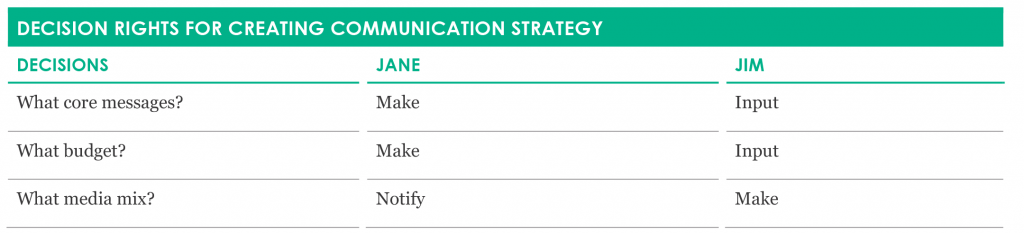
First and foremost, you and your colleague must be on exactly the same page with respect to what the key decisions are that are made in the course of your work, and then you need to have an open and frank discussion around who has the right to ‘make’ the decision vs. who has an ‘input’ right (I.e. They need to be consulted, but ultimately the decision is not theirs to make), or even just a ‘notify’ right (I.e. They must be notified once the decision has been made).
A lot of the issues in shared roles come when people believe they have a make right, but actually they just have an input right, or vice versa. Agreeing on this up front can diffuse a lot of potential tension.
It is very tempting to establish ‘joint make’ rights for key decisions—i.e. we both need to agree to make the decision. In my experience, ‘joint make’ rights cause some significant issues in the real world, and often lead to paralysis. Even though it can be very painful up front, it is better to align on one person who ultimately has the responsibility for making each decision. These ‘make’ rights would ideally be aligned with the unique knowledge, skills, etc. that you bring to the table. Sometimes this may not be possible, but try to use a “joint make” very sparingly.
One way to think about making this real is in going through the core job responsibilities you’ve outlined in your job description and really honing in on what the choices implied in each. For example, let’s say one element of your job is to “oversee the creation and implementation of a comprehensive communication strategy”. Within this task you might have 3 key decisions: 1) what core messages are we highlighting to which audiences, 2) what budget are we allocating for communications, 3) what media mix are we going to use. What you want to do is isolate the decisions that are likely to be hotly contested, and make sure you have clearly laid out decision rights with your partner. For example:
Once decision rights are clarified, accountability is easy: you are accountable to your supervisor for the decisions over which you have a ‘make’ right, and your accountability as colleagues is that you will effectively provide for, and really listen to, input across all decisions where you have agreed that the other person has input rights. Allocating decision rights is an exercise in power. Prepare for the discussion with your colleague to be a challenging one. If you push through it, however, you will have a solid foundation upon which to build a productive, collaborative relationship.

 Olympian Karyn Garossino, BA, M. Ed., brings a combination of insight and grit from 40+ years of being coached and coaching others. Her experience at the highest levels of elite sport, Master’s Degree in psychology and adult education, and experience working with thousands of leaders in business and government bring huge depth to her understanding what it takes to thrive under pressure—and to lead others to do the same.
 Just minutes from Union Station on Toronto’s waterfront, OCAD U CO is a state-of-the-art 14,000 square foot studio designed specifically for collaborative innovation work. The space features is home to 20 resident design-led startups, a suite of formal and informal meeting spaces, and is the setting for our program, How To Lead Innovation, which we run in partnership with OCAD U CO and the Smith School of Business at Queen’s University.