Coaching is, at its core, a deeply human endeavor. It’s a skill that requires empathy, curiosity, and an ability to connect with others on a personal level. Effective coaching demands patience, insight, and adaptability, making it a uniquely human process. Yet, as artificial intelligence (AI) tools like Copilot and ChatGPT become increasingly advanced and widely used, the potential to integrate AI into the coaching process is becoming more apparent. Rather than viewing AI as a replacement for human coaches, we see it as a complement—a tool to augment the learning experience and extend the reach of coaching.
Our approach, inspired by our company’s founder Dr. Peter Jensen, is rooted in the idea of AI as “the coach’s coach.” Instead of attempting to replicate the nuanced human interactions of coaching, we’re leveraging AI to sustain learning and assist leaders as they progress toward coaching mastery. AI becomes a tool that helps leaders get comfortable with coaching and sharpens their skills, rather than replacing the critical role of a human coach.
Drawing inspiration from “The Coach’s Coach”
Dr. Peter Jensen has been known for decades as “the coach’s coach.” Over 35 years, his focus has been on empowering coaches rather than stepping into their shoes. He works to help them improve their craft and support their teams more effectively, offering guidance, insights, and tools to help them reach their potential. His role isn’t to be the head coach, but instead to act as a mentor and resource for those who are.
This philosophy guided us as we considered the potential of AI in leadership and coaching development. What if every leader had access to an AI-powered coach in their pocket—one they could turn to for advice, guidance, and practice whenever they needed it? This vision drives our integration of AI as a tool that complements and supports, rather than competes with, human coaches.
Understanding AI’s role in the learning curve
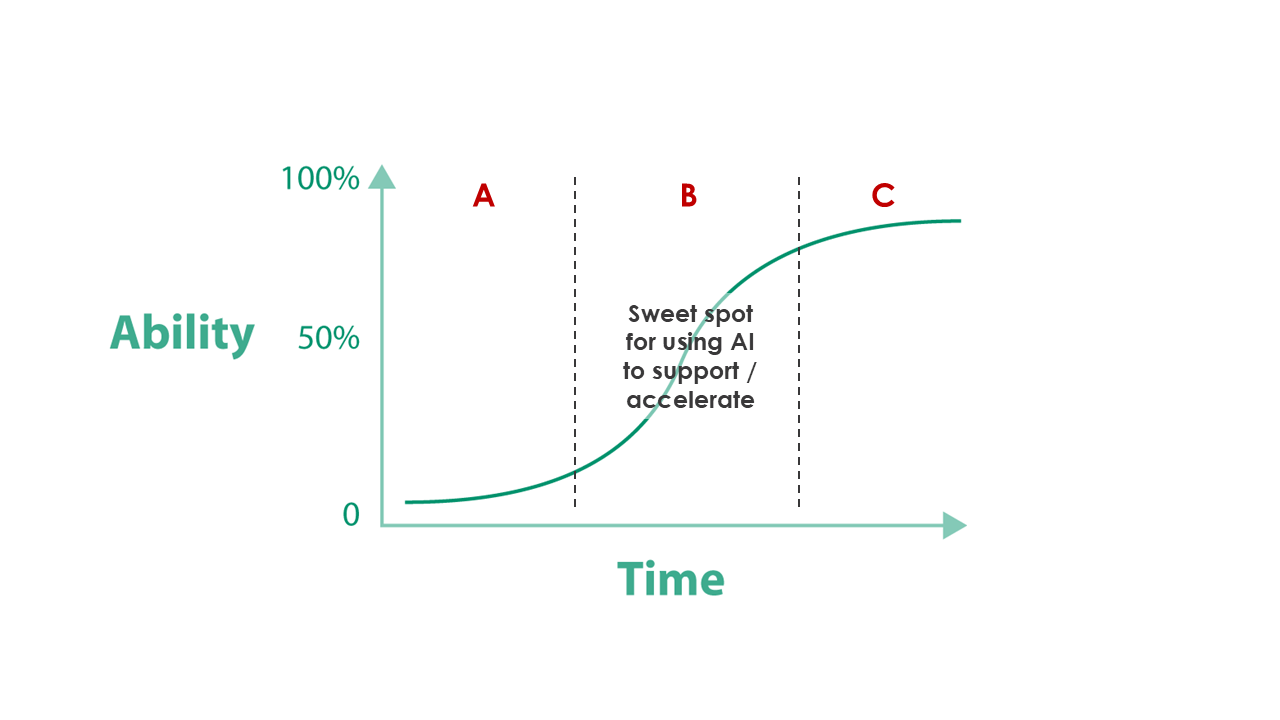
The learning curve is a familiar concept in skill development. It illustrates how people acquire new skills over time, beginning with an initial uncomfortable phase of struggle and slow gains, progressing through steady improvement, and then hitting the final grueling ascent to achieve true mastery. AI’s role is most valuable in the intermediate stages, where learners have built a foundation and consistent practice and support can help them to make big leaps up the curve.
High touch to learn
At the beginning of the learning curve, learners are stepping into unfamiliar territory, and progress can be slow and frustrating. At this stage, motivation, encouragement, and a safe environment to make mistakes are critical. This is where the presence of a human coach is indispensable. Human interaction provides the emotional support and expert guidance that learners need to build confidence and take those first steps.
“The goal of this high-touch phase is to equip learners with a solid foundation and prepare them to apply their new skills independently.”
For example, in our 3×4 Coaching program, leaders regularly report discomfort with delivering corrective feedback and therefore delay or outright avoid it. In the classroom, we are able to set them up in pods with their peers and, through a triad exercise, show that giving “negative” feedback can be a positive, developmental experience. With the encouragement (and accountability) of their peers, participants take the first steps up the learning curve and start to build confidence.
This is not much different than learning to ride a bicycle. Initially, the learner needs someone to hold the bike steady, provide feedback, and offer reassurance. This hands-on support is essential for achieving balance and overcoming the fear of falling. Similarly, in leadership development, learners benefit greatly from in-person workshops or coaching sessions where they can practice new skills, ask questions, and receive real-time feedback. The goal of this high-touch phase is to equip learners with a solid foundation and prepare them to apply their new skills independently.
High tech to transfer
As learners move past the initial hurdles, they enter the middle phase of the learning curve. This is the growth phase, where they’ve gained a basic understanding but need consistent practice to refine their skills and build confidence. At this stage, AI can play a crucial role in supporting learners’ development.
AI tools excel at providing scalable, consistent support during this phase. They can simulate real-world scenarios, offer constructive feedback, and serve as a resource for learners to practice and refine their skills. Our pilot programs have confirmed the value of this approach. Leaders who have used our AI tools report that these tools help them apply what they’ve learned in their training programs. For example, our AI tools have been instrumental in helping leaders simulate coaching conversations, deliver feedback effectively, and prepare for performance reviews. By practicing in a non-judgemental, low-stakes environment, they gain confidence and improve their skills before applying them in real-world situations.
AI as sustainment
AI is particularly effective at supporting sustainment. To understand this, it’s helpful to distinguish between two types of motivation in the learning process: the motivation to learn and the motivation to transfer.
“People are motivated to learn when they encounter new ideas, engaging experiences, or compelling stories.”
The motivation to learn is rooted in intellectual curiosity. People are motivated to learn when they encounter new ideas, engaging experiences, or compelling stories. This type of motivation often requires a human touch—someone who can inspire and captivate learners, sparking their interest in the subject matter. These are areas where human coaches excel. They can create dynamic, interactive learning experiences that draw learners in and motivate them to engage with new concepts.
The motivation to transfer, on the other hand, is about applying what has been learned in a real-world context. This requires an environment where learners feel supported and confident in their ability to succeed. Motivation to transfer comes from having access to resources, someone to turn to for advice, and a sense of accountability. These are areas where AI shines. By providing tools and guidance for application, AI helps learners bridge the gap between theory and practice.
AI can simulate coaching conversations, offer tailored feedback, and provide reminders to keep learners accountable to their goals. It creates an environment where learners can experiment, refine their skills, and build confidence in their abilities—all while supporting their long-term growth.
The future of coaching
The integration of AI into coaching enhances rather than replaces the role of human coaches. While human coaches inspire curiosity, build foundational skills, and connect on a personal level, AI excels at providing scalable, consistent support during the critical growth phase of skill development. This complementary relationship allows learners to benefit from both personalized guidance and accessible tools for practice and refinement.
By blending the strengths of human connection and technological capability, we create a sustainable, accessible coaching model. Human coaches can focus on motivation and expertise, while AI supports learners in applying and mastering new skills. This balanced approach ensures coaching remains effective and widely available, fostering a culture where both learners and coaches thrive in an evolving landscape. What could you achieve if every leader in your organization had a coach in their pocket – one they could access at any time to craft the perfect piece of feedback, prepare for a difficult coaching conversation, or get personalized advice for coaching their team?
“PJ” is our AI coaching companion that helps leaders apply their coaching skills by offering customized support whenever needed. Developed in partnership with The Modern Office Company, this intuitive and friendly chat bot is the latest advancement in sustainment for our flagship 3×4 Coaching program.
What is PJ?
We’re calling PJ The Coach’s Coach. It’s a tool designed to help leaders work through coaching challenges and get advice on applying the 3×4 Coaching model, our framework of 3 plays and 4 skills that exceptional coaches use to deliver results and build commitment.
At its heart, PJ is an AI chat bot developed by Third Factor and The Modern Office Company. With a license, you can ask PJ questions and discuss just about anything related to coaching. PJ has been trained in the 3×4 Coaching model and can help you use questions, listening, feedback and confronting to build clarity, improve competence or give recognition.
What really excites us is that PJ is a true coach. Unlike other chat bots that jump straight into giving advice, PJ first listens to understand and asks clarifying questions to get to the heart of every issue. A conversation with PJ flows like a conversation with a real coach – acknowledging the very real challenges of leadership, building clarity about what’s really going on, and generating practical strategies for applying the coaching skills.
What can PJ help with?
PJ is designed to help with just about any coaching challenge. Whether you need help building clarity around an issue, delivering difficult feedback, or finding the right way to recognize a team member’s efforts, PJ is there to help.
Here is a list of sample prompts you might give PJ across a variety of categories:
Work through challenges
My direct report seems unmotivated and I’m not sure why
I’m struggling to build a relationship with a new team member
I’m not sure how to best coach someone with more experience than me
Prepare for a Conversation
Help me prepare for a challenging conversation with my direct report
I need to have a team discussion to clarify performance expectations
How should I deliver feedback on something that I didn’t directly observe?
Enhance skills
Give me a scenario to practice using the BID feedback model
What are strategies for improving my active listening?
How can I get more comfortable with having tough conversations?
Generate ideas
What are some simple but personalized recognition ideas for my team?
What are approaches to identify my team’s strengths and weaknesses?
I’d like ideas for quickly building relationships with new team members
Coach in different contexts
How do I coach someone from a different generation than me?
What are strategies for coaching someone who doesn’t report to me?
How do I adjust my coaching for in-person vs. remote team members?
Deepen coaching knowledge
Can you explain the concept of ‘developmental bias’ in more detail?
Does the BID model work for both reinforcing and corrective feedback?
What does it mean to use emotion as a fuel for change?
See PJ in action
PJ is trained to coach you through problems rather than just giving answers. After you explain what you need, PJ will ask clarifying questions to understand the nature of the coaching challenge. It will then help you discover how to apply the coaching plays and skills to address the issue and help you create a detailed action plan.
Here’s a real conversation with PJ about a team member’s punctuality to give you an idea of just what PJ can do.
How do I get access to PJ?
PJ is currently in a closed Beta and not available to the general public. If you want to try PJ and give us feedback on how to improve, send us an email explaining your coaching challenge and why you think PJ could help.
In the midst of rapid expansion and a shift to a remote-first environment, retail consulting and technology company, Orium, partnered with Third Factor to give its leaders a framework and skills to lead with its values.
Twenty-four of Orium’s leaders participated in a total of three days of training, leading to an uplift in engagement among leaders and their teams, and enabling the organization to navigate the pressure that comes with doubling in size.
Click here to read the case study.
New manager development programs are often a surprising “problem child” in the Learning & Development portfolio.
The recent Association for Talent Development (ATD) report sponsored by Third Factor, “New Manager Development: Building a Foundation for the Future,” highlights a critical gap: while 70% of organizations have new manager development programs, most fail to realize their full potential with 77% reporting only moderate success or worse.
Successful
Unsuccessful
No program
Helping new managers transition from individual contributor to people leadership roles is vitally important for the performance of not only those managers but everyone that reports to them as well. But with the large population of managers in most organizations, Learning & Development (L&D) is often tasked to execute these programs at scale and on a shoestring budget. Add in the time pressures on new managers, and it can feel near impossible to deliver impactful leadership development programs for this audience.
We know how challenging this mandate can be, so we’ve collected some practical strategies from leading organizations that we partner with to help get the value out of your investment in new manager development.
Leadership at the Helm: Building Top-Down Support
The ATD report underscores the importance of senior leadership in new manager development. Most of the organizations surveyed indicated that a lack of either resources, senior leadership support, and/or prioritization were challenges to training new managers. So how do you build that critical support at the top of the house?
01.
Pick your moment and leverage business needs to advance new manager training.
02.
Enlist your partners to sell your vision for new manager training internally.
03.
Get senior leaders directly involved in training to underscore its importance.
First, pick your moment. When organizations make significant investments in new manager development, it typically comes at a time when there is a clear business need – for example, a new strategy, a culture transformation, declining engagement scores, or high turnover. Use these windows of opportunity to demonstrate how Learning & Development can help turn conceptual business plans into real action by driving the right behaviors in managers.
Second, enlist your partners. You need every tool in your arsenal to build the strongest business case to senior leaders for investing in new manager development. Involve HR or internal business partners as well as your third-party vendors to help demonstrate to senior leaders the value and expected outcomes of these programs. Hearing directly from your leadership team about a strategic transformation they are driving from transactional to advisory services, for example, will enable your vendors to design programs that directly support those needs.
Finally, start small and get senior leaders directly involved. One L&D team that we work with is driving a multi-year rollout of a two-day in-person program to help managers build coaching skills – a significant investment of time and resources. But it all started with just one session focused on the C-Suite team. Through that firsthand experience, the CEO and his team became passionate champions of the program. They not only committed to funding a broad program rollout, but the CEO now speaks directly to every cohort of managers that goes through the program. His involvement sends a strong message about his commitment to manager development and also reinforces the connections between the content and their business priorities.
Balancing Learning Formats
Training a large population of new managers can be costly. For many organizations, it’s just not feasible to offer in-person experiential learning programs to all new managers.
In fact, the ATD report notes that asynchronous learning channels are the most common offering made available to new managers. We often hear from L&D leaders about the benefits of asynchronous learning for creating custom learning pathways and offering flexible programs that work around the busy schedules of new managers. Yet there is always a desire to incorporate some of the benefits of live, in-person learning experiences as well.
Increasingly, organizations are looking at blended learning formats to provide the scale and cost effectiveness of asynchronous learning but with some of the human connection and energy of live or in-person programs.
A financial services company that we partner with offers an asynchronous program that enables managers to learn coaching skills through a series of self-paced videos. But to enhance the experience through peer support and live discussions, managers are placed into learning cohorts that proceed through the program as a community. A live virtual kickoff provides context about the program, introduces managers to others in their cohort and builds energy around the learning journey they are about to start on. Midway through the program, cohorts reconvene for a live application lab to work through any questions and challenges as they start applying the skills in their work environment. And upon completion of the program, managers have access to 1:1 coaching and a library of resources to support ongoing skill development and application.
“The most successful new manager development programs that we see always place a strong focus on practical application.”
Whether asynchronous, in-person, or a blended format, the most successful new manager development programs that we see always place a strong focus on practical application. New managers are often completely underwater balancing their priorities of delivering results while also developing their people.
In fact, time constraints on new managers were the most common challenge cited in ATD’s report. Most new managers simply don’t have the time, energy, or interest to dive deep into theories on motivation and performance. Instead, they need a few practical tools that they can implement immediately, opportunities to practice new skills, and strategies to focus on actions that will have the greatest impact so that they see immediate results and build confidence.
Measuring What Matters: The Art of Success Metrics
You’ve heard it a million times – “how are we measuring the impact of this program?” When it comes to reallocating investment or cutting costs, new manager development programs are an easy target if they can’t demonstrate impact. Effective metrics not only demonstrate program effectiveness but also ensure the program remains relevant, impactful, and aligned with evolving business priorities.
ATD’s report highlights a similar issue: 87% of respondents cite a lack of metrics to track the program’s results as a challenge to new manager training. While most organizations do assess program effectiveness, many focus on participant satisfaction and use informal conversations rather than quantitative or outcomes-based measures. So how can you incorporate impactful metrics without creating an overly complex science project?
Most important is systematizing and quantifying participant feedback with a short, standard feedback form for every participant to complete. In our experience, taking a few minutes to do this at the end of sessions before participants return to their other work is the best way to drive response rates and specific feedback. In addition to participant satisfaction, include one or two questions tied to target outcomes – for example, participants’ confidence in their ability to apply the skills in their daily work.
With a basic feedback system in place, start looking at longer-term metrics and impacts. A large energy organization that we work with administers a final survey approximately three months after leadership development programs on how participants are applying their learnings and the resulting business impact of those actions. These concrete examples offer powerful impact stories that are highlighted to the company’s most senior leaders.
Another financial services organization surveyed the direct reports of program participants and found that more than 85% noticed an improvement in their leaders after completing the manager development program – a metric that helped build ongoing support and expansion of the program.
Transforming Insights into Impact
As the ATD report highlights, new manager development programs are a critical aspect of the L&D portfolio and yet there are very real challenges to making them effective and impactful. These strategies offer a blueprint to help ensure the investment in these programs delivers real value for the business and for your people.
Seizing the Opportunity in Wealth Management
Wealth management is undergoing an epochal change with an $84.4-trillion wealth transfer at stake. The hearts, minds and wallets of the next generation will go to firms that can:
Level up field coaching and enable advisors to have new and more uncomfortable conversations
Up-skill advisors to manage bigger teams with a diverse range of experience
Become exceptional matchmakers using psychometric data to create winning advisory teams
In this webinar, Third Factor CEO, Dane Jensen, will outline how to make the move from investment advice to "Personal CFO" using examples from our work with some of North America's leading wealth management firms and based on the whitepaper he co-authored with Third Factor Principal Trainer, Garry Watanabe..
You should attend if:
You're responsible for leadership development or change management within a wealth management organization
You need new ideas for up-skilling advisors to engage in new conversations and navigate the changing industry landscape
You're looking for innovative solutions to enhance the succession planning process
You want to learn more about how top wealth management firms are navigating the fundamental shift in client preferences
Seizing the Opportunity in Wealth Management
Sorry we missed you
This event has passed, but it won't be the last. Be the first to know about future webinars from Third Factor by entering your information below.
About the presenter:Dane Jensen is the CEO of Third Factor, the author of The Power of Pressure: Why Pressure Isn't The Problem, It's The Solution, an acclaimed speaker, an instructor at Queen's University and the University of North Carolina, and a regular contributor to Harvard Business Review.
At a glance:
Roughly one quarter of organizations say their new manager training programs are extremely or highly successful, but an equal number report their programs as only slightly successful or not successful at all.
Key reasons for investing in training for new managers include better individual performance (85%), continuity of organizational culture and values (69%), and better team performance (62%).
Top focus areas for new manager training include communication skills (93%), providing feedback (92%), and performance management (91%).
91% say their new managers just don’t have enough time to invest in development programs.
Third Factor has partnered with the Association for Talent Development (ATD) on exciting new research that reveals how organizations approach training for new managers. The report draws on a sample of 287 organizations seeks to understand why organizations do or don’t invest in training for new managers, how new manager training is approached, and the common trends in the most successful new manager development programs.
In today’s rapidly evolving business landscape, the importance of new manager training is highlighted by a notable statistic: 70% of organizations have a development program for new managers, and among those without, 54% plan to introduce one within the next two years. This trend underscores a growing recognition of the crucial role new managers play in organizational success. However, transitioning from an individual contributor to a managerial role is a journey filled with challenges. Managers must not only manage tasks but also lead people, a shift that requires a fundamentally different skill set and mindset.
Successful new manager training programs can be hard to come by
While about a quarter of organizations consider their programs extremely or highly successful, another quarter view them as only slightly or not at all successful. This suggests a broad spectrum in the effectiveness of such programs across different organizations, highlighting the need for tailored approaches and continuous improvement in managerial training practices. It underscores the importance of not just having a training program in place, but also ensuring its relevance, effectiveness, and alignment with organizational goals.
The good news is that the report shows 78% of organizations actively measure the success of these programs. The most common method used is assessing participant satisfaction. However, high-performing organizations often go further by evaluating long-term impacts such as the retention rate of managers and their contribution to organizational performance. This approach underscores the importance of not only implementing development programs but also rigorously assessing their outcomes to ensure they meet organizational goals and contribute to long-term success.
Performance and culture are the most desired outcomes
When developing training programs for new managers, organizations are unsurprisingly focused on performance – but the question of whose performance is most important raised our eyebrows.
While 85% of organizations want their new manager development programs to enhance individual performance, only 62% include team performance in their goals. While enhancing a manager’s skills is essential, it’s crucial to recognize that a manager’s success is inherently tied to their team’s performance. Focusing solely on individual managerial skills without equally emphasizing team leadership and development can create a disconnect. This approach may lead to managers who excel individually but struggle to foster a high-performing team, ultimately impacting the broader organizational effectiveness.
Fortunately, continuity of organizational culture and values is also a top outcome for new manager development. Some 69% of organizations rely on new manager development programs to ensure that leadership is aligned with the core principles of the organization. This alignment helps in maintaining a consistent organizational ethos, which is essential for long-term success and identity.
The most important skill for new managers? Communication.
The skill new manager training programs focus on above all others is communication, with 93% of organizations prioritizing this in their development programs.
In our 3×4 Coaching program, we teach that coaches use four key communication skills to develop their people: questioning, active listening, feedback, and confronting. Feedback also made the list of skills, with 92% of new manager development programs dedicating time to giving people information about their performance.
While performance management (91%) is another top focus area, the communication skill of confronting didn’t make the list. Questioning, listening and feedback are useful and necessary skills, but aren’t always the best tools when a valued performer needs to make a non-optional change to their behaviour.
Teaching new managers skills for managing challenging conversations is a worthwhile investment. Giving younger leaders the opportunity to learn and practice the skill means they will be better prepared to confront problem behaviors when they reach a more senior position. By thinking of communication skills for new managers as an investment in the future, organizations can strengthen their entire leadership pipeline.
Finding time is a top challenge in training new managers
The primary challenge in this developmental journey, as reported by 91% of organizations, is the lack of time for new managers to participate in training programs. It’s no secret that new managers are expected to hit the ground running, often having been selected for their aptitude for the role and prior success in a non-leadership role.
The rub is that the bias toward execution, rather than leadership, is actually counterproductive. While managers at this level need to be adept at leading their people while being responsible for their own work product, putting emphasis on the former in the earliest days could set them up for a career-long belief that their individual productivity is more important than that of their team. This misprioritization can also lead to a situation where managers are underprepared for their roles. Moreover, the pressure of managing operational tasks while also trying to develop people management skills can lead to burnout and decreased effectiveness.
Just as new managers need to skillfully coach their people in the flow of getting things done, their own leadership training needs to happen in the flow of work. Training programs need to be flexible and easily integrated into the daily workflow of new managers. This might involve bite-sized learning modules, on-the-job training, and leveraging technology for accessible and engaging learning experiences. Additionally, creating a culture of continuous learning and providing ongoing support and resources can help new managers adapt to their roles more effectively and efficiently.
Equipping new managers for success
The research from Third Factor and the Association for Talent Development presents a valuable opportunity for improvement in new manager training. This study offers a roadmap for organizations to refine their leadership development strategies, emphasizing the integration of training into daily work, a comprehensive focus on communication skills, and prioritizing team success alongside individual performance. By embracing these insights, organizations can significantly enhance their outcomes, nurturing leaders who are well-equipped to meet the challenges of the modern business world.
You can download the full report from the ATD website.
Hybrid work can be a great model for people who are established in their careers, but it presents unique challenges for those just starting out. Early career employees don’t have the same opportunities to observe the workplace culture and leaders often struggle to provide frequent, specific feedback when not working in the same physical space.
So how will we lead this generation just entering the workforce, for whom “hybrid work” is not even a relevant term because it is the only style of work they know? Effective coaching needs to be part of the DNA of how we lead people now. In practical terms, it involves making the culture visible, creating opportunities to observe performance, and establishing systems to bridge the gap between in-person and remote work in a way that builds trusting relationships.
Make the culture visible
George Bernard Shaw famously noted “the single biggest problem in communication is the illusion that it has occurred.” Early in our careers, workplace culture and the nuances of professional life were communicated to us mostly by simply being in the office. We saw how people interacted outside of meetings and we overheard the words they used with their leaders. Through observation we formed images in our minds that we could then emulate.
It is easy to expect that employees entering the workforce today will similarly absorb these indirect messages. But with fewer opportunities to observe how things work, early career employees are left to make many assumptions about how to successfully navigate a new organization. Compound this with the tremendous ambiguity that remains around so many aspects of hybrid work, and you are likely to run into issues.
One of the greatest coaches we worked with, Jack Donohue, spoke of the need to build sharp clarity before we can offer effective feedback. People cannot do things that they cannot imagine. We need to break down vague concepts such as “flexible work,” “professionalism,” and “remote collaboration” into specific behaviours that people can see in their mind. Perhaps on your team “flexible work” really means that all team members are online and available between the hours of 10am and 3pm, their MS Teams status is always kept up to date, and the entire team is together in the office between 9am and 5pm on Wednesdays. Drilling down to this level of specificity is necessary to build the clarity that will enable early career employees to succeed.
Create opportunities to observe performance
When I was on my first project as a new management consultant, I was tasked with completing the analysis of a large data set. It was a steep learning curve, but I was eager to prove myself. I would continually tell my manager that everything was going well when I was actually working late nights scouring the internet to troubleshoot Excel errors.
My manager eventually called a time-out when she glanced over my shoulder and found me manually moving data around a spreadsheet. While she commended my eagerness to learn, she also pointed out the people sitting beside me who could teach me a much faster approach. “Might it be better to ask one of them for help and then you will know how to do it too?” she asked. A wild idea, I know.
In a hybrid world, we must intentionally create opportunities to observe performance.
It is never easy to teach early career employees everything they need to know in their first job. But it is even more complicated when we do not have opportunities to glance over their shoulder and directly observe their work. In a hybrid world, we must intentionally create these opportunities to observe performance. Working alongside new employees on early projects and joining them in as many meetings as possible is critical to see them in action and identify behaviours to reinforce or adjust.
A leader in one of our coaching workshops liked to regularly use screen sharing capabilities. This allowed her to see the steps that her team member was following and quickly identify process steps that she wanted to either reinforce or adjust. By sharing her own screen, she normalized the practice so that her team was comfortable with the approach. It also made her own work more visible and surfaced process steps that had become so automatic for her that she wouldn’t have otherwise thought to teach them.
When it is not possible to see the person in action, questions are a valuable tool to gain insight into their thinking. One leader we worked with likes to use questions such as “how would you approach this task” or “can you walk me through your thinking” so that he can offer adjustments or additional information before getting started on the task. During regular check-ins, questions such as “what are you most proud of this week” or “what would you like some feedback on” can provide jumping off points to understand how the person is working. The key is to continue asking questions and actively listening until you get below the surface-level responses and uncover specific behaviours to reinforce or adjust through feedback.
Build systems to bridge the gaps
Our Principal Trainer, Garry Watanabe, says issues with early career employees also often arise because they do not yet have mental maps for how things get done in the organization. In the office, getting quick answers is as easy as asking someone who does not look too busy. But when everyone is remote, it is impossible to see who might be warm for an interruption.
Garry suggests pairing early career employees with a peer-level buddy or more experienced mentor who they can go to for help. Providing a dedicated resource empowers them to find the answers they need and removes some of the barriers to seeking help. It also offers a safe way to ask for quick feedback and build confidence, all while freeing up your time together for more meaningful interactions.
Connecting early career employees with other team members in this way provides the added benefit of building relationships across the team, which is the ultimate system for bridging the gaps between in-person and remote work.
Start your people on a path to success
There is no doubt that leading early career employees in a hybrid world introduces new complexities and challenges. But by making the informal aspects of work more explicit, creating opportunities to observe performance, and building systems to bridge the gap, leading in this environment can be just as effective and fulfilling for both leaders and employees.
Imagination, belief and energy are precious resources that need to be carefully nurtured when high performance is the goal. At the same time, saddling someone with an unattainable target because you don’t want to dampen their enthusiasm risks a catastrophic failure that can destroy self-confidence and trust in the coach.
An ambitious but naïve performer setting an unrealistic goal for themselves is commonplace: a direct report applies for a role where they are unlikely to be the successful candidate; an individual you coach sets a performance target for themselves based on their best year ever when headwinds are coming on strong; or your team is running a pilot project that’s very unlikely to get the green light to proceed.
How can you communicate belief in the performer, while at the same time protecting them from experiencing what could be a devastating setback?
A moment of insight
One such moment for me happened over 20 years ago when I was working as a swimming coach in Thousand Oaks, California. I was coaching an adult swimming group – or as we called them, “Masters Swimmers” – to prepare them for the first competition of the summer.
Masters swimming competitions are interesting events: the beer tent opening is as big a deal as the performances in the pool. But, make no mistake, the performances matter to the athletes.
“I immediately realized I had made a mistake”
I was doing some goal-setting work with an athlete who had recently taken up the sport and asked her what she thought would be a good goal time for her 100-meter freestyle. Her answer was completely unrealistic, so I suggested a much more attainable goal. The smile vanished from her face, her shoulders slumped, and I immediately realized I had made a mistake.
In my well-intentioned effort to save this performer from disappointment, I had limited what she could imagine for herself, communicated a lack of belief in her capabilities and cut off a key source of energy.
Don’t fear negative emotion
In that moment, my gut reaction was to spare this person from setting herself up for failure. What I’ve learned is exceptional coaches know that negative emotion is an inherent part of the journey of growth and development. Progress isn’t linear.
When people are testing their limits and doing things that they’ve never done before they will experience setbacks from time to time. And when those setbacks occur, they will experience negative emotions such as frustration or disappointment. But people can survive frustration and disappointment.
On the other hand, if you encourage them to set safe goals that you know they will achieve, you limit the powerful “pull forward” that comes with imagining what might be possible.
Frame a range of outcomes
While negative emotion is a powerful tool, the coach still needs to prevent a devastating failure. Where I suggested a new goal in place of the one my swimmer had set, I could have included it in a range of possible outcomes that framed a realistic performance as a level of success.
In practice, this looks like a series of goals that includes the most ideal outcome and also a few other outcomes that are more realistic and attainable.
Goal “A” might represent a nearly perfect result where they execute flawlessly and all the breaks fall their way.
Goal “B” might represent a good result where they execute relatively well, but not perfectly, and 50% of the breaks fall their way.
And finally, Goal “C” might represent a result they can live with where they make a few execution mistakes and experience some bad luck in the process.
Framing targets in this manner helps performers to dream about what might be possible while at the same time preparing them for when the ideal outcome does not occur. This approach is also a useful way to help a perfectionist objectively assess their performances.
“Perfectionists often evaluate any imperfect performance as failure”
Perfectionists often evaluate any imperfect performance as failure. By working with the performer to set a range of target outcomes in advance, the coach is then in a position to help them evaluate their performance against objective criteria.
This often results in the perfectionist being forced to admit that their “failure” was in fact a “good performance” or at worst “one they can live with.”
Blend empathy and accountability
If the performer doesn’t achieve their ideal outcome, help them harness the negative emotion and use it to fuel growth rather than rushing in to try to make them feel better.
Do this by first allowing them to sit with the emotion of the moment. Be there to help them process the experience by providing a listening ear. And then, when the performer seems ready, ask them for their thoughts on how to move forward. And then work with them to create a plan to increase the likelihood of an improved result next time.
Re-writing history
If I could go back in time and revisit that moment on the pool deck when that athlete suggested an unrealistic goal, what would I do?
I would have accepted that negative emotion is a natural part of the growth process. And rather than trying to shield them from the possibility of failure, I would have allowed them to dream about what might be possible.
I would have helped them set a range of goals. And if they failed to achieve their ideal outcome, I would have helped them process the disappointment and then channel that energy into the process of getting better.
Of course it was that moment of less than stellar coaching, and the resulting disappointment I felt with myself, that ultimately helped me find a better way forward.

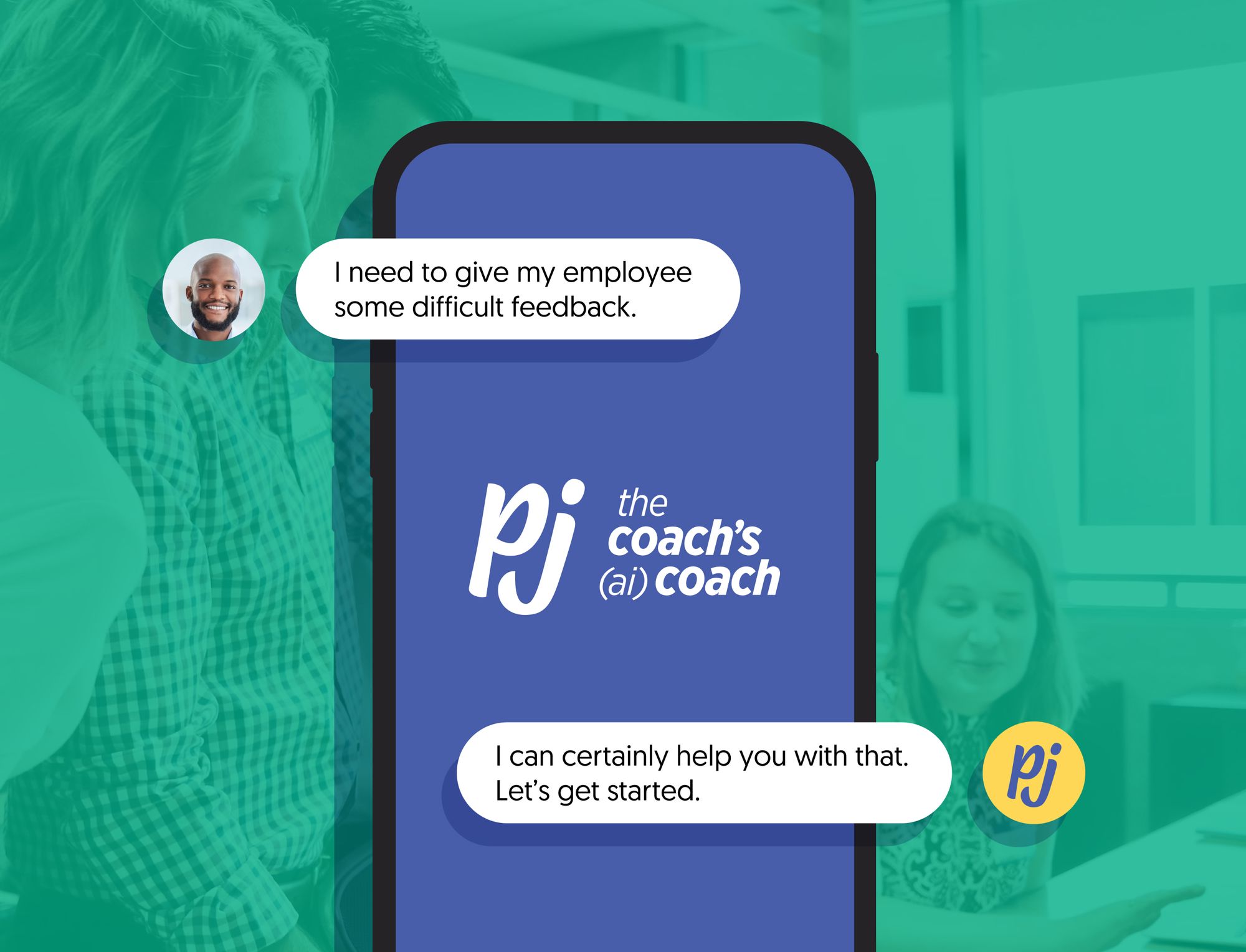 At its heart, PJ is an AI chat bot developed by Third Factor and The Modern Office Company. With a license, you can ask PJ questions and discuss just about anything related to coaching. PJ has been trained in the 3×4 Coaching model and can help you use questions, listening, feedback and confronting to build clarity, improve competence or give recognition.
What really excites us is that PJ is a true coach. Unlike other chat bots that jump straight into giving advice, PJ first listens to understand and asks clarifying questions to get to the heart of every issue. A conversation with PJ flows like a conversation with a real coach – acknowledging the very real challenges of leadership, building clarity about what’s really going on, and generating practical strategies for applying the coaching skills.
At its heart, PJ is an AI chat bot developed by Third Factor and The Modern Office Company. With a license, you can ask PJ questions and discuss just about anything related to coaching. PJ has been trained in the 3×4 Coaching model and can help you use questions, listening, feedback and confronting to build clarity, improve competence or give recognition.
What really excites us is that PJ is a true coach. Unlike other chat bots that jump straight into giving advice, PJ first listens to understand and asks clarifying questions to get to the heart of every issue. A conversation with PJ flows like a conversation with a real coach – acknowledging the very real challenges of leadership, building clarity about what’s really going on, and generating practical strategies for applying the coaching skills.
 About the presenter:
Dane Jensen is the CEO of Third Factor, the author of The Power of Pressure: Why Pressure Isn't The Problem, It's The Solution, an acclaimed speaker, an instructor at Queen's University and the University of North Carolina, and a regular contributor to Harvard Business Review.
About the presenter:
Dane Jensen is the CEO of Third Factor, the author of The Power of Pressure: Why Pressure Isn't The Problem, It's The Solution, an acclaimed speaker, an instructor at Queen's University and the University of North Carolina, and a regular contributor to Harvard Business Review.