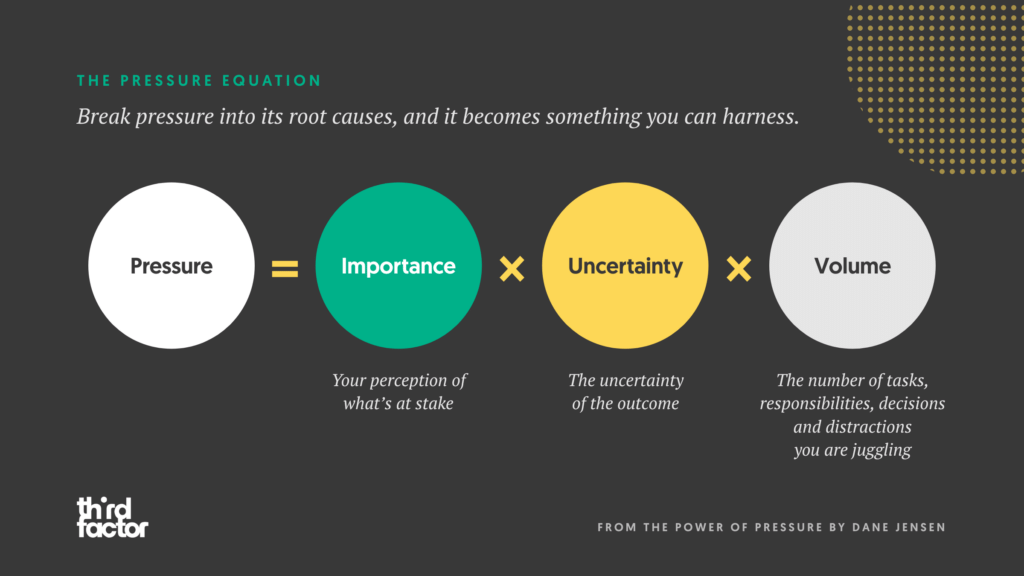
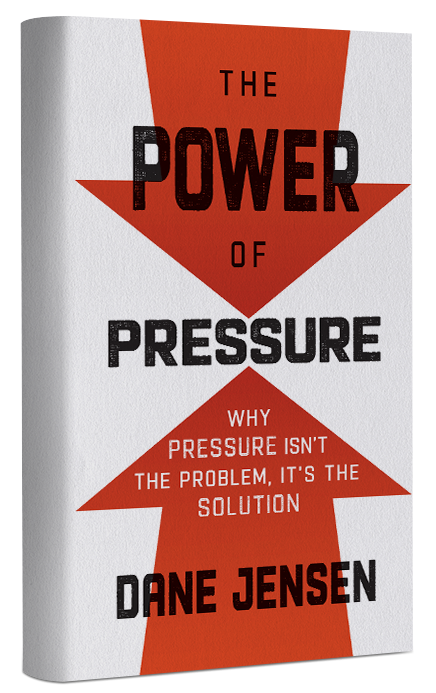
Many of us are taught that pressure is a bad thing – and, as a result, we work to avoid it where possible. But five years ago, Third Factor’s CEO Dane Jensen made a different argument. In The Power of Pressure: Why Pressure Isn’t the Problem, It’s the Solution, he contended that the energy under pressure is essential fuel for performing better at work and in life – if harnessed effectively. To research the book, Dane spoke with Navy SEALs, Olympic athletes, executives and parents about their highest-pressure moments. He identified two types of pressure. Peak pressure is a sudden spike, like stepping onstage for a big presentation. Long-haul pressure wears on us for weeks or months. He also introduced the pressure equation: Pressure = Importance × Uncertainty × Volume. Breaking pressure into these three parts makes it easier to anticipate and respond to. To mark the fifth anniversary of The Power of Pressure, Dane shared what nearly 3,800 people have told him about their highest-pressure moments, how his thinking has changed, and what he hopes readers take from the book.

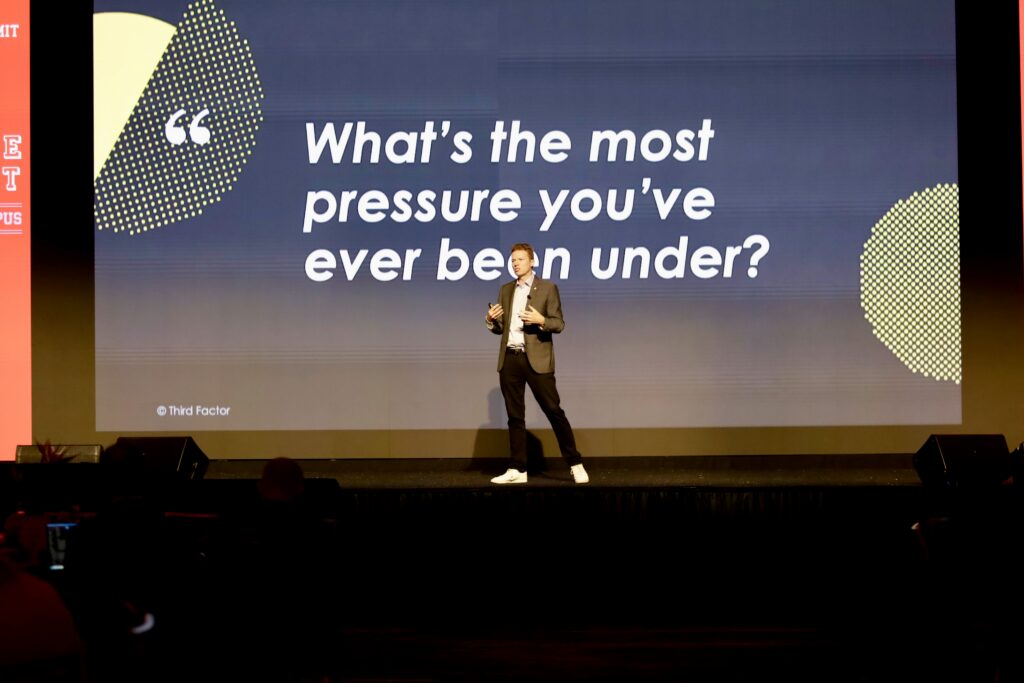
You’ve asked thousands of people the question, “What’s the most pressure you’ve ever been under?” What have they told you?

When I give Power of Pressure keynotes, I often ask people to submit an anonymous, one-sentence description of the most pressure they’ve faced. So far, I’ve collected 3,797 stories. Dane Jensen The Pressure Equation On Stage Keynote The answers represent a vast cross-section of human experience – from cold-sweat moments such as “singing the national anthem in front of 10,000 people and I forgot the words halfway through” to life-and-death situations, like the person who described “performing CPR on my newborn who stopped breathing.” Then there are the tough moments that are part of life – a dying parent, a sick spouse or an excruciating time at work. As part of the five-year anniversary of the book, I’ve been digging a little deeper into the stories I’ve received – and it turns out the most common theme is caring for others. These stories represent 29 per cent of all responses. Many related to either end of life – 9.4 per cent involved a loved one’s illness or death – or responsibilities during the early years of life: 8.4 per cent related to pregnancy, birth or childcare. I see this finding as very reassuring. We live in an era that increasingly glorifies personal achievement. But when we ask people about their highest-pressure moments, they return to the responsibility they feel to ensure others are cared for in their most vulnerable moments.

If you applied the pressure equation to what people are facing now, which variable – importance, uncertainty, or volume – stands out most? And how does that compare to when The Power of Pressure was first published?

The book came out during the heart of COVID and, as a result, the acute uncertainty we were facing was the dominant thing I heard when I spoke with people. Five years later, I hear a lot about volume – the sheer number of priorities, to-dos, decisions, distractions, and inputs people face. The pressure equation: Pressure = Importance × Uncertainty × Volume, from The Power of Pressure by Dane Jensen. Most companies I work with have reduced their headcount over the last three years. That has left the remaining employees with a larger share of the overall workload. At the same time, AI has dramatically raised expectations around the volume of work one person should be able to handle and the speed at which they should get it done. Outside of work, changing expectations have led working parents to spend almost twice as much time managing their kids’ affairs as they did 50 years ago. This dramatic rise in volume cannot be solved by time management alone. After the book came out, I wrote an article for Harvard Business Review called “Time Management Won’t Save You.” In it, I said that better time management can backfire. As we get more efficient at squeezing more into our days, we simply pile on more tasks, decisions and distractions, creating even more pressure and stress. I’ve found myself sharing that article more than any other recently as people grapple with drinking from a firehose 24/7.

What part of your book has resonated most with people?

I somewhat cheekily titled chapter nine “Sleep and Other Inconvenient Necessities.” But in an era when many of us don’t get enough sleep, it’s the chapter people most often come up to me and talk about. In particular, I hear a lot about two sleep tips from the book: The first is to use the clips from a coat hanger to clamp together hotel room drapes so you can have total darkness, no matter how wonky the window coverings may be. I used this one myself recently at a Hilton in Grand Rapids, Michigan. The second is called “the 100 challenge.” If you’re tossing and turning, it’s a great way to quiet your mind and fall asleep. Here’s how I described it in the book: “Start by holding a vivid image in your mind’s eye of a room with a chalkboard or whiteboard at the front – it could be a school classroom, a meeting room at work, or something similar. For some reason, a chalkboard works best for me – but your mileage will vary. “Imagine writing the number 100 in chalk or whiteboard marker on the board. Hold the image of the numbers on the board steady for a second. “Imagine erasing the number with a chalk or whiteboard eraser. Try to really feel the process of erasing it. “Write the number 99 where the 100 was. “Continue the process to 98, 97, 96, etc., … and see how far down you can get.” Sometimes it’s the simple stuff that works.

How has your thinking about pressure changed?

One of the central ideas in the book is that there’s a difference between dealing with “peak pressure” moments and dealing with “long-haul pressure.” Peak pressure is when the pressure suddenly spikes, like when you’re about to speak in front of a large audience. The long haul is different. That’s when you’re under pressure for an extended period, like an important project at work that’s been going on for weeks or months while you navigate your kid’s competitive baseball season.
One of the central ideas in the book is that there’s a difference between dealing with “peak pressure” moments and dealing with “long-haul pressure.”
The skills required for one can be counterproductive for the other. So, the book is organized to contrast the three skills for handling peak pressure with the three skills for dealing with long-haul pressure, to show how different they are. I’ve come to believe that this is a little too binary. Whether pressure arrives in bursts or sits with us over the long haul, the overarching goal is to keep each of the three components of the pressure equation in balance. So while the book emphasizes six discrete skills for dealing with pressure, I increasingly think of it as holding three tensions: What changes between peak pressure and long haul is the relative emphasis on each side of the tension. For example, when it comes to importance, over the long haul it is often more about finding a sense of importance. In peak pressure moments, however, it is less about finding importance and more about keeping what’s at stake in perspective – we engage in “importance inflation” where we mentally build up an exam, a job interview, or a big sales pitch into a moment of existential importance. I’ve found that thinking about it like this is both more accurate and practical. The tensions give me a quick way to diagnose where I’m out of whack and therefore what intervention would be most useful.

What lasting message do you want people to take from your book?

I hope what endures is both an emotional and intellectual shift around pressure. The emotional shift is that, ultimately, the book offers a dose of optimism. Yes, pressure is unavoidable. But rather than a toxin, it can fuel growth, contribution and connection. I wanted to change how people feel about pressure. So instead of seeing it as a threat, they see it as something that challenges and motivates them. The intellectual shift comes from the pressure equation we spoke about earlier – the idea that we can break pressure down to its root causes and, in doing so, manage it better. It’s a different way of thinking about pressure. My goal with this book was to give people a clear path to the kind of direct action that is incredibly helpful when pressure hits.

Key Takeaways:

  • Our highest-pressure moments are usually about other people. Of nearly 3,800 stories Dane has collected, the most common theme is caring for others, at 29 per cent of all responses.
  • Volume has replaced uncertainty as the pressure people feel most. When the book came out during COVID, uncertainty dominated. Today, smaller teams and rising expectations around AI have left people with more priorities, decisions and inputs than ever.
  • Time management alone won’t solve a volume problem. Getting more efficient often means piling on more tasks, which creates even more pressure.
  • Sleep is the chapter readers talk about most. Simple fixes, like clipping hotel drapes shut or counting down from 100 on an imagined chalkboard, are often the ones that stick.
  • Managing pressure is about holding three tensions in balance. See your work as important without being overwhelmed by the stakes, act on the uncertainty you can control while accepting what you can’t, and build your capacity for a busy life while cutting volume that isn’t productive.
What’s the most pressure you’ve ever been under? Dane Jensen joins CTV’s Your Morning to discuss what he learned by asking this question and share his advice for how you can use the energy that accompanies pressure to thrive.

Join Third Factor CEO, Dane Jensen, to celebrate the launch of his new book: The Power of Pressure: Why Pressure isn’t the Problem, It’s the Solution.


In this virtual book launch event, Dane Jensen will tell unforgettable stories of pressure, teach practical skills for performing in peak moments and over the long haul, and leave you with renewed energy for tackling the biggest sources of pressure in your life.


Registration is $29.99 and includes participation in the live event on September 1st or 8th, 2021, access to a recording of the session, and a hardcover copy of The Power of Pressure.


You should attend if:
SORRY WE MISSED YOU

This event has passed, but it won’t be the last. Be the first to know about future events from Third Factor by entering your information below.

About the presenter:
Dane Jensen is the CEO of Third Factor, an acclaimed speaker, an instructor at Queen’s University and the University of North Carolina, a regular contributor to Harvard Business Review, and the author of The Power of Pressure (HarperCollins).

As we anxiously await the launch of Dane Jensen’s new book, The Power of Pressure, the Summer Reading List has arrived just in time to give us the distraction we need. This is our favourite summer tradition, in which members of the Third Factor team offer their best picks for your summer. Diverse as always, this list includes novels, nonfiction, a collection of short stories, and even an audiobook about dragons. Whether you want something lighthearted or something to chew on, your next favourite book is in this list. Here are this year’s picks.

Peggy Baumgartner, Chief Learning Officer

Think Again by Adam Grant

One book I am eager to dive into this summer is Adam Grant’s Think Again. For me, learning to stay curious longer and being less certain that I already have the answers will allow me to approach whatever the post-Covid world throws my way. Grant is an amazing storyteller with a great analytical mind so I am sure it will be an amazing read.
A bit of a departure from my previous picks, The Vanquished is a thoroughly researched, thought-provoking, and highly readable look at the period of upheaval, bloodshed, and social re-ordering that followed WWI in the defeated countries. It upended my understanding of the inter-war period and, as one reviewer put it, “makes it easier to understand why order came to be a supremely desirable objective in 1930s Europe, trumping freedom.” If you’re a history buff, this is a book that will give you a ton of new insight without putting you to sleep.

Garry Watanabe, Principal Trainer & Sport Lead

The Wizards of Once by Cressida Cowell

I purchased the audiobook for longer car rides as a way to entertain my kids that did not involve staring into a screen, and I ended up getting drawn into the story along with them. As a parent, I loved the imaginative storytelling and positive messages. As a person, I was thoroughly entertained. An unexpected bonus: the audiobook is brilliantly narrated by Scottish actor David Tennant, who seamlessly switches between over a dozen distinct characters. Just a heads up – this is a 4 volume series but it flies by. We are (sadly) on the fourth and final volume.

Cyndie Flett, Principal Trainer

Lifespan by David A. Sinclair

This is a great opportunity to rethink a lot of what we think we know about our health. Sinclair really challenges many of the traditional notions about health and backs it all with stellar evidence. This is a great summer read – if you don’t mind digging into the science of things! Incredible insights, research simplified, great stories and some very practical advice. I particularly enjoyed the Longevity Now chapter. All told, I’ve made a few key changes since reading this book that has put a bounce back in my step, has me sleeping better, and more energized for the coming pivot back to whatever our new normal is.

Vladimir Oppenheim, Bookkeeper

Free to Choose by Milton and Rose Friedman

In this book, the economists Milton and Rose Friedmen promote (very eloquently) the idea of free market economy, originally introduced more than 200 years ago by Adam Smith. They discuss how the idea of a free market economy clearly manifested itself in a rapid and unprecedented development of countries like Great Britain and the United States in the 19th century – and how later, unwise interference of government bodies into the process caused more damage than help.

Jordan Lavin, Marketing Lead

The Witches by Roald Dahl

Over the past few years, most of my reading time has been spent sharing children’s books with my two young boys. As they’re starting to get to an age where they’re interested in novels, Roald Dahl’s The Witches has been a standout favourite. The story follows a young boy who falls victim to real witches – and exacts his revenge. The story is brilliant, the imagery fantastic, and the characters voices make it extra fun to read aloud. Bonus points for the many adaptations including the movies and graphic novel the kids will read to themselves.
From the first page, the imagery, so eloquently described, becomes reality to my senses. I see, feel and smell the sweetgrass. The meaning and symbolism shared are the first of many lessons in life that grace the pages that follow. As I continue to read the stories, I accept Kimmerer’s invitation to understand the world from a different perspective. Not a new one. An old one, ancient in fact, almost erased. The remarkable transfer of knowledge on botony, language, culture and history flows easily and beautifully. Part wonderment, part awe become woven into painful reality as I try to comprehend the injustices on our Indigenous peoples. This book is a gift to the soul and a tender reflection on what needs to be understood by all who share this earth. As we come out of the pandemic and look to restore the lives we love I clutch my heart and hope that our future is informed by the hope of braiding sweetgrass.

Carrie Drybrough, VP of Operations

Anxious People by Fredrik Backman

Eight people. A failed robbery. An open house. Anxious People centres on how a shared event can change the course of many lives. I found this novel a bland read for the first 95 pages as the writing did little to draw out the characters. But the story gains momentum as the captives’ lives and their relationships with the outside world and one another blend together. Backman’s philosophical insights and humour make the book worth a summer read.

Kara Stelfox, Associate Trainer

Heart Breath Mind by Dr. Leah Lagos, Psy.D.

This is a fantastic read if you’ve ever wanted practical strategies to help you manage stress and perform at your best (and, really, who hasn’t?!). In Heart Breath Mind, Dr. Lagos clearly explains her practical, 10-week breathing training protocol, which is based on the science behind heart rate variability (HRV). Your heart muscle is in a constant, two-way conversation with your brain and body via the vagus nerve. This book helps you learn to take better control of that conversation in stressful moments. I am 7 weeks into the 10-week training protocol, and I can feel the physical, mental, and emotional impact that resonant frequency breathing can have when practiced consistently over time. You may not give your breathing a second thought in everyday life, but this book shows you that it can be a powerful tool for better performance, stress management, and increased mental clarity!

Lori Quinn, Account Executive

The Birth of Loud by Ian S. Port

This book offers great insight into the history of American music between 1950 and 1970. It’s about ingenuity, hard work and perseverance. Learn about the rivalry between polar opposites, Leo Fender and Les Paul, while enjoying the joy ride of rock music. Lots of great stories about the humble origins of the tools that allowed rockers & blues players to get loud. We know the music – here is how it got there.

Sandra Stark, Co-Founder

The Book of Longings by Sue Monk Kidd

This author is a great writer, researcher and story teller. The Book of Longings is a historical novel taking place in the first century during Jesus’ time. To read a book about this time period, that involves Jesus but is not about him, was really interesting. The protagonist is a bright, inspiring woman engaged in a bold struggle to realize her own potential in a time and culture where she has no power. Her life in intertwined with Jesus life in a completely unexpected way. Jesus is portrayed here from a very humanistic perspective rather than a spiritual one. Reading about their parallel journeys was fascinating. I thoroughly enjoyed this book. It was definitely a page turner.

Alexis Ullerick, Program Logistics Lead

Divisadero by Michael Ondaatje

My pick for the summer reading list follows the lives of three people, all on very different p aths but still intertwined. One becomes a con artist, so you know it’s good!

Jon Fraser, VP of Sales

Find You First by Linwood Barclay

I’ve enjoyed Linwood Barclay’s novels for a number of years, and his latest is no exception. He weaves great character development (including a ripped from the headlines rather despicable villain) with interesting plot twists and lots of action. As with most of his novels, this is a great blend of mystery and thriller.
I really wanted to recommend Transcend, which is a revisitation of Abraham Maslow and his hierarchy of needs but that might be a bit heavy for summer reading! Not that Adam‘s book is light, but rather it’s a wonderfully easy read given his style and sense of humor. It’s basically encouraging us to keep an open mind and that if we have some humility and curiosity and reconsider our beliefs we can always reinvent ourselves. He’s a wonderful storyteller which makes for a great summer read. He and Brené Brown have a wonderful podcast that covers off some of the content as well. Many websites use affiliate links to make money when you buy something from Amazon – we don’t. Feel free to follow the links provided or pick up the book you want from your favourite local bookseller. What happens to people who get really good at time management? They get more work! In his latest piece for Harvard Business Review, Third Factor CEO, Dane Jensen, explores why time management is a trap – and what you can do instead to be more efficient without becoming overwhelmed. Read the article at HBR.org. We are very excited that Dane Jensen’s book, The Power of Pressure: Why Pressure isn’t the Problem, It’s the Solution, is coming out this summer! HarperCollins is releasing the book on August 31st, but you can get a sneak peek and read the first chapter today! Enter your details below to get your exclusive access now.
The Power of Pressure: Read the First Chapter

Enter your name and email address to get access.