

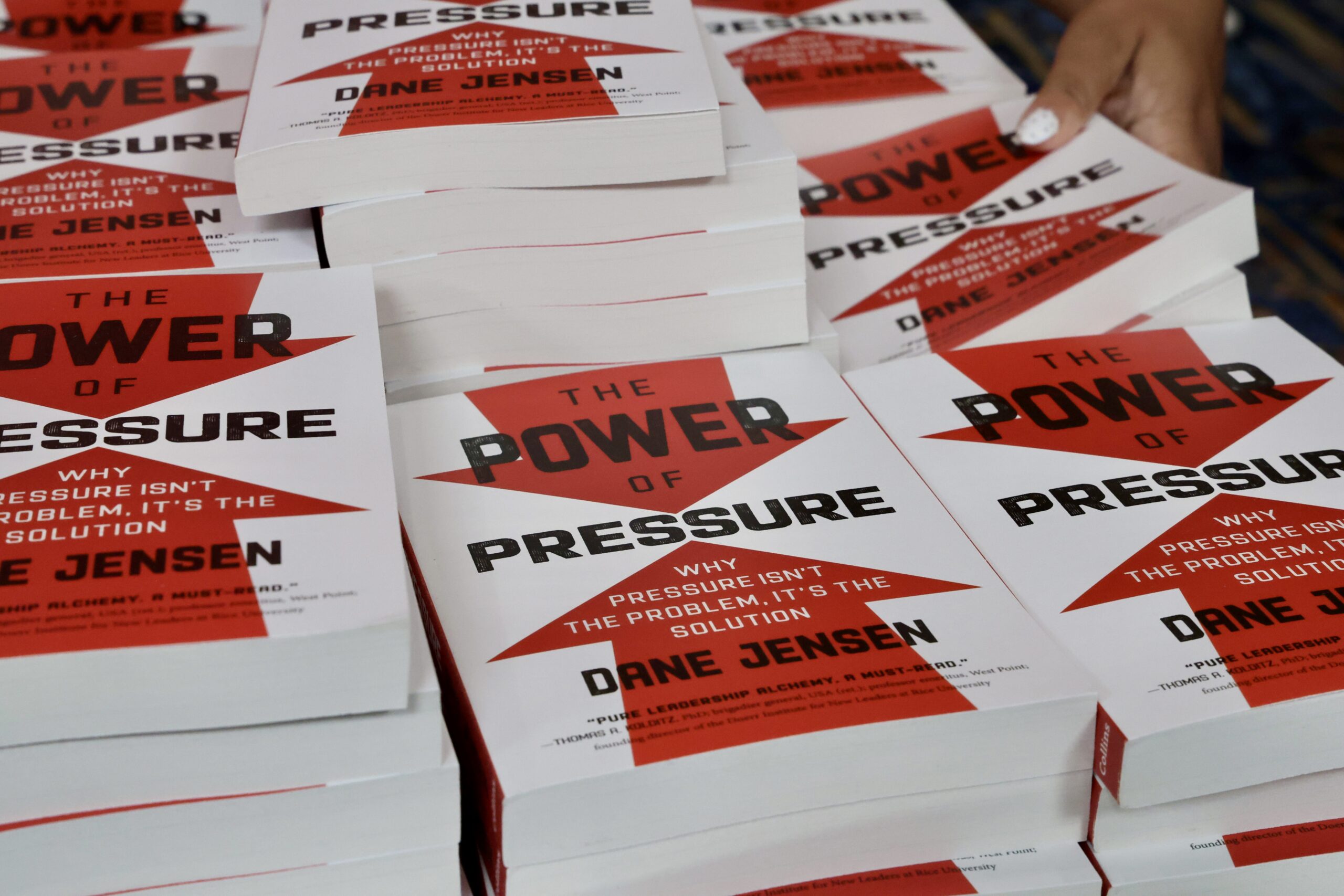
Many of us are taught that pressure is a bad thing – and, as a result, we work to avoid it where possible. But five years ago, Third Factor’s CEO Dane Jensen made a different argument. In The Power of Pressure: Why Pressure Isn’t the Problem, It’s the Solution, he contended that the energy under pressure is essential fuel for performing better at work and in life – if harnessed effectively.
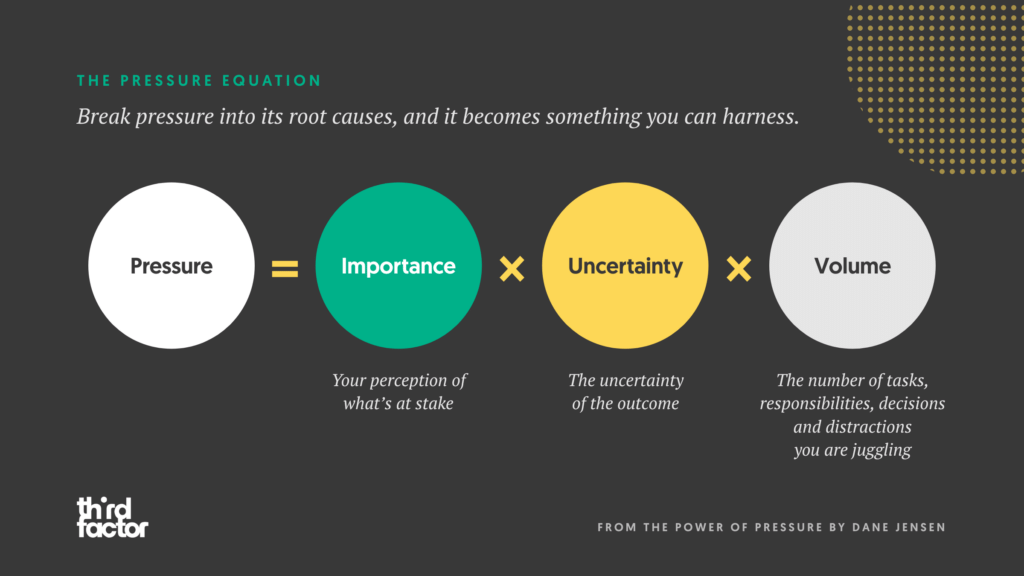
To research the book, Dane spoke with Navy SEALs, Olympic athletes, executives and parents about their highest-pressure moments. He identified two types of pressure. Peak pressure is a sudden spike, like stepping onstage for a big presentation. Long-haul pressure wears on us for weeks or months. He also introduced the pressure equation: Pressure = Importance × Uncertainty × Volume. Breaking pressure into these three parts makes it easier to anticipate and respond to.
To mark the fifth anniversary of The Power of Pressure, Dane shared what nearly 3,800 people have told him about their highest-pressure moments, how his thinking has changed, and what he hopes readers take from the book.
You’ve asked thousands of people the question, “What’s the most pressure you’ve ever been under?” What have they told you?
When I give Power of Pressure keynotes, I often ask people to submit an anonymous, one-sentence description of the most pressure they’ve faced. So far, I’ve collected 3,797 stories.
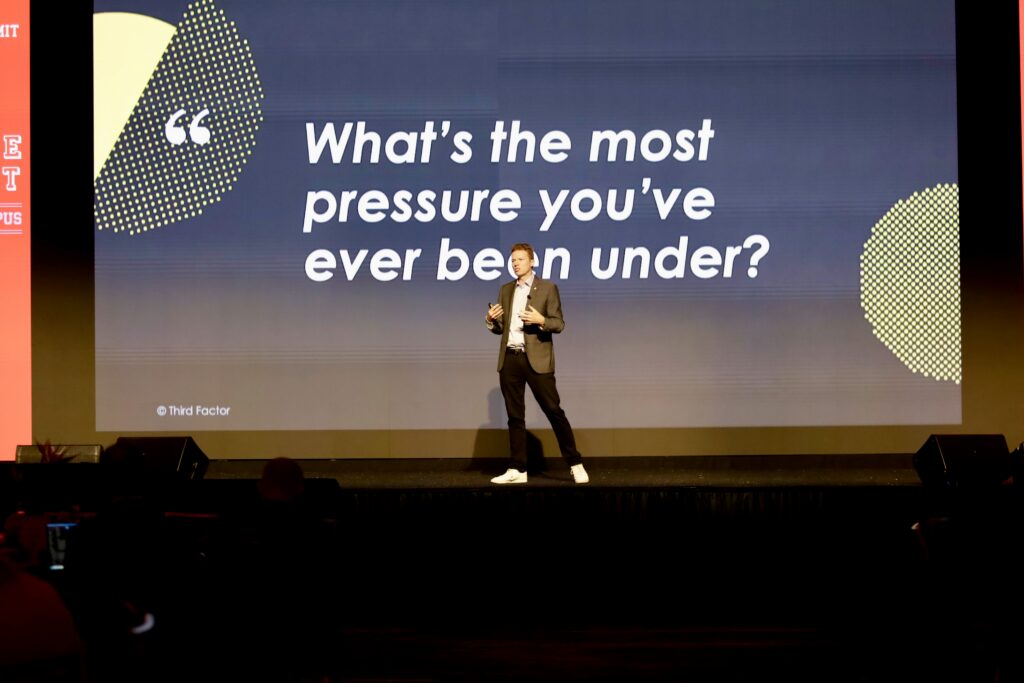
The answers represent a vast cross-section of human experience – from cold-sweat moments such as “singing the national anthem in front of 10,000 people and I forgot the words halfway through” to life-and-death situations, like the person who described “performing CPR on my newborn who stopped breathing.” Then there are the tough moments that are part of life – a dying parent, a sick spouse or an excruciating time at work.
As part of the five-year anniversary of the book, I’ve been digging a little deeper into the stories I’ve received – and it turns out the most common theme is caring for others. These stories represent 29 per cent of all responses.
Many related to either end of life – 9.4 per cent involved a loved one’s illness or death – or responsibilities during the early years of life: 8.4 per cent related to pregnancy, birth or childcare.
I see this finding as very reassuring. We live in an era that increasingly glorifies personal achievement. But when we ask people about their highest-pressure moments, they return to the responsibility they feel to ensure others are cared for in their most vulnerable moments.
If you applied the pressure equation to what people are facing now, which variable – importance, uncertainty, or volume – stands out most? And how does that compare to when The Power of Pressure was first published?
The book came out during the heart of COVID and, as a result, the acute uncertainty we were facing was the dominant thing I heard when I spoke with people.
Five years later, I hear a lot about volume – the sheer number of priorities, to-dos, decisions, distractions, and inputs people face.
Most companies I work with have reduced their headcount over the last three years. That has left the remaining employees with a larger share of the overall workload. At the same time, AI has dramatically raised expectations around the volume of work one person should be able to handle and the speed at which they should get it done.
Outside of work, changing expectations have led working parents to spend almost twice as much time managing their kids’ affairs as they did 50 years ago.
This dramatic rise in volume cannot be solved by time management alone. After the book came out, I wrote an article for Harvard Business Review called “Time Management Won’t Save You.” In it, I said that better time management can backfire. As we get more efficient at squeezing more into our days, we simply pile on more tasks, decisions and distractions, creating even more pressure and stress. I’ve found myself sharing that article more than any other recently as people grapple with drinking from a firehose 24/7.
What part of your book has resonated most with people?
I somewhat cheekily titled chapter nine “Sleep and Other Inconvenient Necessities.” But in an era when many of us don’t get enough sleep, it’s the chapter people most often come up to me and talk about.
In particular, I hear a lot about two sleep tips from the book: The first is to use the clips from a coat hanger to clamp together hotel room drapes so you can have total darkness, no matter how wonky the window coverings may be. I used this one myself recently at a Hilton in Grand Rapids, Michigan.
The second is called “the 100 challenge.” If you’re tossing and turning, it’s a great way to quiet your mind and fall asleep. Here’s how I described it in the book:
“Start by holding a vivid image in your mind’s eye of a room with a chalkboard or whiteboard at the front – it could be a school classroom, a meeting room at work, or something similar. For some reason, a chalkboard works best for me – but your mileage will vary.
“Imagine writing the number 100 in chalk or whiteboard marker on the board. Hold the image of the numbers on the board steady for a second.
“Imagine erasing the number with a chalk or whiteboard eraser. Try to really feel the process of erasing it.
“Write the number 99 where the 100 was.
“Continue the process to 98, 97, 96, etc., … and see how far down you can get.”
Sometimes it’s the simple stuff that works.
How has your thinking about pressure changed?
One of the central ideas in the book is that there’s a difference between dealing with “peak pressure” moments and dealing with “long-haul pressure.” Peak pressure is when the pressure suddenly spikes, like when you’re about to speak in front of a large audience. The long haul is different. That’s when you’re under pressure for an extended period, like an important project at work that’s been going on for weeks or months while you navigate your kid’s competitive baseball season.
One of the central ideas in the book is that there’s a difference between dealing with “peak pressure” moments and dealing with “long-haul pressure.”
The skills required for one can be counterproductive for the other. So, the book is organized to contrast the three skills for handling peak pressure with the three skills for dealing with long-haul pressure, to show how different they are.
I’ve come to believe that this is a little too binary. Whether pressure arrives in bursts or sits with us over the long haul, the overarching goal is to keep each of the three components of the pressure equation in balance. So while the book emphasizes six discrete skills for dealing with pressure, I increasingly think of it as holding three tensions:
- Seeing what I do as important, without being overwhelmed by what’s at stake.
- Taking direct action to manage uncertainty, while embracing the uncertainty that can’t be tamed.
- Building the physical platform to handle a high-volume life, while eliminating volume that is unproductive.
What changes between peak pressure and long haul is the relative emphasis on each side of the tension. For example, when it comes to importance, over the long haul it is often more about finding a sense of importance. In peak pressure moments, however, it is less about finding importance and more about keeping what’s at stake in perspective – we engage in “importance inflation” where we mentally build up an exam, a job interview, or a big sales pitch into a moment of existential importance.
I’ve found that thinking about it like this is both more accurate and practical. The tensions give me a quick way to diagnose where I’m out of whack and therefore what intervention would be most useful.
What lasting message do you want people to take from your book?
I hope what endures is both an emotional and intellectual shift around pressure.
The emotional shift is that, ultimately, the book offers a dose of optimism. Yes, pressure is unavoidable. But rather than a toxin, it can fuel growth, contribution and connection. I wanted to change how people feel about pressure. So instead of seeing it as a threat, they see it as something that challenges and motivates them.
The intellectual shift comes from the pressure equation we spoke about earlier – the idea that we can break pressure down to its root causes and, in doing so, manage it better. It’s a different way of thinking about pressure.
My goal with this book was to give people a clear path to the kind of direct action that is incredibly helpful when pressure hits.
Key Takeaways:
- Our highest-pressure moments are usually about other people. Of nearly 3,800 stories Dane has collected, the most common theme is caring for others, at 29 per cent of all responses.
- Volume has replaced uncertainty as the pressure people feel most. When the book came out during COVID, uncertainty dominated. Today, smaller teams and rising expectations around AI have left people with more priorities, decisions and inputs than ever.
- Time management alone won’t solve a volume problem. Getting more efficient often means piling on more tasks, which creates even more pressure.
- Sleep is the chapter readers talk about most. Simple fixes, like clipping hotel drapes shut or counting down from 100 on an imagined chalkboard, are often the ones that stick.
- Managing pressure is about holding three tensions in balance. See your work as important without being overwhelmed by the stakes, act on the uncertainty you can control while accepting what you can’t, and build your capacity for a busy life while cutting volume that isn’t productive.