
Lesson #1: Perfect Conditions Are a Myth
One of the clearest lessons from Tokyo is that “perfect conditions” are largely an illusion. Athletes spend years preparing, yet competition is always uncertain. They never know exactly how their body will respond, how opponents will perform, or what the environment will deliver on the day that matters most. Tokyo made that impossible to ignore. There were no guarantees. No familiar routines. No comforting rituals. Daily COVID testing became part of life. Every morning meant spitting in a tube and waiting. Stories circulated of athletes testing positive and being sent to the “fever clinic.” Each time, the village would ripple with silent worry. And still, athletes showed up to compete. I remember one athlete in an individual event whose entire Olympic experience lasted nine minutes. One performance. First round. Done. This was not the Games she had imagined. Within 48 hours, she was on a plane home. When we spoke, she was heartbroken. Not just about the result, but about the experience she missed. She couldn’t explore Tokyo. She couldn’t soak up the atmosphere and carry it forward into the next four-year cycle. “I don’t want to go yet,” she said. “I still want to feel the Olympics.” That moment captured the emotional whiplash of Tokyo. Years of preparation compressed into minutes, followed by an abrupt exit from a city she barely saw. And yet, she stepped in knowing this might happen. That willingness to enter uncertainty is the essence of sport. It also mirrors leadership and business more than we wish to admit. At work, we try to control what we can: plans, timelines, strategies, forecasts. We design “ideal conditions” in our heads and on our slides. But at some point, courage becomes simpler than that. We need to ask: What is mine to control right now? Then commit to that fully, even when the picture is incomplete. The bar shifts from “I will only perform if conditions are perfect” to “I will perform under the conditions that actually exist.” Listen to Monique describe how perfect conditions are a myth:Lesson #2: Self-Awareness Is a Performance Skill
When the external environment changes, self-awareness becomes non-negotiable. It becomes a performance skill. Many athletes rely on specific conditions to bring out their best. Some feed off the energy of a crowd. Others depend on routines and rituals. Others draw strength from the presence of family or familiar faces. In Tokyo, much of that disappeared. Athletes were forced to ask new questions:- What actually fuels me?
- What drains me?
- How do my strengths show up when conditions shift?
- Which parts of my routine are essential – and which are habits I’ve never questioned?
- Do I spiral when I see this, or can I notice it and return to my routine?
- Do I absorb everyone else’s fear, or anchor to what I can control today – sleep, food, warm-up, mindset?
Lesson #3: Presence Calms the System
In Tokyo, just arriving felt like an achievement. Between testing protocols, travel restrictions, health concerns, and constant logistical hurdles, getting to the Games was a maze. For many athletes, coaches, and staff, stepping into the village carried real emotional weight. Thinking too far ahead—to medals, expectations, outcomes – only amplified anxiety. Presence became more than a mindset. It became a stabilizer. Staying anchored to the next task, the next decision, the next controllable action helped athletes manage fear, disappointment, and even success. Because even success was disorienting. Celebrations were brief. Support systems were limited. Within two days of competing, many athletes were back home, sitting on a familiar couch, trying to process an experience that ended almost as quickly as it began. Uncertainty didn’t end with competition. It followed them home. The parallel to today’s work environment is hard to miss. Markets shift. Plans change. AI is reshaping roles and workflows in ways we can see but not yet fully understand. Conditions are moving faster than our slide decks. The leaders who navigate this best aren’t the ones who eliminate uncertainty. They’re the ones who stay present inside it. Presence doesn’t mean pretending everything is fine. It means acknowledging what’s hard, then returning to a simple question: Given everything going on, what matters most right now? Listen to Monique describe how presence can help focus attention:Beyond Tokyo: Adapting When the Script Changes
The Tokyo Games offered a powerful reminder: resilience isn’t about grinding endlessly. It’s about adapting intelligently when the script changes. It starts with acceptance. Some conditions are out of your control. The first step is to separate what you can’t influence from what you can – and invest your energy there. It also requires honest self-recognition:- Where do you get your energy from?
- What causes you to lose it?
- Which boundaries protect your ability to perform under pressure?
- How might those answers change when conditions do?
Build Resilience In Your Organization
Bring the skills that elite athletes use to build resilience and perform under pressure to your organization. Contact us to learn more about our resilience programs.
From the outside, Karyn and Rod Garossino’s ice dancing performance at the 1988 Calgary Olympics looked like a hometown dream. A brother and sister from rural Alberta. Competing for Canada. An Olympics on home ice. Five flawless performances on the biggest stage in sport. What people saw was excellence. What they did not see was how hard it was to stay steady enough to deliver it. For Karyn, the Olympics were shaped by two moments she could never have predicted. One came before the competition even began, while athletes waited to enter the opening ceremonies. The other came standing at centre ice, when a roaring hometown crowd would not stop cheering. Together, these moments revealed something essential about high performance: preparation matters, but so does an ability to adapt when things do not go as planned.“In high-performance sport, and in fact much of all high performance, consistency is the holy grail.”
–Karyn Garossino
From Carstairs to the Olympic Stage
Karyn and her brother Rod grew up in Carstairs, Alberta, where skating was simply part of Prairie life. What started as a love of the sport became a serious pursuit, supported by strong coaching, family commitment, and years of disciplined training. In 1981, the pair won junior ice dance gold at the Canadian National Skating Championships, and throughout the decade, they competed at the highest level in Canadian, international and World Championships. Then Calgary won the bid to host the 1988 Olympic Games. Suddenly, the idea of competing at a hometown Games became real. As that moment got closer, so did the pressure. Like many athletes facing a once-in-a-lifetime moment, Karyn prepared not only physically but mentally for what it would feel like to perform under a global spotlight.Different Fabric. Same Cloth.
One of Karyn’s most vivid Olympic memories came before the competition started. Athletes from around the world gathered in a staging area ahead of the opening ceremonies. Each team was dressed in its country’s colours. But as the wait stretched on, things got a little playful: jackets were briefly traded, hats and scarves were exchanged, and the differences between teams started to fade.What Karyn felt in that moment was a deep sense of connection and the awe of belonging to the historic Olympic movement. These athletes represented different nations, but they shared similarities – years of sacrifice, discipline, routine, and the pursuit of excellence. In her words, “we were wearing different fabric, but were cut from the same cloth.” One by one the nations left to join the ceremonies saving the host country to march in last. Then Team Canada entered the stadium. The sound of 85,000 people thundered through the building. In that instant, she realized something else: This was not just her Olympics, or even just the athletes’ Olympics It was our Games. The moment belonged to everyone who had made it possible: athletes, coaches, families, volunteers, organizers, sponsors, and an entire country. What she expected to feel as an individual competitor became something much bigger: the incredible honour of wearing red and white and representing the extraordinary collective effort of a nation.“We were wearing different fabric, but were cut from the same cloth.”
The Crowd Wouldn’t Stop Cheering
If the opening ceremonies created awe, the competition brought a different kind of pressure. When Karyn and Rod were announced onto centre ice, the crowd erupted. That part was expected. What was not was that the cheering didn’t stop. Normally, once skaters take their position, the arena quiets and the music begins. But this audience kept cheering, waving flags, and feeding even more energy into the building. The music could not start until the arena settled, so Karyn and Rod stood in position and waited. And waited. For a brief instant, they felt the weight of what was happening. They exchanged a smile and a shared realization: Oh my God, we’re at the Olympics. It was a deeply human moment. But it was also risky. Because even positive energy can get in the way of performance. The challenge was not only handling fear or adversity. It was managing excitement, emotion, and the significance of the moment. Karyn knew they had to get back to what they had trained for. They turned to breathwork, a skill they had practised for years to steady themselves under pressure. Within three exhales, they were back in form. Their activation level dropped. Their focus returned. Their physiology settled. The crowd eventually quieted, the music began, and they performed brilliantly. They achieved a 12th-place Olympic finish. The next year, they would win gold at the senior Canadian Championships. Looking back, what lessons did Karyn learn from her Olympic experience that are helpful to anyone facing high-performance situations? Here, she helps us understand three practical takeaways:Lesson #1: Consistency Is Built Before the Moment
Karyn describes consistency as the holy grail of high performance: the ability to deliver what you are capable of in any condition, not just ideal ones. That consistency was built long before the moment arrived. Karyn and Rod prepared not only their skating but also their mindset. Through imagery and planning, they anticipated the noise, emotion, and pressure of the Games so they would not be overwhelmed. That is a critical lesson for any high achiever – whether in sports or business. The goal is not to hope everything goes perfectly. It is to be ready when it doesn’t. Consistency is not about controlling the environment. It is about training how to respond to it. Listen to Karyn describe how consistency is built before the moment:Lesson #2: Control What You Can Control
One of Karyn’s clearest lessons from Calgary is simple: high performers must learn to distinguish between what they can control and what they cannot. She could not control the crowd. She could not make the audience quiet down. She could not change the scale of the moment. What she could control was her own internal state. That distinction matters because pressure grows when we fixate on things we cannot change. Recovery begins when we return to what we can manage: our breathing, our attention, our preparation, and our next move. In that moment on the ice, the solution for Karyn was not to fight the environment. It was to return to the training that brought her to the Games. Listen to Karyn distinguish what you can control and what you cannot:Lesson #3: Breathwork Is a Performance Skill
Karyn is clear that the breathing exercise she used in Calgary was not improvised. She had practised it for years. Its purpose was to manage the body when the outside world became overwhelming. Slow, controlled breathing gave her a direct way to regulate her physiology and recover focus. Her method was simple: breathe low and breathe slow. Under pressure, breathing rises high into the chest and speeds up. But when breathing starts lower in the body, from the diaphragm, and the exhale lasts longer than the inhale, the body begins to relax. That matters because physiology drives performance. If your body is overstimulated, thinking narrows and execution suffers. When your physiology settles, your trained skill improves. In Calgary, three breaths were enough because Karyn and Rod’s skills were already there. That is what makes breathwork so powerful: it is not just a calming technique; it is a trained performance tool. Listen to Karyn provide insight into how breathwork is a performance skill:Practical Tool: Return to Centre in Three Breaths
When pressure rises unexpectedly, use this simple reset:- Notice the surge: Pay attention to the moment when your energy starts to spike. Maybe your chest tightens, your focus narrows, or your thoughts speed up.
- Breathe low: Drop the breath lower into your body rather than keeping it high in the chest.
- Breathe slowly: Lengthen the exhale so it is longer than the inhale.
- Repeat for three breaths: Use three deliberate breaths to regain control.
- Return to the task: Ask: What can I control right now? Then put your attention there.
Build Resilience In Your Organization
Bring the skills that elite athletes use to build resilience and perform under pressure to your organization. Contact us to learn more about our resilience programs.

When to watch
Summer McIntosh: July 27 – August 4 Josh Liendo: July 31, August 3, August 4 Ilya Kharun: July 31, August 3, August 4
When to watch
Paralympic Games: August 28 – September 8 Women’s Goalball: August 29 – September 5
When to watch
Women’s Beach Volleyball: July 27 – August 9
When to watch
Men’s Basketball: July 27 – August 10 Women’s Basketball: July 28 – August 11 Women’s 3×3 Basketball: July 30 – August 5 Men’s Wheelchair Basketball: August 29 – September 7 Women’s Wheelchair Basketball: August 29 – September 8
When to watch
Men’s Basketball: July 27 – August 10 Women’s Basketball: July 28 – August 11 Women’s 3×3 Basketball: July 30 – August 5 Men’s Wheelchair Basketball: August 29 – September 7 Women’s Wheelchair Basketball: August 29 – September 8
When to watch
Artistic Swimming: August 5 – August 10
When to watch
Rowing: July 27 – August 3The Canadian Ski Team
Ski Cross is one of the most exciting freestyle skiing events at the Games. We’ve been proud to work with the athletes and coaches on both the men’s and women’s teams to help them build self-awareness, leverage their strengths, and perform under pressure. We’ll be cheering them on in the Ski Cross events on February 17th & 18th. Our work with Alpine Canada has also taken us to the downhill skiing events. We’ll be keeping a close eye on Team Canada at the men’s and women’s Slalom, Giant Slalom, and Super-G events.Figure skaters from around the world
Brian Orser and Tracy Wilson are not just Olympic medallists, but widely regarded as the top coaches in the sport. They’ve shared their perspectives on performing in critical moments with us, and we’ll be cheering on their skaters as they compete for the podium in Beijing.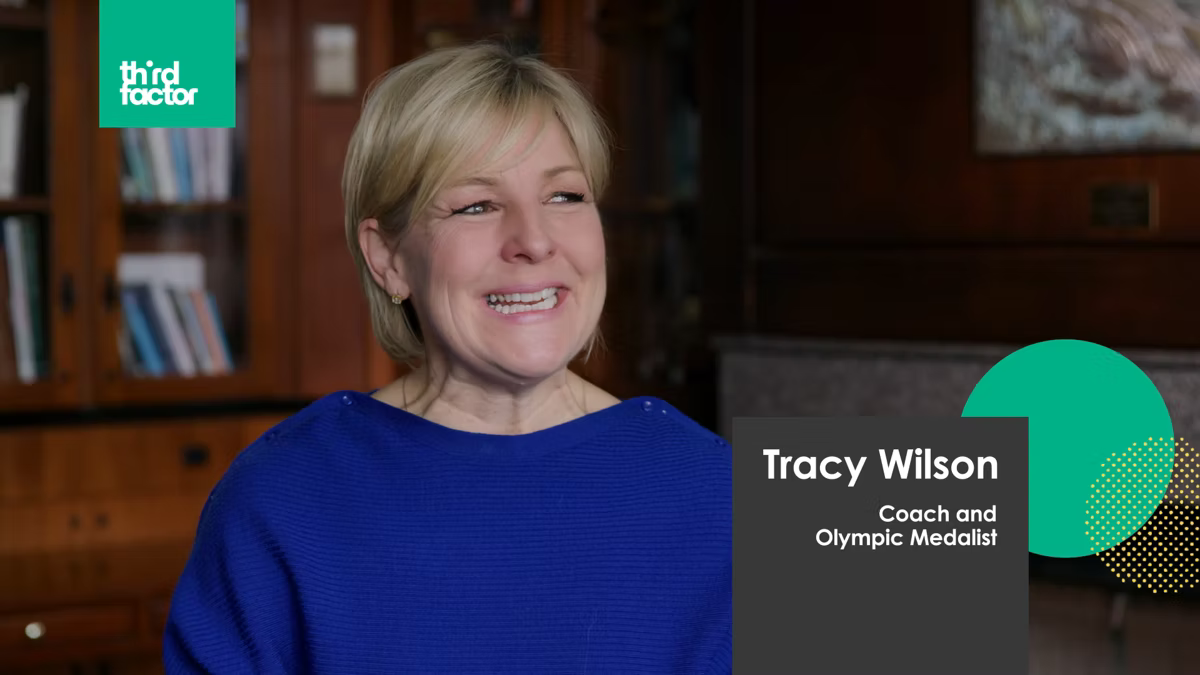 Tracy Wilson is an Olympic Medallist and 7-time Canadian champion
The Canadian Women’s Hockey Teams
We’ll be staying up late to watch Team Canada battle to reclaim Gold. We’ll also be keeping our eye Marie-Philip Poulin who is not just one of the best pressure performers in the world, but the best hockey player in the world, full stop according to our co-founder Peter Jensen. At Third Factor, we are sad to learn that Team Canada will not be competing at the Tokyo Olympic and Paralympic Games this summer. At the same time, we are also incredibly proud of the Canadian Olympic and Paralympic Committees for taking the lead and making the right decision for the health and safety of Canada’s athletes, coaches, staff, volunteers and fans. The chaos, challenges and health risks posed by COVID-19 make the decision to withdraw from the Games a necessary one. Athletes are unable to train. Coaches and support teams cannot properly plan. Travel is unavailable and unsafe for family members and other attendees. And the sponsors that support athletes and teams are now unable to proceed with their marketing efforts without risking the appearance of being insensitive and out-of-touch given the current reality.“We stand ready to support our athletes, coaches and leadership organizations through the coming months and in Team Canada’s inevitable return to Olympic competition.”By withdrawing Team Canada from the Tokyo Games, the COC and CPC have made an important statement that this crisis is bigger than the Olympic and Paralympic Games and that our collective health and safety should be our only priority over the coming months. They have also given a clear answer to the athletes who have been tortured by uncertainty and were wondering whether they would have a chance to compete and, if so, whether they would have to risk their health in order to do so. We join the COC and CPC in calling on the International Olympic and Paralympic Committees to postpone the Tokyo Games by one year so that all members of the international community may focus on their physical, mental and financial health, caring for loved ones, and doing their part to stop the spread of COVID-19. For the last three decades, our organization has been proud to support the Olympic community in Canada. We stand ready to support our athletes, coaches and leadership organizations through the coming months and in Team Canada’s inevitable return to Olympic competition. Signed, Dane Jensen, Peter Jensen, Sandra Stark, Peggy Baumgartner, Garry Watanabe & Cyndie Flett on behalf of the entire team at Third Factor.
Editor’s note: Since publishing, we have learned that the IOC has officially postponed the start of the Tokyo Games.
This Friday marks the 10-year anniversary of the Closing Ceremonies of the Vancouver 2010 Olympic Games. Here at Third Factor, we were incredibly proud to directly and indirectly support many of the athletes and coaches that would go on to become household names. Ten years later, we are still committed to supporting Olympic and Paralympic athletes and coaches in their bid for the podium. And three incredible stories from the 2010 Games continue to influence our understanding of the power of pressure and the way we interact with our clients across all areas of our business.Changing a Canadian mindset
Prior to the Vancouver Olympics, Canada was known in Olympic circles for one notable achievement: it was the only nation in the world to host the Games without a local athlete winning gold. In fact, Canada had achieved this feat twice; first at the 1976 Summer Games in Montreal, and again at the 1988 Winter Games in Calgary. When Vancouver won the bid to host the 2010 Winter Games, Canada’s 13 winter national sport organizations were determined to change that reputation. A report by sport management consultant and Olympic Hall of Famer, Cathy Priestner Allinger, found that Canadian athletes ranked top-five in the world the year before the games were far less likely to go on to win an Olympic medal than international athletes who were performing at the same level.“Canada’s challenge wasn’t producing world-class athletes; it was producing world-class athletes who could perform with all the distractions and pressure of the Olympics”In other words, Canada’s challenge wasn’t producing world-class athletes; it was producing world-class athletes who could perform with all the distractions and pressure of the Olympics. Brian Orser was one of Canada’s star athletes at the Calgary Games in 1988, and he spoke to us about the pressure of competing in front of a home crowd. To help Canada’s performers prepare for the pressure of Olympic competition, the not-for-profit organization Own the Podium was formed to provide and fund support structures designed to give Canadian athletes the preparation that would allow them to access their best performances in the face of Olympic pressure. Own The Podium was a spectacular success. At Vancouver, Canadian athletes won 26 medals, including a record-setting 14 gold medals, placing Canada third overall. Since that time, Canadian athletes have been ‘converting’ at a rate of around 70% and Canadians now enter Olympic Games with an expectation that they could indeed, be the best in the world.
The impact of self-awareness and communication strategies
We had always believed that self-awareness was a critical component of team performance, and there was no doubt on the subject following our work with the Canadian Women’s Olympic Hockey Team at the Vancouver Games. In 2010, the team was looking to defend its gold medal from the Turin Games four years prior. They were also preparing to face their American arch-rivals who had bested them at the world championship the year before. As the team’s mental performance coach, Third Factor Founder, Dr. Peter Jensen, was tasked with helping the team perform through the high-stakes tournament while under intense scrutiny from the home crowd. To help keep the team running like a finely tuned engine, he elected to bring in our collaboration guru, Peggy Baumgartner, to guide the team through our Self-Aware Team process. Through the program, the team was able to gain a better understanding of their tendencies – both individually and as a team under pressure. And, they leveraged that new understanding to design systems to keep communication flowing effectively when the pressure mounted. The players remember it as a challenge that was both extremely difficult, and extremely worthwhile. With a strategy in place, the team was able to communicate and stay consistent whether things were going well or poorly. They were able to work their way through the ups and downs of Olympic competition and successfully defend their gold medal on home ice. What we learned is that when you have a high functioning team – even one that’s among the best in the world – one of the most powerful ways to further enhance their performance is to increase their self-awareness and communication skills.The convergence of health and performance
For us at Third Factor, there was a hidden storyline we were following that was far more significant than the Olympics. One week prior to the start of the Games, Peter Jensen was with the Women’s Olympic Hockey Team in Jasper, Alberta, at their pre-Olympic camp when he received confirmation that he had throat and neck cancer.“Peter had to keep the information from the team so as not to become an enormous distraction”Peter had to notify the leadership at Hockey Canada and, with their blessing, continued to support the mental performance of the Women’s Olympic Hockey Team. As they headed into their most important competition of the four-year cycle, Peter had to keep the information from the team so as not to become an enormous distraction while simultaneously teaching skills, being at his best and dispensing regular doses of his usual sense of humour. Peter is currently cancer-free and maintains a crazy busy schedule delivering keynote speeches to audiences big and small around the world. Peter wrote about his experience in his own words in his whitepaper, When Health and Performance Converge: What I (re)Learned From Cancer. It’s a great read if you’re curious to learn more about how he was able to stay resilient through such a difficult time. To those of us at Third Factor, the 2010 Vancouver Games are a reminder that Peter doesn’t just teach people how to handle pressure, he lives and breathes the content.