What could you achieve if every leader in your organization had a coach in their pocket – one they could access at any time to craft the perfect piece of feedback, prepare for a difficult coaching conversation, or get personalized advice for coaching their team?
“PJ” is our AI coaching companion that helps leaders apply their coaching skills by offering customized support whenever needed. Developed in partnership with The Modern Office Company, this intuitive and friendly chat bot is the latest advancement in sustainment for our flagship 3×4 Coaching program.
What is PJ?
We’re calling PJ The Coach’s Coach. It’s a tool designed to help leaders work through coaching challenges and get advice on applying the 3×4 Coaching model, our framework of 3 plays and 4 skills that exceptional coaches use to deliver results and build commitment.
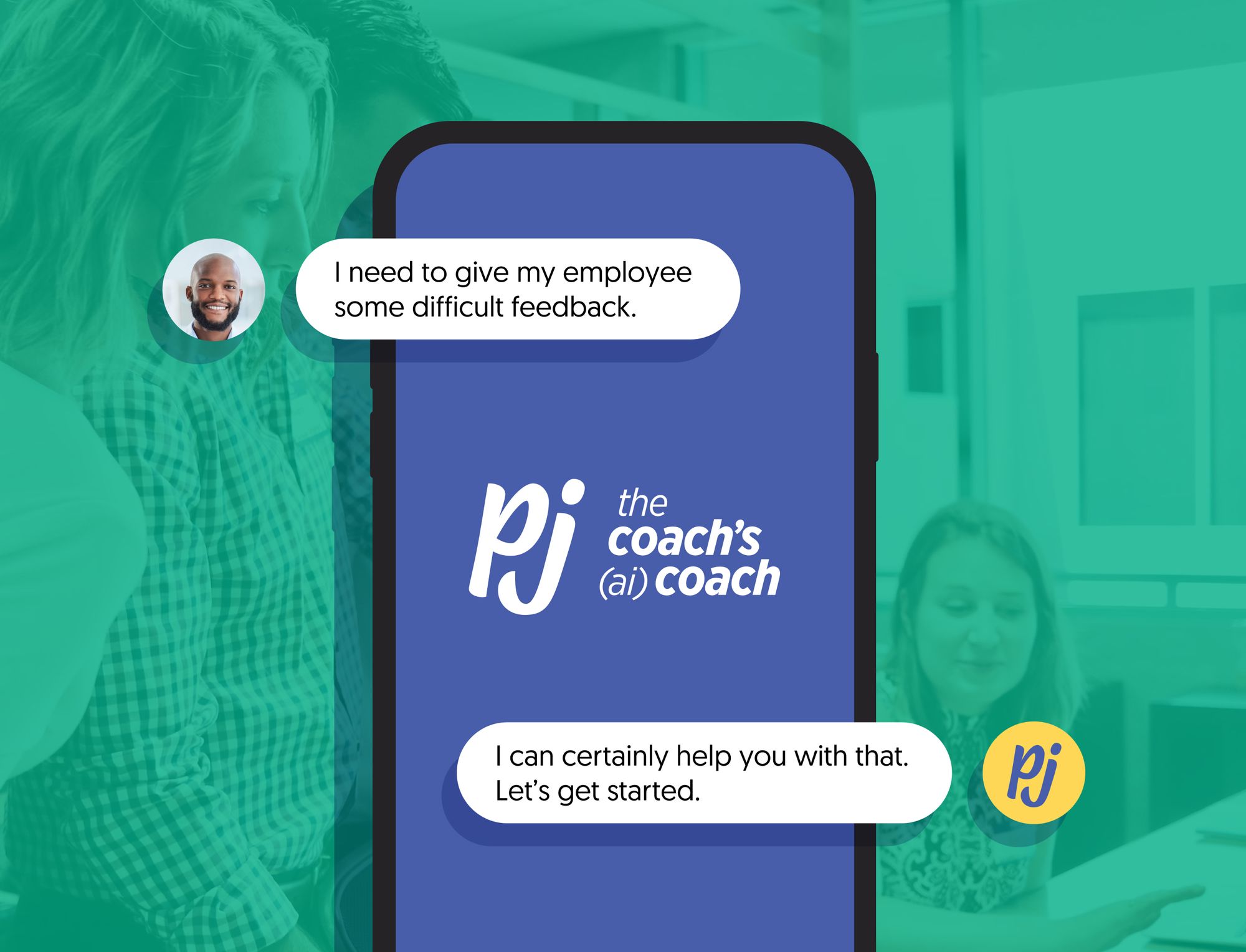
At its heart, PJ is an AI chat bot developed by Third Factor and The Modern Office Company. With a license, you can ask PJ questions and discuss just about anything related to coaching. PJ has been trained in the 3×4 Coaching model and can help you use questions, listening, feedback and confronting to build clarity, improve competence or give recognition.
What really excites us is that PJ is a true coach. Unlike other chat bots that jump straight into giving advice, PJ first listens to understand and asks clarifying questions to get to the heart of every issue. A conversation with PJ flows like a conversation with a real coach – acknowledging the very real challenges of leadership, building clarity about what’s really going on, and generating practical strategies for applying the coaching skills.
What can PJ help with?
PJ is designed to help with just about any coaching challenge. Whether you need help building clarity around an issue, delivering difficult feedback, or finding the right way to recognize a team member’s efforts, PJ is there to help.
Here is a list of sample prompts you might give PJ across a variety of categories:
Work through challenges
My direct report seems unmotivated and I’m not sure why
I’m struggling to build a relationship with a new team member
I’m not sure how to best coach someone with more experience than me
Prepare for a Conversation
Help me prepare for a challenging conversation with my direct report
I need to have a team discussion to clarify performance expectations
How should I deliver feedback on something that I didn’t directly observe?
Enhance skills
Give me a scenario to practice using the BID feedback model
What are strategies for improving my active listening?
How can I get more comfortable with having tough conversations?
Generate ideas
What are some simple but personalized recognition ideas for my team?
What are approaches to identify my team’s strengths and weaknesses?
I’d like ideas for quickly building relationships with new team members
Coach in different contexts
How do I coach someone from a different generation than me?
What are strategies for coaching someone who doesn’t report to me?
How do I adjust my coaching for in-person vs. remote team members?
Deepen coaching knowledge
Can you explain the concept of ‘developmental bias’ in more detail?
Does the BID model work for both reinforcing and corrective feedback?
What does it mean to use emotion as a fuel for change?
See PJ in action
PJ is trained to coach you through problems rather than just giving answers. After you explain what you need, PJ will ask clarifying questions to understand the nature of the coaching challenge. It will then help you discover how to apply the coaching plays and skills to address the issue and help you create a detailed action plan.
Here’s a real conversation with PJ about a team member’s punctuality to give you an idea of just what PJ can do.
How do I get access to PJ?
PJ is currently in a closed Beta and not available to the general public. If you want to try PJ and give us feedback on how to improve, send us an email explaining your coaching challenge and why you think PJ could help.
Welcome to our summer reading list for 2024. The team at Third Factor has once again come together to recommend their top reads from the past year. Whether you want fiction, non-fiction, or even a cookbook filled with new recipes to try, you’re sure to find something new and interesting on this list.
This year, we’ve included a special recommendation from our new AI coaching companion, PJ. What does a virtual 3×4 Coaching expert recommend you read this summer? Scroll down to find out.
Ask will teach you how to read other people’s minds. Okay, maybe not literally – but author Jeff Wetzler shows convincingly that, with the right questions and the right approach to listening, we can get incredibly good at knowing what others are thinking. The book opens with a sobering look at how bad we are at intuiting others’ thoughts and feelings, and how easy it is to stay on the surface without ever benefitting from the thoughts and opinions that others truly hold, but may be reluctant to share. Wetzler lays out a highly practical framework for curiosity, packed with great questions and tips for listening. As someone who speaks for a living, I am always looking to get better at listening – and this has been an incredibly helpful book.
I highly recommend “Hidden Potential” by Adam Grant, especially for its take on team dynamics. The book shows that team success isn’t just about picking the most skilled people but about building the glue that holds everyone together. This resonated with my experience with Canada’s National Basketball Team. Their World Cup success wasn’t just about talent but their unity and teamwork, leading to their first Olympic qualification in over 20 years. Grant’s insights reflect what I’ve seen firsthand in sports.
I heard Pooka Lakshmin speaking about “faux self-care” on the Ezra Klein podcast and was very intrigued so I picked-up her book. It’s very thoughtfully written with examples from Lakshmin’s clinical practice and her own experiences. She points out that self-care shouldn’t be something to add to your to-do list but behaviour changes in your everyday life. She breaks down the four key elements of self-care: boundaries, self-compassion, getting to know yourself, and asserting your power. She even explains how the more we practice these concepts the more we can impact change on a larger scale. I am already working on incorporating tips from the book, and I feel off the hook for not being into meditation or yoga.
Christopher Gentile, Director Strategic Partnerships & Accounts
As someone who isn’t a big fiction-reader (but loves history!), The Amazing Adventures of Kavalier and Clay is an epic novel that blends history, adventure and human emotion into a masterpiece. It’s set against the backdrop of World War II and follows the journey of Joe Kavalier and Sam Clay, two cousins, as they move from Europe to navigate the world of 1930s America. Joe Kavalier, a talented artist and escape artist, escapes Nazi-occupied Prague to seek refuge in New York City, where he teams up with his cousin Sam Clay, an ambitious writer, to create the iconic superhero “The Escapist.” As they rise to fame, they encounter love, loss and challenges while facing their own personal struggles, relationships and identities. Chabon does an excellent job bringing the streets of New York City to life, as the layers of complexity to each character makes for a beautifully crafted and captivating story of friendship, creativity and strength in the face of adversity. It’s a fun, nostalgic and uplifting read for summertime.
Garry Watanabe, Senior Principal, Performance and Leadership
A senior executive at Stripe and former senior executive at Google, Johnson has made an impact in some of the biggest and fastest growing companies in the world. The book is full of incredibly practical advice and tools. More importantly, it helps leaders understand how to deliver on a key challenge: leading with both empathy and accountability. If you get the audio version, as an added bonus, the author personally reads the book, which in my experience, truly makes the words come to life.
“Leaders Eat Last” by Simon Sinek is an essential read for anyone aspiring to become a better leader in their organization. Sinek explores the core principles of leadership that build trust, foster collaboration, and drive innovation within teams. By creating a culture where employees feel valued and empowered, the book offers actionable insights that can transform your leadership style and significantly improve team dynamics and performance. Embrace these principles to inspire and lead your organization toward sustained success.
“Demon Copperhead” is a compelling novel that reimagines Charles Dickens’ “David Copperfield” in modern Appalachia, following a resilient and sharp-witted kid named Demon navigating tough times, poverty, and additiction. It’s a powerful story about overcoming adversity and offers deep insights into human resilience and empathy.
This is a book about the practice of paying attention and refining our sensitivity to tune in to the more subtle notes. This is not a book you read and put on a shelf. You can pick it up any time as it is dripping with wisdom, for life, art and creativity. I love everything about this book, from the person who suggested it and bought it for me through to the texture of the creative cover and silky pages in between. Rubin suggests that living in discovery is at all times preferrable to living through assumptions. I like that perspective.
With summer just around the corner and my daughter’s wedding fast approaching, I’m diving into the Love and Lemons Cookbook for some culinary inspiration. This cookbook is a treasure trove of effortless and delicious vegetarian recipes, perfect for the special occasion at our cottage. With many vegetarians among our guests, I want to ensure that the weekend is filled with delightful and satisfying meals. If anyone has favorite meatless recipes to share, I would love to hear them! Let’s make this celebration as tasty as it is memorable.
For a deep dive into the psychology of change and how to guide others through it, “Immunity to Change: How to Overcome It and Unlock the Potential in Yourself and Your Organization” by Robert Kegan and Lisa Laskow Lahey is a fantastic choice. It explores why people resist change, even when it’s in their best interest, and offers practical steps for identifying and overcoming those internal barriers. It’s particularly insightful for coaches working with individuals facing significant personal or professional transitions.
“Remarkably Bright Creatures” by Shelby Van Pelt is a delightful read. This heartwarming and immensely readable novel explores the power of connecting with other living creatures and its impact on our lives. With a clever storyline and a touch of mystery, it’s perfect for a feel-good summer read. If you enjoyed “A Man Called Ove,” you’ll love this book.
Many websites use affiliate links to make money when you buy something from Amazon – we don’t. Feel free to follow the links provided or pick up the book you want from your favourite local bookseller.
New manager development programs are often a surprising “problem child” in the Learning & Development portfolio.
The recent Association for Talent Development (ATD) report sponsored by Third Factor, “New Manager Development: Building a Foundation for the Future,” highlights a critical gap: while 70% of organizations have new manager development programs, most fail to realize their full potential with 77% reporting only moderate success or worse.
Successful
Unsuccessful
No program
Helping new managers transition from individual contributor to people leadership roles is vitally important for the performance of not only those managers but everyone that reports to them as well. But with the large population of managers in most organizations, Learning & Development (L&D) is often tasked to execute these programs at scale and on a shoestring budget. Add in the time pressures on new managers, and it can feel near impossible to deliver impactful leadership development programs for this audience.
We know how challenging this mandate can be, so we’ve collected some practical strategies from leading organizations that we partner with to help get the value out of your investment in new manager development.
Leadership at the Helm: Building Top-Down Support
The ATD report underscores the importance of senior leadership in new manager development. Most of the organizations surveyed indicated that a lack of either resources, senior leadership support, and/or prioritization were challenges to training new managers. So how do you build that critical support at the top of the house?
01.
Pick your moment and leverage business needs to advance new manager training.
02.
Enlist your partners to sell your vision for new manager training internally.
03.
Get senior leaders directly involved in training to underscore its importance.
First, pick your moment. When organizations make significant investments in new manager development, it typically comes at a time when there is a clear business need – for example, a new strategy, a culture transformation, declining engagement scores, or high turnover. Use these windows of opportunity to demonstrate how Learning & Development can help turn conceptual business plans into real action by driving the right behaviors in managers.
Second, enlist your partners. You need every tool in your arsenal to build the strongest business case to senior leaders for investing in new manager development. Involve HR or internal business partners as well as your third-party vendors to help demonstrate to senior leaders the value and expected outcomes of these programs. Hearing directly from your leadership team about a strategic transformation they are driving from transactional to advisory services, for example, will enable your vendors to design programs that directly support those needs.
Finally, start small and get senior leaders directly involved. One L&D team that we work with is driving a multi-year rollout of a two-day in-person program to help managers build coaching skills – a significant investment of time and resources. But it all started with just one session focused on the C-Suite team. Through that firsthand experience, the CEO and his team became passionate champions of the program. They not only committed to funding a broad program rollout, but the CEO now speaks directly to every cohort of managers that goes through the program. His involvement sends a strong message about his commitment to manager development and also reinforces the connections between the content and their business priorities.
Balancing Learning Formats
Training a large population of new managers can be costly. For many organizations, it’s just not feasible to offer in-person experiential learning programs to all new managers.
In fact, the ATD report notes that asynchronous learning channels are the most common offering made available to new managers. We often hear from L&D leaders about the benefits of asynchronous learning for creating custom learning pathways and offering flexible programs that work around the busy schedules of new managers. Yet there is always a desire to incorporate some of the benefits of live, in-person learning experiences as well.
Increasingly, organizations are looking at blended learning formats to provide the scale and cost effectiveness of asynchronous learning but with some of the human connection and energy of live or in-person programs.
A financial services company that we partner with offers an asynchronous program that enables managers to learn coaching skills through a series of self-paced videos. But to enhance the experience through peer support and live discussions, managers are placed into learning cohorts that proceed through the program as a community. A live virtual kickoff provides context about the program, introduces managers to others in their cohort and builds energy around the learning journey they are about to start on. Midway through the program, cohorts reconvene for a live application lab to work through any questions and challenges as they start applying the skills in their work environment. And upon completion of the program, managers have access to 1:1 coaching and a library of resources to support ongoing skill development and application.
“The most successful new manager development programs that we see always place a strong focus on practical application.”
Whether asynchronous, in-person, or a blended format, the most successful new manager development programs that we see always place a strong focus on practical application. New managers are often completely underwater balancing their priorities of delivering results while also developing their people.
In fact, time constraints on new managers were the most common challenge cited in ATD’s report. Most new managers simply don’t have the time, energy, or interest to dive deep into theories on motivation and performance. Instead, they need a few practical tools that they can implement immediately, opportunities to practice new skills, and strategies to focus on actions that will have the greatest impact so that they see immediate results and build confidence.
Measuring What Matters: The Art of Success Metrics
You’ve heard it a million times – “how are we measuring the impact of this program?” When it comes to reallocating investment or cutting costs, new manager development programs are an easy target if they can’t demonstrate impact. Effective metrics not only demonstrate program effectiveness but also ensure the program remains relevant, impactful, and aligned with evolving business priorities.
ATD’s report highlights a similar issue: 87% of respondents cite a lack of metrics to track the program’s results as a challenge to new manager training. While most organizations do assess program effectiveness, many focus on participant satisfaction and use informal conversations rather than quantitative or outcomes-based measures. So how can you incorporate impactful metrics without creating an overly complex science project?
Most important is systematizing and quantifying participant feedback with a short, standard feedback form for every participant to complete. In our experience, taking a few minutes to do this at the end of sessions before participants return to their other work is the best way to drive response rates and specific feedback. In addition to participant satisfaction, include one or two questions tied to target outcomes – for example, participants’ confidence in their ability to apply the skills in their daily work.
With a basic feedback system in place, start looking at longer-term metrics and impacts. A large energy organization that we work with administers a final survey approximately three months after leadership development programs on how participants are applying their learnings and the resulting business impact of those actions. These concrete examples offer powerful impact stories that are highlighted to the company’s most senior leaders.
Another financial services organization surveyed the direct reports of program participants and found that more than 85% noticed an improvement in their leaders after completing the manager development program – a metric that helped build ongoing support and expansion of the program.
Transforming Insights into Impact
As the ATD report highlights, new manager development programs are a critical aspect of the L&D portfolio and yet there are very real challenges to making them effective and impactful. These strategies offer a blueprint to help ensure the investment in these programs delivers real value for the business and for your people.
At a glance:
Roughly one quarter of organizations say their new manager training programs are extremely or highly successful, but an equal number report their programs as only slightly successful or not successful at all.
Key reasons for investing in training for new managers include better individual performance (85%), continuity of organizational culture and values (69%), and better team performance (62%).
Top focus areas for new manager training include communication skills (93%), providing feedback (92%), and performance management (91%).
91% say their new managers just don’t have enough time to invest in development programs.
Third Factor has partnered with the Association for Talent Development (ATD) on exciting new research that reveals how organizations approach training for new managers. The report draws on a sample of 287 organizations seeks to understand why organizations do or don’t invest in training for new managers, how new manager training is approached, and the common trends in the most successful new manager development programs.
In today’s rapidly evolving business landscape, the importance of new manager training is highlighted by a notable statistic: 70% of organizations have a development program for new managers, and among those without, 54% plan to introduce one within the next two years. This trend underscores a growing recognition of the crucial role new managers play in organizational success. However, transitioning from an individual contributor to a managerial role is a journey filled with challenges. Managers must not only manage tasks but also lead people, a shift that requires a fundamentally different skill set and mindset.
Successful new manager training programs can be hard to come by
While about a quarter of organizations consider their programs extremely or highly successful, another quarter view them as only slightly or not at all successful. This suggests a broad spectrum in the effectiveness of such programs across different organizations, highlighting the need for tailored approaches and continuous improvement in managerial training practices. It underscores the importance of not just having a training program in place, but also ensuring its relevance, effectiveness, and alignment with organizational goals.
The good news is that the report shows 78% of organizations actively measure the success of these programs. The most common method used is assessing participant satisfaction. However, high-performing organizations often go further by evaluating long-term impacts such as the retention rate of managers and their contribution to organizational performance. This approach underscores the importance of not only implementing development programs but also rigorously assessing their outcomes to ensure they meet organizational goals and contribute to long-term success.
Performance and culture are the most desired outcomes
When developing training programs for new managers, organizations are unsurprisingly focused on performance – but the question of whose performance is most important raised our eyebrows.
While 85% of organizations want their new manager development programs to enhance individual performance, only 62% include team performance in their goals. While enhancing a manager’s skills is essential, it’s crucial to recognize that a manager’s success is inherently tied to their team’s performance. Focusing solely on individual managerial skills without equally emphasizing team leadership and development can create a disconnect. This approach may lead to managers who excel individually but struggle to foster a high-performing team, ultimately impacting the broader organizational effectiveness.
Fortunately, continuity of organizational culture and values is also a top outcome for new manager development. Some 69% of organizations rely on new manager development programs to ensure that leadership is aligned with the core principles of the organization. This alignment helps in maintaining a consistent organizational ethos, which is essential for long-term success and identity.
The most important skill for new managers? Communication.
The skill new manager training programs focus on above all others is communication, with 93% of organizations prioritizing this in their development programs.
In our 3×4 Coaching program, we teach that coaches use four key communication skills to develop their people: questioning, active listening, feedback, and confronting. Feedback also made the list of skills, with 92% of new manager development programs dedicating time to giving people information about their performance.
While performance management (91%) is another top focus area, the communication skill of confronting didn’t make the list. Questioning, listening and feedback are useful and necessary skills, but aren’t always the best tools when a valued performer needs to make a non-optional change to their behaviour.
Teaching new managers skills for managing challenging conversations is a worthwhile investment. Giving younger leaders the opportunity to learn and practice the skill means they will be better prepared to confront problem behaviors when they reach a more senior position. By thinking of communication skills for new managers as an investment in the future, organizations can strengthen their entire leadership pipeline.
Finding time is a top challenge in training new managers
The primary challenge in this developmental journey, as reported by 91% of organizations, is the lack of time for new managers to participate in training programs. It’s no secret that new managers are expected to hit the ground running, often having been selected for their aptitude for the role and prior success in a non-leadership role.
The rub is that the bias toward execution, rather than leadership, is actually counterproductive. While managers at this level need to be adept at leading their people while being responsible for their own work product, putting emphasis on the former in the earliest days could set them up for a career-long belief that their individual productivity is more important than that of their team. This misprioritization can also lead to a situation where managers are underprepared for their roles. Moreover, the pressure of managing operational tasks while also trying to develop people management skills can lead to burnout and decreased effectiveness.
Just as new managers need to skillfully coach their people in the flow of getting things done, their own leadership training needs to happen in the flow of work. Training programs need to be flexible and easily integrated into the daily workflow of new managers. This might involve bite-sized learning modules, on-the-job training, and leveraging technology for accessible and engaging learning experiences. Additionally, creating a culture of continuous learning and providing ongoing support and resources can help new managers adapt to their roles more effectively and efficiently.
Equipping new managers for success
The research from Third Factor and the Association for Talent Development presents a valuable opportunity for improvement in new manager training. This study offers a roadmap for organizations to refine their leadership development strategies, emphasizing the integration of training into daily work, a comprehensive focus on communication skills, and prioritizing team success alongside individual performance. By embracing these insights, organizations can significantly enhance their outcomes, nurturing leaders who are well-equipped to meet the challenges of the modern business world.
You can download the full report from the ATD website. At Third Factor, we’ve made it our job to learn as much as we can from top performers in sport, government, academia, industry, business and share their best practices with people like you. It should come as no surprise that this group of lifelong learners loves to read, and our deep curiosity leads us in some unexpected directions.
Because reading is no fun if you can’t share it with others, we’ve made it an annual tradition to share our top picks in a Summer Reading List. Whether you want to learn something new or lose yourself in a story, these are the books our team recommends for Summer 2023.
Titan is an incredible book that chronicles a remarkable life. Neither celebrating nor condemning Rockefeller, author Ron Chernow delves deeply into the inherent contradictions of a deeply religious man who amassed the greatest fortune in history, a robber baron who ruthlessly accumulated capital and also revolutionized science, medicine and education through his unprecedented philanthropy. It is a biography that provides a wealth of lessons on leadership (my copy is full of dog-eared pages on communication, delegation, and management), a reflection on ethics, a cautionary tale on the inter-generational challenges of wealth, a rollicking account of the dawn of industry in the late 19th and early 20th century, and an intimate survey of a 98-year life that is unlikely to ever be duplicated. I cannot recommend it highly enough.
Let me start by telling you what this is not. It is not a traditional time management book. We are mortals and assuming you live to 80 years of age you have roughly 4000 weeks. The human lifespan is observably, terrifyingly, insultingly, short.
When you get efficient at managing your tasks, you actually end up with more of them and many of them will not be what you really want to do. In other words when you get efficient at using your time, time ends up mastering you, and you end up with more demands that will offset any benefits.
In the appendix, at the end of the book, Brukeman includes 10 tools for embracing your finitude. That list alone is worth the price of the book.
This is an easy book to read, light in tone, and very practical on a philosophical level. I highly recommend it!
Nothing but the Truth is the memoir of Canadian lawyer Marie Henein and is an inspiring example of an authentic leader amidst numerous obstacles. Breaking away from the confines of a male-dominated system, Henein fearlessly embraces her true self and values. Through her actions and choices, she demonstrates the power of staying true to oneself rather than conforming to societal norms. “Nothing but the Truth” is a surprisingly brilliant read that will leave you motivated and empowered.
Our modern approach to work looks radically different than the hunting and gathering work that our brains evolved to do – it’s no wonder burnout, disengagement, and unhealthy work cultures are so prevalent across our organizations today. In Tomorrowmind, Gabriella Rosen Kellerman and Martin Seligman explore our changing workplaces through the lens of behavioural science and offer practical solutions for fostering resilience, creating meaning, navigating change, and tapping into creativity to build the mindsets needed for the workplaces of today and the future.
Garry Watanabe, Senior Principal, Performance and Leadership
Kevin Kelly is the former editor of “The Whole Earth Catalog”, the Chief Maverick at Wired Magazine and dubbed “the real life world’s most interesting man.” His book, Excellent Advice for Living, is essentially a collection of quotes or mottos to help guide practical action and decision making in everyday life. For example: “That thing that made you weird as a kid could make you great as an adult – if you don’t lose it.” While you can read it in an hour, its insights are worth practicing for a lifetime. I wish I had picked it up earlier.
With a long history of studying and teaching resilience I’m drawn to life stories that demonstrate conscious reflection and balanced perspective. Run Towards the Danger is a collection of 6 essays that bring an insightful voice to adversity and the inner dialogue that occurs while navigating challenging times. Award winning actor, screenwriter and director Sara Polley reveals intimate details about work, family, and health that represent the complexity and humanity that surrounded her. As Polley makes sense of her own life experiences one cannot help but think more deeply of one’s own. There is tremendous vulnerability and pain, curiosity and humour on these pages and much inspiration to live fully with courage and understand the past with compassion.
This is a beautifully written story of family with five boys, the youngest of whom begins to voice thoughts and feelings about being a girl at a very young age. What unfolds is an insightful and enlightening exploration of how the family, the parents and the brothers, manages the challenges presented for the child and themselves. There are so many layers morally, practically and emotionally that inspired and challenged me as I reflected on how I would respond as a parent. While this sounds like a dark and psychologically dense topic the book is written with a beautiful lightness that captures the chaos and joy endemic in a family with two good parents and 4 boisterous, kind young men and one young woman in the making. Reading this book was an enjoyable and mind broadening exercise complete with hope. It evoked deep empathy and great respect in me for any family or individual who must make this journey.
This inspiring and thought-provoking book was my intro to performance psychology. In this captivating memoir, former child chess prodigy and martial arts champion Josh Waitzkin shares his insights on achieving excellence in any field. This taught me all about the concept of the learning process as an art form, emphasizing the importance of mindset, adaptability, and resilience. It’s a great way to enjoy a read while in the pursuit of mastery in any field (from leading in an organization to simply tending to your summer garden).
Essentialism is about eliminating the non-essentials from your life to make more room for doing less, but better. I chose this book because it inspired me to make small changes to how I prioritize my life at home and work that have really made a difference. Some tips I took to heart were if something isn’t a clear yes, it’s likely a no – and how to say no gracefully, yourself. It also emphasizes the importance of sleep which is key to getting everything else right.
I love a good memoir and this book did not disappoint. A Life in Parts is a story about the joy, necessity and the transformative power of simple hard work. It’s a wonderful and inspiring story of how we can tap into some skill or natural talent when we have the single-mindedness and fortitude to commit. If you’ve watched and enjoyed Bryan Cranston’s work, you will enjoy this book.
This summer I’ll be reading Nudge: The Final Edition by Richard H. Thaler and Cass R. Sunstein, whose work has helped governments and businesses around the world achieve better outcomes not through force or persuasion, but using environmental design. The Final Edition promises to incorporate new stories and insights learned from the frenzy of activity the first edition initiated when it was published in 2008.
Many websites use affiliate links to make money when you buy something from Amazon – we don’t. Feel free to follow the links provided or pick up the book you want from your favourite local bookseller.
The Meta-Skilled Organization: Building the Capability to Evolve
Skills allow us to execute. Meta-skills like empathy, resilience, creativity, and self-awareness allow us to evolve.
As organizations and industries face increasingly rapid change and disruption, in which job descriptions are fluid and agility is essential, these meta-skills are increasingly at the heart of sustained success.
The ability to adapt is what makes us future-proof, and what separates individuals and teams that endure from those who are replaced.
In this webinar, Third Factor CEO and author of The Power of Pressure, Dane Jensen, will illustrate how the capability to evolve can be broken down into six core meta-skills and outline practical skills and strategies you can use to cultivate your own ability to adapt.
You’ll gain new insights into what’s really required for future-proofing yourself and your organization, and discover six core meta-skills across three categories that foster personal evolution.
You should attend if:
You want to build your team or organization’s resilience to rapid change
You’re responsible for change management at a project or organizational level
You’re charged with building competencies of adaptability, flexibility, innovation, or problem solving
You want to build your own capability to adapt to an uncertain future
The Meta-Skilled Organization
Sorry we missed you
This event has passed, but it won’t be the last. Be the first to know about future webinars from Third Factor by entering your information below.
About the presenter:Dane Jensen is the CEO of Third Factor, the author of The Power of Pressure: Why Pressure Isn’t The Problem, It’s The Solution, an acclaimed speaker, an instructor at Queen’s University and the University of North Carolina, and a regular contributor to Harvard Business Review.
How do you make a leadership development program stick at a time when there are so many competing priorities?
This is the problem Renee Landry, Bayer’s U.S. Learning Lead, and Rachel Lamb, Bayer’s Senior Leadership Expert, set out to solve. The solution was Rise & Thrive, an innovative microlearning experience developed in partnership with SweetRush and Third Factor.
Approximately half of Bayer’s US leaders voluntarily participated in the program, which has received outstanding quantitative and qualitative feedback from participants as well as attention from the broader learning industry. The program has also been recognized with four Brandon Hall Group Excellence Awards.
Click here to read the case study. We are thrilled to announce that we have been awarded four Brandon Hall Group Excellence Awards alongside our partners, Bayer and SweetRush.
The awards are a result of our participation in Bayer’s innovative Rise and Thrive program, a microlearning experience based on the idea that if you have two minutes, you have enough time to become a stronger, more empathetic, more inclusive leader. The experience comprises bite-sized content including short videos, curated articles, and 2-minute “dares.”
Rise and Thrive was pioneered by Bayer’s U.S. Learning Lead, Renee Landry, and Senior Leadership Expert, Rachel Lamb. The interactive experience was developed by e-learning development company SweetRush and supported with video and learning content by Third Factor.
Approximately half of Bayer’s 4,000 US leaders voluntarily participated in the program, which has received outstanding quantitative and qualitative feedback from participants as well as attention from the broader learning industry.
The awards include:
Gold: Best Advance in Custom Content
Gold: Best Unique or Innovative Learning and Development Program
Gold: Best Use of Video for Learning
Silver: Best Unique or Innovative Leadership Program
Brandon Hall Group is a research and analyst firm with a mission to empower excellence in organizations around the world. The Excellence Awards recognize the best organizations that have successfully deployed programs, strategies, modalities, processes, systems, and tools that have achieved measurable results. All of this year’s winners can be found on the Brandon Hall Group website.

 At its heart, PJ is an AI chat bot developed by Third Factor and The Modern Office Company. With a license, you can ask PJ questions and discuss just about anything related to coaching. PJ has been trained in the 3×4 Coaching model and can help you use questions, listening, feedback and confronting to build clarity, improve competence or give recognition.
What really excites us is that PJ is a true coach. Unlike other chat bots that jump straight into giving advice, PJ first listens to understand and asks clarifying questions to get to the heart of every issue. A conversation with PJ flows like a conversation with a real coach – acknowledging the very real challenges of leadership, building clarity about what’s really going on, and generating practical strategies for applying the coaching skills.
At its heart, PJ is an AI chat bot developed by Third Factor and The Modern Office Company. With a license, you can ask PJ questions and discuss just about anything related to coaching. PJ has been trained in the 3×4 Coaching model and can help you use questions, listening, feedback and confronting to build clarity, improve competence or give recognition.
What really excites us is that PJ is a true coach. Unlike other chat bots that jump straight into giving advice, PJ first listens to understand and asks clarifying questions to get to the heart of every issue. A conversation with PJ flows like a conversation with a real coach – acknowledging the very real challenges of leadership, building clarity about what’s really going on, and generating practical strategies for applying the coaching skills.



























 You should attend if:
 About the presenter:
Dane Jensen is the CEO of Third Factor, the author of The Power of Pressure: Why Pressure Isn’t The Problem, It’s The Solution, an acclaimed speaker, an instructor at Queen’s University and the University of North Carolina, and a regular contributor to Harvard Business Review.
About the presenter:
Dane Jensen is the CEO of Third Factor, the author of The Power of Pressure: Why Pressure Isn’t The Problem, It’s The Solution, an acclaimed speaker, an instructor at Queen’s University and the University of North Carolina, and a regular contributor to Harvard Business Review.
 We are thrilled to announce that we have been awarded four Brandon Hall Group Excellence Awards alongside our partners, Bayer and SweetRush.