SORRY WE MISSED YOU
This event has passed, but it won’t be the last. Be the first to know about future webinars from Third Factor by entering your information below.
The people she most enjoys working with challenge each other, hold different views and are willing to have tough conversations. Working through those moments brings people together rather than pulling them apart, she says. In other words, great collaboration isn’t about avoiding tension or making things feel smooth. It’s about how people handle the tension that’s already there. The difference between good and great collaborators shows up in what they focus on – especially when things get hard.“95 per cent of people believe they are better at collaboration than others. Almost no one thinks they are the problem.”
You’ve likely seen both in meetings. The person in “I gap” mode quietly rehearses what they’ll say while someone else is talking. They’re focused on their own next move. The person in “We gap” mode is curious about what hasn’t been said. They track the energy in the room and notice who hasn’t spoken. When they do speak, they ask questions that bring others in, not questions that make them look smart. This distinction is at the heart of what makes a great collaborator. It’s not about having the most to say, it’s about paying attention to what the group needs.“The person in “We gap” mode is curious about what hasn’t been said. They track the energy in the room and notice who hasn’t spoken. When they do speak, they ask questions that bring others in, not questions that make them look smart.”
When collaboration breaks down, Scott focuses on the space between people, not the people themselves. He asks team members to put themselves in each other’s shoes and assume others are acting in the group’s best interest. In his experience, most issues start to resolve when people do this. After a recent kickoff, Scott sent a note that captured the “We gap” in plain terms: “Our success doesn’t rely only on our plans or expertise – it depends on how well we work with the groups around us. Trust accelerates everything.” He also defined what trust looks like: be clear, be consistent, communicate openly – especially when things get hard – assume positive intent and listen carefully under pressure. Scott shared one moment that stuck with him. After a series of wins, one of his managers was invited to breakfast with the board and asked what drove the results. The manager didn’t list his achievements. He said, “I have the support of my leadership and the support of all my peers.” Scott called that a small piece of gold. It shows what’s possible when people shift from mine to ours. That shift doesn’t happen by accident. It occurs when leaders focus on what happens between people, rather than on how individuals perform. The gap between good and great collaboration isn’t filled by better team members or by making things more comfortable. It’s filled by people who pay attention to what happens between them. That’s a shift we can all make.“That shift doesn’t happen by accident. It occurs when leaders focus on what happens between people, rather than on how individuals perform.”
“They will never care how much you know, until they know how much you care.”He’d come in armed with systems, standards and structures. His expectations, he thought, were crystal clear. But when the team hit a rough patch, he could feel it: Players were complying with the plan, not owning it. They were doing what was asked, but they weren’t bringing the honesty, grit or collaboration that was needed. Looking back, Dallas is blunt: He was leading from systems and standards first. Care came second. Over time, he switched the order. “They will never care how much you know,” he says now, “until they know how much you care.” He still runs a tight ship. The standards are high. But now he starts with care, gets disciplined about consistency, and lets trust show up as a byproduct. And when that happens, something important shifts: Accountability stops being something he does to the team and becomes something the team does with and for each other. That’s the journey this article is about. And it’s one that’s seen over and over, from NHL locker rooms to university parking lots to a sweaty beep test in a Swedish sports hall.
.jpg) Coaches West: Jeff Daniels & Dallas Eakins (right), American Hockey League (AHL), 2013 All-Star Skills Competition. American Hockey League (AHL), CC BY 4.0, via Wikimedia Commons.
Coaches West: Jeff Daniels & Dallas Eakins (right), American Hockey League (AHL), 2013 All-Star Skills Competition. American Hockey League (AHL), CC BY 4.0, via Wikimedia Commons.
Start with Care. Really know your people and their experience.
Be Disciplined to Stay Consistent. Show up the same way in the highs and lows, while holding high standards.
Let the Team Hold the Line. They naturally hold each other accountable because they feel the care and see it, consistently.
“The athletes need to be able to prepare for something very different than they’ve imagined their entire life”The opening and closing ceremonies are still up in the air. Mid February, the IOC will publish a playbook outlining their plan. Now from a psychological perspective, the athletes need to be able to prepare for something very different than they’ve imagined their entire life. I’m sure you’ve had the experience, especially early on in the pandemic, of going to do something you normally do and then realizing, “Oh I’m not driving anywhere. I simply have to go on my computer and go online.” Those images of how we used to do things stay very strong for a long period of time. But once we start doing things differently, those things become the inner images. The athletes don’t have the advantage of that because we still don’t know enough detail to paint a clear picture of what it’s going to look like to be in Tokyo. It will get clearer over the coming months. And it will definitely not be a level playing field. Some of the countries will prioritize the athletes in terms of vaccinations, others will not. Some countries have been allowing their athletes to train in groups, others, including Canada, have not. One of the biggest things is that test events that normally are held in the Olympic venues to help athletes prepare for the Olympics, will not be held. It’s been ages since any of our athletes have had the opportunity to compete. And so, as I’ve said, A lot of changes and a lot of variables. There’s no doubt you’ll hear a lot about this in the coming months. But the Olympics are usually about overcoming hardship and hope, and my goodness, we could all use a little of that. The nature of work has changed. And for many, things won’t be going back to “normal” – ever. As people adapt to their new realities, the mix of new responsibilities, new communication systems, changes to meetings and protocols and the associated ambiguity can lead to friction, anxiety and stress. When we think about collaboration, we often go straight to tools and technology. But guess what? Your organization is full of human beings, and as humans our ability to work together begins with our individual interactions. Before any technology can enable effective collaboration, the people using it need skills to understand, engage and appreciate the people they work with. In this interactive, 60-minute online session, Cyndie Flett will explore the mindsets and behaviours that lead to productive and collaborative interactions, break down how individual interactions set the tone and influence how effectively a group works together, and look at a few practical tools you can use to manage relationships and enhance collaboration so you can achieve more of the results you want, and manage your own health and wellbeing along the way
 Cyndie Flett is one of Canada’s leading experts on coaching. As the former Vice President of Research and Development for the Coaching Association of Canada, and Director of the National Coaching Certification Program, Cyndie has dramatically impacted the way that literally millions of coaches are educated across the country.
Cyndie Flett is one of Canada’s leading experts on coaching. As the former Vice President of Research and Development for the Coaching Association of Canada, and Director of the National Coaching Certification Program, Cyndie has dramatically impacted the way that literally millions of coaches are educated across the country.
Cyndie Flett is one of Canada’s leading experts on coaching. As the former Vice President of Research and Development for the Coaching Association of Canada, and Director of the National Coaching Certification Program, Cyndie has dramatically impacted the way that literally millions of coaches are educated across the country.
“Canada’s challenge wasn’t producing world-class athletes; it was producing world-class athletes who could perform with all the distractions and pressure of the Olympics”In other words, Canada’s challenge wasn’t producing world-class athletes; it was producing world-class athletes who could perform with all the distractions and pressure of the Olympics. Brian Orser was one of Canada’s star athletes at the Calgary Games in 1988, and he spoke to us about the pressure of competing in front of a home crowd. To help Canada’s performers prepare for the pressure of Olympic competition, the not-for-profit organization Own the Podium was formed to provide and fund support structures designed to give Canadian athletes the preparation that would allow them to access their best performances in the face of Olympic pressure. Own The Podium was a spectacular success. At Vancouver, Canadian athletes won 26 medals, including a record-setting 14 gold medals, placing Canada third overall. Since that time, Canadian athletes have been ‘converting’ at a rate of around 70% and Canadians now enter Olympic Games with an expectation that they could indeed, be the best in the world.
“Peter had to keep the information from the team so as not to become an enormous distraction”Peter had to notify the leadership at Hockey Canada and, with their blessing, continued to support the mental performance of the Women’s Olympic Hockey Team. As they headed into their most important competition of the four-year cycle, Peter had to keep the information from the team so as not to become an enormous distraction while simultaneously teaching skills, being at his best and dispensing regular doses of his usual sense of humour. Peter is currently cancer-free and maintains a crazy busy schedule delivering keynote speeches to audiences big and small around the world. Peter wrote about his experience in his own words in his whitepaper, When Health and Performance Converge: What I (re)Learned From Cancer. It’s a great read if you’re curious to learn more about how he was able to stay resilient through such a difficult time. To those of us at Third Factor, the 2010 Vancouver Games are a reminder that Peter doesn’t just teach people how to handle pressure, he lives and breathes the content. On November 19th, 2019, 75 leaders from Toronto’s business and HR communities gathered at OCAD U CO for a discussion on team resilience. Here’s what they learned: Leading the discussion, Third Factor CEO Dane Jensen brought together the voices of elite athletes and coaches to talk about what separates those teams that are able to rebound from failure to reach even higher levels of performance from teams that tend to crumble or falter in the face of failure. Drawing on insights from our work with high-performing sports teams, including the last four medal winning women’s Olympic hockey teams and the men’s and women’s national soccer teams, Dane identified what it takes for teams to not just perform but also to recover and be resilient. These are the four traits we’ve observed that characterize resilient teams, or differentiate resilient teams from those that are less resilient: 1. Negative emotion. Resilient teams process negative emotion in a way that leads to harder work and higher standards as opposed to detachment or combustion. They frame it so rather than being scared of negative emotion, they choose to lean into it, work with it, and see it with a sense of challenge, control and commitment. 2. Communication. The teams that recover quickly from setbacks communicate differently because they have worked consciously on awareness. They’ve surfaced their communication styles and worked on having performance conversations in the good times. 3. Relationships. Teams are more resilient when they work diligently on building relationships, even if that’s just 30 seconds for each person every day. 4. Shared purpose. Teams work best in the face of failure when they have a clear a line of sight to shared purpose. They don’t do hard work for it’s own sake, but because they choose to connect it to something that actually matters to them.
Be the first to know about upcoming learning opportunities from Third Factor by entering your information below.
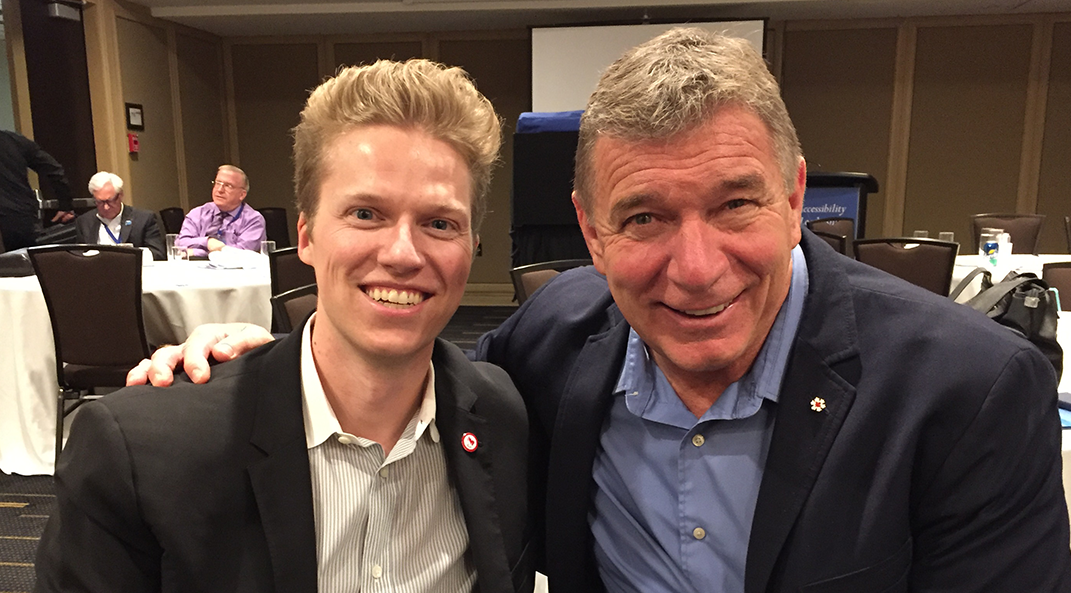 Third Factor CEO Dane Jensen and Rick Hansen
This year, the focus will be primarily on discussing what it means to be a collaborative community of organizations. How do we think about combining our efforts to make sure that we are punching above our weight and not just acting as a number of independent organizations? We are stronger as a whole and through better corporate collaboration, we can accelerate the pace of progress for people with disabilties.
This year also marks the launch of the Accessibility Professional Network, a membership network created to bring together accessibility professionals, consultants, students and anyone passionate about creating a Canada that’s accessible for all. The network will host its first Annual Accessibility Professional Network Conference on Oct. 31-Nov. 1 in Toronto, which will provide a platform to learn about national and international initiatives in accessibility and contribute to enhancing the field of accessibility in Canada.
Canada is a better place to live because of the important work that Rick and the Foundation have done to raise awareness and remove barriers, and we’re pleased that we’re able to contribute to a movement that’s making a real difference in the lives of people with disabilities in this country.
If you’re interested in doing more to improve accessibility within your organization or community, learn more at the Rick Hansen Foundation.
Third Factor CEO Dane Jensen and Rick Hansen
This year, the focus will be primarily on discussing what it means to be a collaborative community of organizations. How do we think about combining our efforts to make sure that we are punching above our weight and not just acting as a number of independent organizations? We are stronger as a whole and through better corporate collaboration, we can accelerate the pace of progress for people with disabilties.
This year also marks the launch of the Accessibility Professional Network, a membership network created to bring together accessibility professionals, consultants, students and anyone passionate about creating a Canada that’s accessible for all. The network will host its first Annual Accessibility Professional Network Conference on Oct. 31-Nov. 1 in Toronto, which will provide a platform to learn about national and international initiatives in accessibility and contribute to enhancing the field of accessibility in Canada.
Canada is a better place to live because of the important work that Rick and the Foundation have done to raise awareness and remove barriers, and we’re pleased that we’re able to contribute to a movement that’s making a real difference in the lives of people with disabilities in this country.
If you’re interested in doing more to improve accessibility within your organization or community, learn more at the Rick Hansen Foundation.