Taking stock of the list above can be overwhelming. “What is most different from three years ago,” shared one advisor, “is the amount of things you need to know – from planning, to asset management, legal, mortgages, insurance, and so on.” And sitting above the array of new technical and product expertise is a heightened level of conversational skills required to build client relationships in which individuals feel safe to discuss highly personal matters – hopes and fears that they often have not shared even with their family or close friends.
Better conversations at scale
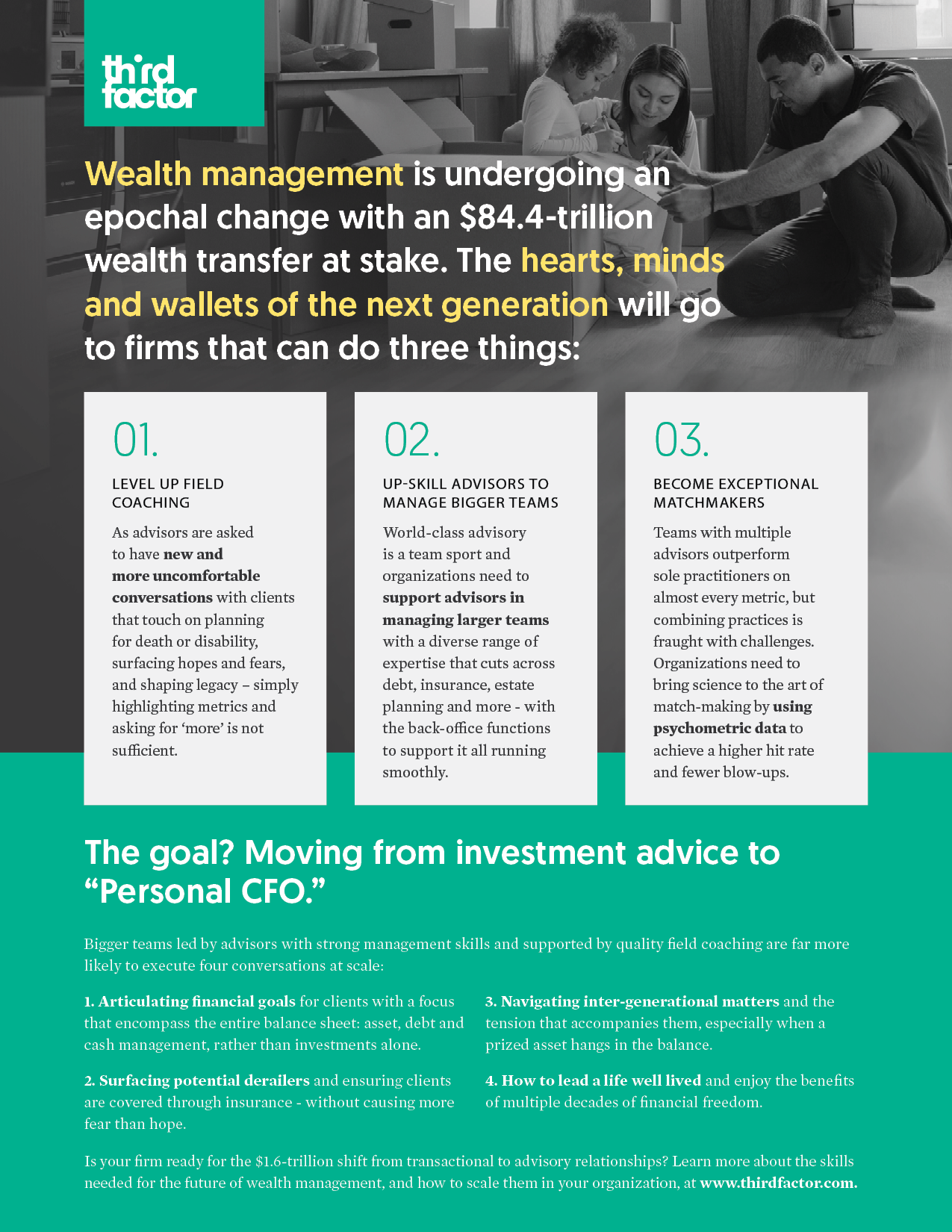
In every wealth management organization, there are high performing advisor teams already having these conversations with their clients. The challenge is doing it consistently and at scale. Even planning conversations, the first and most straightforward of the four categories above, are not yet happening with consistency. As of 2023, JD Power reports that only 57% of full-service wealth management clients say they have a financial plan in place. So how do we scale excellence? Our experience points to three key leverage points for seizing the opportunity:
01.
Level up field coaching to both role model the new kinds of conversations we want advisors to be having with their clients, and to surface and overcome barriers to the adoption of new products and technology.
02.
Equip advisors with the leadership skills to manage bigger teams.
03.
Become exceptional matchmakers to team up advisors with complimentary businesses and skill sets.
LEVELING UP FIELD COACHING – FROM DASHBOARDS TO BEHAVIOR CHANGE
Just as client conversations are shifting from transactional to advisory, so too must internal coaching. In their conversations with advisors, field managers are the critical role model for the types of curious, developmental conversations we want advisors to have with clients.
Historically, field coaching has been dashboard driven – focused on identifying and rewarding high performers and highlighting areas of under-performance to those lagging. As advisors are asked to have new and more uncomfortable conversations with clients that touch on planning for death or disability, surfacing hopes and fears, and shaping legacy – simply highlighting metrics and asking for ‘more’ is not sufficient.
Similarly, driving technology adoption at scale in wealth management is not like rolling out a new, mandatory operating model at McDonald’s. As one consultant put it: “this is an incentive-based business, not a rules-based business.” Field leadership plays a crucial role in helping advisors see the value in new technology and understanding the role it can play in enabling their success, and that of their clients.
To drive new conversations and speed adoption of new technology, field managers need the coaching tools to go beyond dashboard metrics to get at the underlying drivers and blocks of behavior change.
This requires equipping field managers with:
- Strong relationship building skills – in the high autonomy environment of wealth management, the strength of the relationship determines the level of influence.
- A deeper understanding of what drives behavior change (or resistance) – managers need to have a mental model of where resistance comes from and how to overcome it. This is what allows them to be curious rather than judgmental in the face of push-back and dig deep to understand the block they need to remove to change behavior.
- Exceptional questioning, listening and curiosity skills – finally, helping field leaders strengthen their ability to have discovery conversations that seek to understand advisors’ hopes and fears rather than ‘objection handle’ their concerns. Again, this provides role modeling for the types of client conversations we aspire to have.
In our experience, building these skills is best accomplished by identifying an initial cadre of field managers who have both the interest and capacity to become stronger coaches – and investing disproportionately in their development. The results driven by this group can serve as a strong incentive for other managers, and the individuals targeted can serve as internal champions. For example, in one organization we work with, 17 branch managers were nominated by their regional directors to receive extra training and 1:1 support from a master coach for a 12-month period.
EQUIPPING ADVISORS TO LEAD BIGGER TEAMS
A survey of the conversations advisors are being asked to navigate makes it clear that no one has the skills to do it alone. World-class advisory is a team sport and organizations need to support advisors in building larger teams with a diverse range of expertise that cuts across debt, insurance, estate planning and more – with the client service, risk, and back-office functions to support it all running smoothly.
“Advisors all want a team – but they don’t want to manage a team.”
From the advisors’ perspective, downward pressure on fees means they need bigger teams to serve more clients in order to make the same compensation. And bigger practices are more highly valued when the time comes for an advisor to sell their business down the road. It seems like a win-win. And yet, as a seasoned coach to financial advisors put it, “advisors all want a team – but they don’t want to manage a team.” Most advisors pride themselves on their subject-matter expertise and their relationship and selling skills. Managing a team and dealing with the administrative burden from growing headcount is rarely aligned with their areas of core competence. And while some of these responsibilities can be delegated to an office manager, ultimately the leader is responsible for building a compelling vision and team culture that attracts and retains top talent.
More consistent success with creating bigger teams requires that organizations help advisors build people leadership skills. High performing advisors will not get committed to doing things they don’t feel competent at. Training for advisors must go beyond product, sales and client service skills to encompass setting them up for success with ever-growing teams.
BECOMING EXPERT MATCHMAKERS TO TEAM UP ADVISORS
Finally, beyond equipping individual advisors to grow their teams, firms must become experts at developing a repeatable model for combining the practices of individual advisors into teams with multiple advisors.
“Advisors with different backgrounds and skills produce the best performance when teamed up, but those differences can also produce tremendous friction.”
Research by McKinsey has shown conclusively that “team-based wealth management advisors outperform sole practitioners on almost every metric.” Specifically, teams in which the advisors bring a diversity of skills and backgrounds produce the best advisor team performance.
Beyond performance, teaming up advisors also provides more redundancy, allowing advisors to live more balanced lives, and aids in succession planning – a critical priority as a generational shift occurs over the coming 10-15 years.
Accessing these benefits is easier said than done. Advisors with different backgrounds and skills produce the best performance when teamed up, but those differences can also produce tremendous friction and lead to combustion that is both costly and demotivating.
To access the advantages of team performance, wealth management organizations need to bring science to the art of matchmaking to achieve a higher hit rate and fewer blow-ups. This requires:
- Using psychometric data, not just business data, to identify strong teams – two practices may look like an obvious match based on their client lists but be unworkable due to the personalities of the advisors. Using psychometric tools gives organizations a clearer, data-driven view of whose distinct styles will be complimentary vs. combustible.
- Having tough interpersonal conversations up front – using the same psychometric data, organizations can increase eventual success rates by having tough, data-driven conversations up-front that surface and plan for likely sources of conflict based on each advisor’s unique style.
- Building the skill of collaboration – collaborating with someone different than you is a learnable skill that can be improved with practice. Providing advisors with up-front models for working through conflict and effectively working together can head off potential derailers down the road.
There has never been a moment of so much opportunity and risk in the wealth management industry. The firms who can pair a team-based structure with high quality field coaching and technology that enables advisors to confidently broaden the conversations they have with clients are those who stand to gain from volatility and win the hearts, minds, and wallets of the next generation.
Take this whitepaper to go
Enter your name and work email address to instantly access the PDF.




















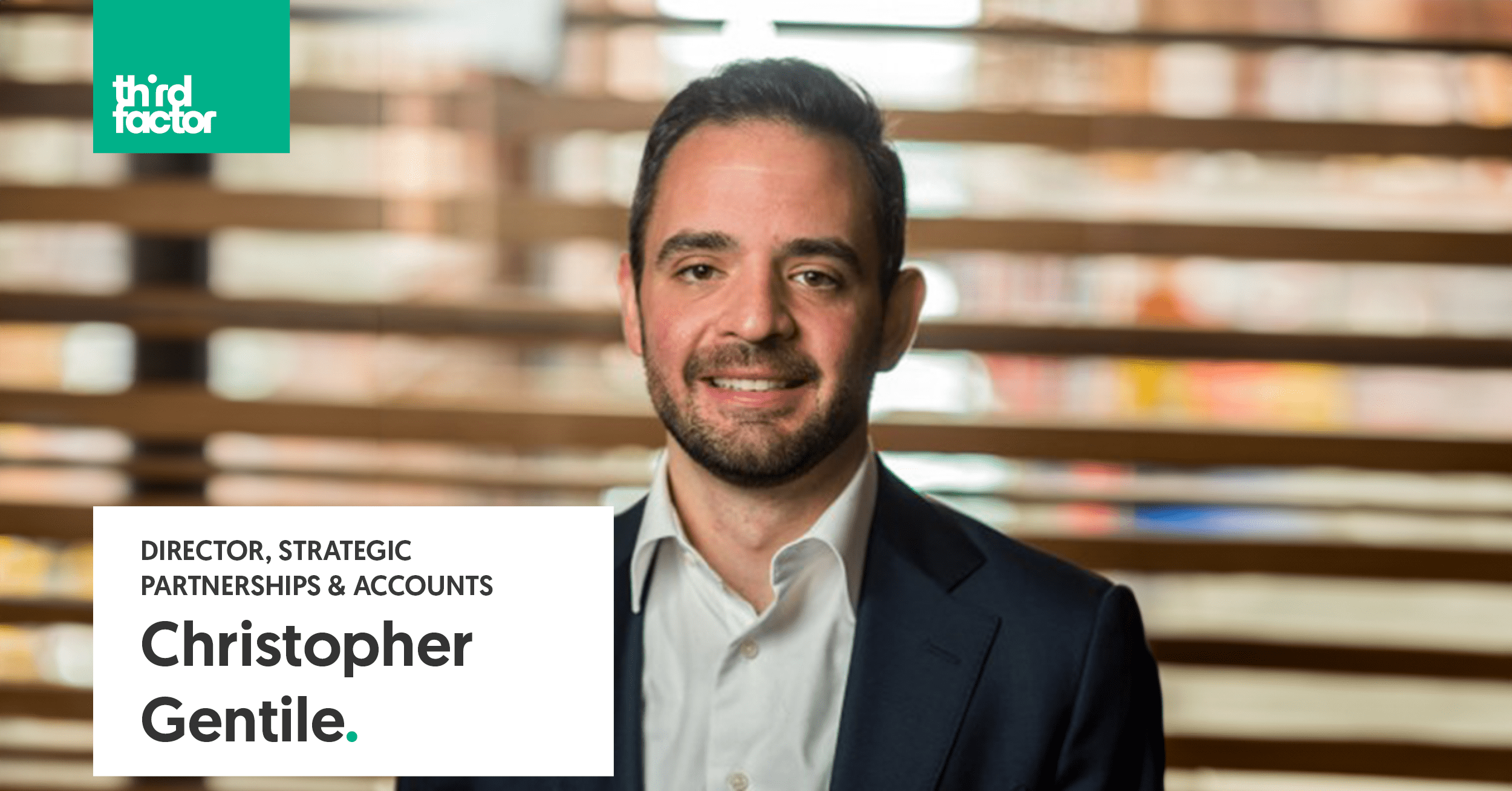 Chris joins us from the Smith School of Business at Queen’s University, where he managed client relationships for customized executive education programs – many of which were delivered in partnership with Third Factor. Before Queen’s, Chris oversaw strategic partnerships at EF Education First, a private education firm focused on developing professionals through educational travel.
Chris holds a Bachelor’s degree from the University of Toronto, and a certificate in Adult Learning & Development from the Ontario Institute of Studies in Education (OISE) at UofT.
Chris has shown a true passion for helping organizations develop their workforce for the future and working with thought-leaders to develop innovative solutions that drive lasting change. We’re excited to see him continue to build on his success with Third Factor. In the midst of rapid expansion and a shift to a remote-first environment, retail consulting and technology company, Orium, partnered with Third Factor to give its leaders a framework and skills to lead with its values.
Twenty-four of Orium’s leaders participated in a total of three days of training, leading to an uplift in engagement among leaders and their teams, and enabling the organization to navigate the pressure that comes with doubling in size.
Click here to read the case study.
Chris joins us from the Smith School of Business at Queen’s University, where he managed client relationships for customized executive education programs – many of which were delivered in partnership with Third Factor. Before Queen’s, Chris oversaw strategic partnerships at EF Education First, a private education firm focused on developing professionals through educational travel.
Chris holds a Bachelor’s degree from the University of Toronto, and a certificate in Adult Learning & Development from the Ontario Institute of Studies in Education (OISE) at UofT.
Chris has shown a true passion for helping organizations develop their workforce for the future and working with thought-leaders to develop innovative solutions that drive lasting change. We’re excited to see him continue to build on his success with Third Factor. In the midst of rapid expansion and a shift to a remote-first environment, retail consulting and technology company, Orium, partnered with Third Factor to give its leaders a framework and skills to lead with its values.
Twenty-four of Orium’s leaders participated in a total of three days of training, leading to an uplift in engagement among leaders and their teams, and enabling the organization to navigate the pressure that comes with doubling in size.
Click here to read the case study.
 About the presenter:
Dane Jensen is the CEO of Third Factor, the author of The Power of Pressure: Why Pressure Isn't The Problem, It's The Solution, an acclaimed speaker, an instructor at Queen's University and the University of North Carolina, and a regular contributor to Harvard Business Review.
About the presenter:
Dane Jensen is the CEO of Third Factor, the author of The Power of Pressure: Why Pressure Isn't The Problem, It's The Solution, an acclaimed speaker, an instructor at Queen's University and the University of North Carolina, and a regular contributor to Harvard Business Review.














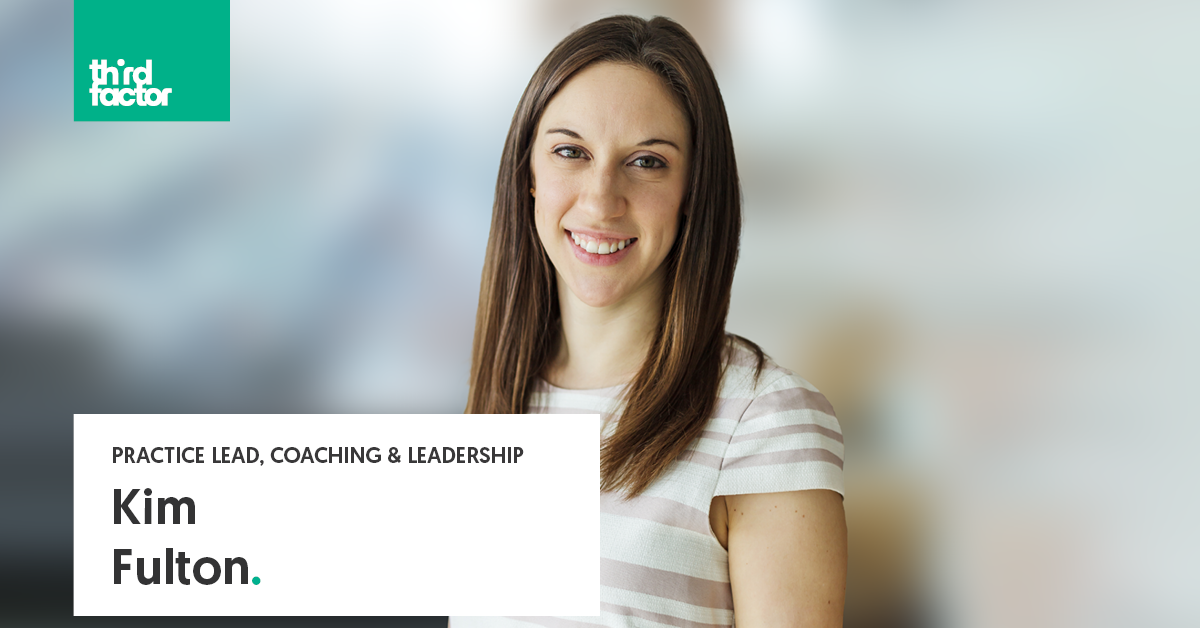 Third Factor has been teaching coaching skills to managers for 30 years, since our Founders Peter Jensen and Sandra Stark pioneered the application of the principals they were observing in their work with Olympic coaches to the corporate world. Rooted in our best-in-class 3×4 Coaching model, our suite of coaching programs have helped tens of thousands of leaders become better coaches. I can’t think of anyone more perfectly suited to continue this tradition of excellence than Kim.
Kim joins us from the consulting firm, Kearney, where she created and led the firm’s employee experience centre of expertise. As part of this role, she established Kearney’s thought leadership in the employee experience space and developed new product offerings to help organizations reimagine work from an employee-centric perspective.
Kim also brings expertise in, and passion for, diversity, equity and inclusion (DEI) initiatives. She’ll be drawing on her experience working with Catalyst, a leading voice in DEI, and as the leader of Kearney’s Women’s Network, to ensure our coaching and leadership programs continue to lead the way when it comes to inclusivity.
Kim not only earned her MBA from the Smith School of Business at Queen’s University, but graduated at the top of her class. She now serves on the Advisory Board for the Full-Time MBA.
Welcome to the Third Factor team, Kim. We can’t wait to see how our programs will benefit from your passion and expertise. How do you make a leadership development program stick at a time when there are so many competing priorities?
This is the problem Renee Landry, Bayer’s U.S. Learning Lead, and Rachel Lamb, Bayer’s Senior Leadership Expert, set out to solve. The solution was Rise & Thrive, an innovative microlearning experience developed in partnership with SweetRush and Third Factor.
Approximately half of Bayer’s US leaders voluntarily participated in the program, which has received outstanding quantitative and qualitative feedback from participants as well as attention from the broader learning industry. The program has also been recognized with four Brandon Hall Group Excellence Awards.
Click here to read the case study.
Third Factor has been teaching coaching skills to managers for 30 years, since our Founders Peter Jensen and Sandra Stark pioneered the application of the principals they were observing in their work with Olympic coaches to the corporate world. Rooted in our best-in-class 3×4 Coaching model, our suite of coaching programs have helped tens of thousands of leaders become better coaches. I can’t think of anyone more perfectly suited to continue this tradition of excellence than Kim.
Kim joins us from the consulting firm, Kearney, where she created and led the firm’s employee experience centre of expertise. As part of this role, she established Kearney’s thought leadership in the employee experience space and developed new product offerings to help organizations reimagine work from an employee-centric perspective.
Kim also brings expertise in, and passion for, diversity, equity and inclusion (DEI) initiatives. She’ll be drawing on her experience working with Catalyst, a leading voice in DEI, and as the leader of Kearney’s Women’s Network, to ensure our coaching and leadership programs continue to lead the way when it comes to inclusivity.
Kim not only earned her MBA from the Smith School of Business at Queen’s University, but graduated at the top of her class. She now serves on the Advisory Board for the Full-Time MBA.
Welcome to the Third Factor team, Kim. We can’t wait to see how our programs will benefit from your passion and expertise. How do you make a leadership development program stick at a time when there are so many competing priorities?
This is the problem Renee Landry, Bayer’s U.S. Learning Lead, and Rachel Lamb, Bayer’s Senior Leadership Expert, set out to solve. The solution was Rise & Thrive, an innovative microlearning experience developed in partnership with SweetRush and Third Factor.
Approximately half of Bayer’s US leaders voluntarily participated in the program, which has received outstanding quantitative and qualitative feedback from participants as well as attention from the broader learning industry. The program has also been recognized with four Brandon Hall Group Excellence Awards.
Click here to read the case study.
