As people leave their jobs in record numbers, organizations are facing two urgent challenges: increase engagement to reduce churn; and prepare those who stay to adapt to the rapidly changing needs of the business.
The solution to both of these challenges is to invest in people and get them excited about their own growth and development. People are more likely to stay – and more resilient to changing demands – when they feel a sense of growth, contribution and connection. But with 40% of employees saying they’re likely to leave their job within 6 months1, time is running out.
Career Conversations is a highly interactive one-hour session that puts people leaders at the centre of a strategy for helping employees develop a clear and compelling view of their path forward in the organization. Leaders are introduced to the “why,” “what,” and “how” of career conversations, and begin engaging with their people before the hour is up. The program can be quickly implemented and scaled to the entire organization, effecting rapid, positive change.
In this 60-minute webinar, Third Factor Associate Trainer Rishi Behari will introduce the Career Conversations program and unpack the leader’s toolkit for holding effective developmental conversations with their people. You’ll leave with a compelling image of what effective career conversations look like, new skills for converting that image into action, and a plan for holding career conversations with clear goals and accountability built in.
You should attend if:
- You are in an HR role and have an urgent need to build employee engagement
- You are a senior leader looking for strategies to adapt to a rapidly changing workforce
- You are responsible for leadership development and need scalable ideas for creating a culture of development
- You want to build your own ability to hold effective career conversations with the people on your team
SORRY WE MISSED YOU
This event has passed, but it won’t be the last. Be the first to know about future webinars from Third Factor by entering your information below.
 About the presenter:
Rishi Behari is a professional coach, consultant, teacher, facilitator and speaker who has carved out an unlikely career path amidst adversity, pressure, and uncertainty, having grown up in an interracial family in the heart of the Canadian prairies.
Rishi has dedicated his professional life to helping others discover and realize their passions, dreams, and potential. He is known for injecting personality, humor, wit and infectious energy into his work and teaching. He draws from his and his students’ personal experiences in order to create an open, engaging and safe environment for leaders at all levels. His relentless desire to explore, innovate and challenge the status quo have made him a multidisciplinary force for igniting positive change in people and organizations.
Rishi comes to the Third Factor team with an impressive and eclectic background across industries, having worked with some of the top schools, businesses, and organizations in the world. His range of experiences include raising ten thousand dollars at the age of nineteen to fund his first entrepreneurial venture, appearing as a business expert on live international television, helping to establish the world’s first premier business program in artificial intelligence, sitting on the advisory board for Canada’s first student-run AI startup incubator, working in the not-for-profit sector to fight systemic inequality and discrimination, teaching in academia and over five years as the VP of a multinational consulting firm.
Rishi is a former university athlete in soccer, and an avid sports and travel enthusiast, having traveled to two World Cups of Soccer, the European Cup of soccer, and the Winter Olympics. His academic credentials include BAs in psychology and sociology and an MBA from the Smith School of Business at Queen’s University and IE Business School in Madrid, Spain.
1 Source: McKinsey
We have long said growth is what gives meaning to pressure. During difficult times, the people who are most likely to stay committed are the ones who have clarity and feel like they’re moving forward with their personal development. And the person with the greatest ability to provide clarity and help drive that development forward is their leader; their coach.
In this interactive, 60-minute online session, one of Canada’s leading experts on coaching, Cyndie Flett, will explore the strategies great coaches use to ensure clarity, inspire and develop their people even when faced with significant uncertainty. And, she’ll introduce the tools leaders can use to overcome the logistical challenges of building engagement while working remotely.
This session is about people – not technology. The environment has changed, but people’s basic needs haven’t. You will come away with a better understanding of the role coaches play in supporting people to rise to the occasion while meeting them where they’re at. You’ll also gain practical tools you can immediately apply in your environment, backed up by examples and best practices from top coaches.
Participants will learn:
- What “overcommunication” really means and the specifics of what information people need to hear, when they need to hear it, and how it needs to be delivered.
- How to use focusing and clarifying questions with examples that can be used immediately.
- How to overcome common blocks to giving effective feedback when leading remotely.
- Tools and strategies for building a communication system and overcoming the logistical challenges that leaders of remote teams face.
SORRY WE MISSED YOU
This event has passed, but it won’t be the last. Be the first to know about future webinars from Third Factor by entering your information below.
About the presenter:
 Cyndie Flett
 is one of Canada’s leading experts on coaching. As the former Vice President of Research and Development for the Coaching Association of Canada, and Director of the National Coaching Certification Program, Cyndie has dramatically impacted the way that literally millions of coaches are educated across the country.
Resilience – the ability to grow through pressure, recover and respond in the face of setbacks, and perform under pressure – is a skill learned in the troughs, not the peaks.
As a result of COVID-19, employees and managers are facing changes in pretty much every aspect of their work – what they need to do, how it needs to get done, where they need to do it from – and also facing the spectre of potentially significant impacts to compensation and results. There hasn’t been a time since 2008 in which resilience is more necessary or more top-of-mind.
Further reading: COVID-19: Ways Forward for Learning & Development
In the face of this tremendous uncertainty and need for resilience, we’ve developed a 60 minute, interactive, virtual, instructor-led session that will equip participants with an understanding of how uncertainty and pressure impact their performance and health, an awareness of the choices they have to enhance their resilience under pressure, and a guided, applied exercise that will specifically tackle how they are framing and taking direct action on the areas that will most impact their performance and resilience over the coming few months.
Participants will leave with a better understanding of what they can control, what they need to let go of, and how they can approach the current and coming uncertainty in a way that maximizes their resilience. As an organization, providing your people with the skills to navigate this period will build engagement and signal a strong commitment to their growth, development and well-being.
The coming few months may not be enjoyable, but with the right tools everyone can emerge with the satisfaction of knowing that they were up to the challenge and high levels of engagement with their job and organization.
Building Resilience When it Matters Most
This webinar has already happened, but you can watch it on demand. Please enter your information below and we’ll email you an access link.
About the presenter:
 Dane Jensen
 is the CEO of Third Factor and an expert on strategy, leadership, and resilience under pressure. Dane oversees Third Factor’s delivery of leadership development programs to leading firms across North America including SAP, TD, RBC, Uber, Twitter, the USGA, and others. He teaches in the Full-Time and Executive MBAs at Queen’s Smith School of Business in Canada and is Affiliate Faculty with UNC Executive Education at the Kenan-Flagler Business School. In addition to his corporate work, Dane works extensively with athletes, coaches, leaders and Boards across Canada’s Olympic and Paralympic sport system to enhance National competitiveness. He has worked as an advisor to Senior Executives in 23 countries on 6 continents, and his first book, tentatively entitled The Power of Pressure, will be published by HarperCollins in early 2021.
In 2002, the Canadian Women’s National Hockey Team entered the Olympic Games in Salt Lake City in an unfamiliar position: as underdogs. They had not hit their stride as a team, their confidence had taken a hit, and emotions were at risk of boiling over. In eight head-to-head games against the Americans leading up to the Olympics, Canada had lost all eight. For many players, it was hard to avoid memories from four years earlier when the team had lost to the Americans in the gold medal game.
Jayna Hefford, who was playing in the first Games of her Hall of Fame career, recalls the point when the stress and emotion came to a head: “There was an intense conversation in the dressing room with the team. A lot of people had a lot to say about things we needed to do and how we were going to get better, and we realized that a lot of what was happening was the blame game.”
“We realized that a lot of what was happening was the blame game.”
Through a frank, players-only discussion the team was able to come together, but the conversation could have gone a number of different ways. It stayed on track because the team was prepared – mentally and emotionally – to have performance conversations under pressure and surface a number of issues the team needed to resolve. And that preparation turned out to be an important stepping stone to winning gold in Salt Lake City.
Training the bomb squad
Handled poorly, team communication under pressure can lead to combustion. And just like you wouldn’t get success as a bomb disposal technician going in without their toolkit, you won’t find success in communicating through tense situations if your team isn’t prepared. The advantage the women’s team had that allowed them to emerge from that conversation united was a deep awareness of their communication tendencies and systems to counteract the counterproductive ones. They had laid the foundation for performance conversations in good times so that they could happen and be productive when the difficulty hit.
In other words: they had a tool kit and they knew how to use it.
“The biggest opportunity for meaningful growth is often to increase self-awareness and strengthen their ability to communicate productively when under pressure.”
We’ve worked with hundreds of teams in elite sport and business, including the last four medal-winning Canadian women’s hockey teams. One of the things we’ve learned is that when teams are already operating at a high level, the biggest opportunity for meaningful growth is often to increase their self-awareness and strengthen their ability to communicate productively when under pressure. To support this, we’ve developed a process to help teams become more aware of their tendencies, develop systems and practice performance conversations anytime.
At the heart of this process is a tool called the TAIS – The Attentional and Interpersonal Styles inventory. The TAIS was developed for use by Navy SEALs and Olympic athletes, and we’ve found it to be an incredibly valuable tool for diagnosing communication challenges on all kinds of teams. When the pressure is on, when teams are in the midst of setbacks and failure, individuals will fall back on their default communication styles.
Five communication choices
The author of the TAIS, Dr. Robert Nidefer, showed that people make five choices over and over in the course of a conversation. These choices are informed by their tendencies on five dimensions.
Give up/take control – are you more likely to try to take control, or cede control to someone else?
Speed up/slow down – are you more likely to force action or a decision, or encourage more thought and consideration?
Extroverted/introverted – are you going to seek out others, or try to solve the problem yourself?
Become quiet/express thoughts – are you going to become quiet and try to understand, or advocate for your position?
Critique/express support – will you say no and become more critical, or will you say yes and express support?
Cut the right wire
Every team will have members with different tendencies. Ultimately, it’s not the tendencies that matter; it’s the level of awareness team members have of their tendencies, and the systems they put in place to leverage their strengths and weaknesses in the heat of the moment. The highest performing teams we work with take three critical steps in preparing for productive communication under any circumstances.
Acknowledge the “I” in team
Great coaches know that the phrase “there is no I in team” is a myth. Every individual makes their own contribution – and without self-awareness, people can’t adjust. That’s why the first step in your team’s communication action plan is to encourage every individual to build self-awareness across these five choices. By knowing and understanding their default tendencies, team members can begin to recognize their behaviour and course-correct when necessary for the good of the team.
Connect to the “we” of the team
It’s advantageous to know your individual tendencies, and the value is multiplied when that information is shared with everyone on the team. When you raise the waterline of team awareness, everyone can work on the same communication system. Team members can see the intent behind the behaviors their teammates exhibit. The process can be incredibly difficult; Team Canada Captain Hayley Wickenheiser called sharing her profile with her team-mates, “the most stressful part of the 4-year [Olympic] quadrennial.”
Come together as a team
Armed with knowledge of self and others, teams can come together and translate self-awareness into action. When pressure hits, if everybody on the team has the tendency to get louder, express their thoughts and try to take control of the conversation, the team can make decisions in advance to decide who’s going to take control when issues arise. By having these conversations earlier, teams can build systems to fall back on when the pressure is turned up.
Preventing detonation
The next time you’re headed into a potentially high stakes conversations, use the five choices below to carry out a short 3-step preparation exercise:
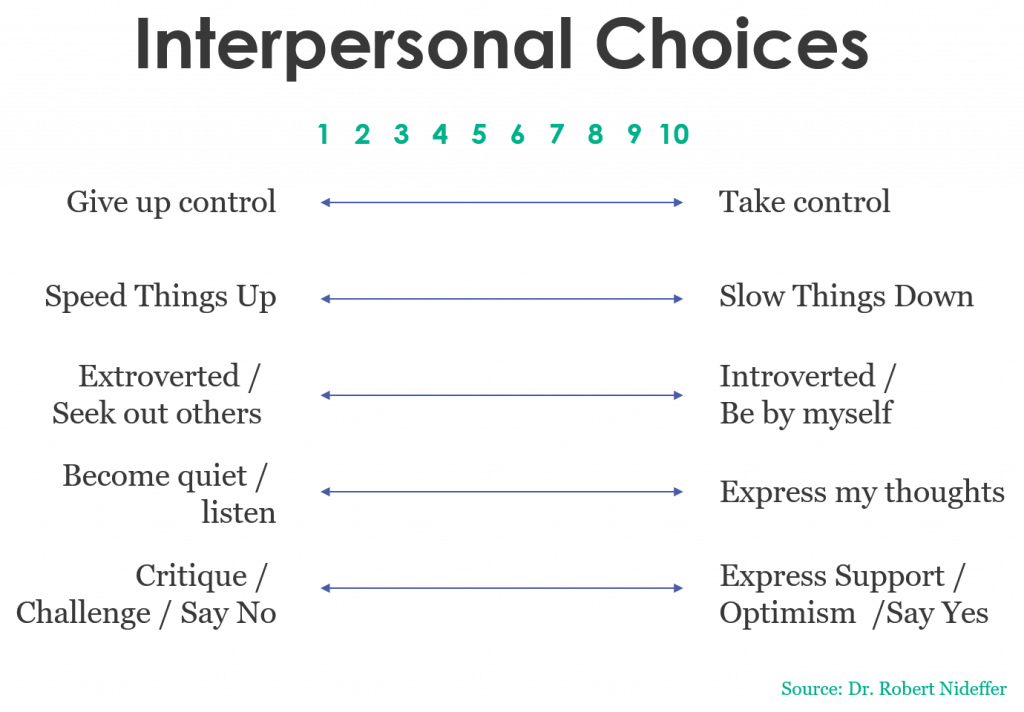
1. Plot your default tendency on each of the five scales – given your past history, where are you most likely to fall?
2. Where would you ideally like to be as you head into this specific interaction?
3. What are the gaps between your ideal and default style? What actions will you take to ensure you are at your ideal?
Repurpose the fuel for growth
We’ve said before that negative emotion is volatile fuel. Improperly handled, it can lead to combustion. Used properly, it can lead to high performance.
Team communication must go beyond just staying cool during difficult times. Teams must use communication to understand and lean in to their negative emotions, uncover what the emotions are telling them, and frame it as an opportunity for growth. This is what happened with the women’s team in 2002. They prepared to have productive communication at all times, and used the tools they learned to find the opportunity for growth at a moment when it could have blown up. Jayna Hefford explains:
By understanding your individual communication style, sharing your tendencies with the team and proactively planning to address potential faults, your team can find its way through difficult times and not just safely diffuse difficult situations but find new strength and opportunity for higher performance in the process.
In the summer of 2019, we changed our name from Performance Coaching to Third Factor. We’ve heard so much positive feedback on the name change, but there’s a big question I’ve been asked many times over: what does third factor mean?
I have the privilege of teaching in the Executive Leadership program at Queen’s University, and I took some time to explain the concept in a recent class. If you’re curious to learn more about the concept of Third Factor, this video will shine some light.
By Dane Jensen / CEO, Third Factor
All teams suffer setbacks. What separates resilient teams from the rest is how they respond. Resilient teams come back stronger after failure because leaders and team members lean into the negative emotions that inevitably accompany setbacks and use the energy under those emotions to fuel recovery.
Negative emotion is volatile fuel
Heading into the women’s World Cup in 2011, Canada’s national soccer team was one of the favourites. Two weeks later, they were knocked out of the round robin in a 4-0 defeat to France and headed home without winning a game – finishing dead last.
“It wasn’t going to define us”
Team Captain Christine Sinclair talked about feeling “humiliated” – like they had let down the country. And yet just one year later, the same team outperformed at the London Olympics to win Canada’s first ever medal in soccer. “We knew what we were capable of and just because we had one bad tournament it wasn’t going to define us,” said Sinclair. The head coach of the Women’s National Team, John Herdman, spoke about how the team was “an easy group to motivate” because they had just suffered such a crushing defeat.
Negative emotion can be powerful fuel for positive response. It can provide ‘bulletin board material’ that leads to determination, and ultimately harder work and higher standards.
But negative emotion is highly volatile fuel. If not handled correctly, it can trigger a negative feedback loop that leads to the blame game and teams that end up either combusting or just detaching.
Three Jobs for Leaders of Resilient Teams
We’ve observed that leaders of resilient teams are able to trigger the positive feedback loop from negative feedback by doing three things differently than leaders of less resilient teams:
1. Lean into negative emotion
Leaders of resilient teams don’t retreat from negative emotion. They don’t try to rescue people from it and make them feel good. Rather, they use it for its developmental potential.
The psychologist Roberto Assagioli has said, “a psychological truth is that trying to eliminate pain merely strengthens its hold. It is better to uncover its meaning, include it as an essential part of our purpose and embrace its potential to serve us.”
When leaders try to reassure people or make the pain go away, they rob it of its power. It is better to acknowledge the pain and embrace it so that it can be used to fuel growth.
“As painful as it feels now, it will help him.”
So, what does ‘leaning in’ look like? Consider “the shot.” Kawhi Leonard’s quadruple bouncing Game 7 buzzer beater was a moment of euphoria for Toronto. On the other side, however, it was a devastating moment for a young Philadelphia 76ers team featuring 25-year-old star Joel Embiid, who left the court in tears. When asked about the emotional response of Embiid in the post-game press conference, Philadelphia head coach Brett Brown said, “As painful as it feels now, it will help him. It will help shape his career.” Rather than shying away from the pain, comforting Embiid and trying to lessen the sting, Brown leaned into it and helped his young player see it as a growth opportunity – a sign that he needed to work harder.
2. Frame negative emotion differently
Leaders of resilient teams have a different answer to the question “what is this pain telling us?” than leaders of less resilient teams.
They frame pain as a signal that they aren’t there yet – rather than a sign that they aren’t good enough. As a result of this framing, resilient teams respond to negative emotion with determination. They get committed to the challenges they face by exerting control where it matters: their own effort.
After a lacklustre season heading into Salt Lake City in 2002, the Canadian women’s hockey team held a player’s only meeting where they came up with the acronym WAR, for ‘We Are Responsible.’ As 4-time gold medalist Janya Hefford reports, “there was a lot of the blame game going on”– and the WAR framing helped them redirect attention away from the officiating, their opponents, etc. and towards what they were responsible for. Ultimately, this perspective proved vital in overcoming 8 straight penalties in the Gold-Medal game to triumph.
3. Channel negative emotion
After embracing negative emotion and finding its meaning, teams and their leaders must still channel the emotion into positive outcomes. Our founder, Peter Jensen, will often ask teams who have suffered failure one powerful question: “What are we going to do with the energy under this emotion?”
it’s easy to channel emotion into what Ben Zander has called “the conversation of no possibilities” and allow the dangerous side of negative emotion affect to take over. Channeling negative emotion productively requires individuals on teams to take responsibility for redirecting energy towards growth and hard work.
Negative emotion is fuel for growth
Resilient teams process negative emotion in a way that leads to harder work and higher standards as opposed to detachment or combustion. They do that by leaning into negative emotion rather than retreating, by framing it a little differently and by seeing it with a sense of challenge, control and commitment.
As a leader, your job is to create the conditions that allow negative emotion to be used to its full potential. The next time your team suffers a setback, encourage your team to accept their feelings, find meaning in their failure, and channel their emotions to come back stronger than before. We all know that we need to move our training focus beyond simply acquiring knowledge; success in training is about the application of new knowledge and skills – it’s about behaviour change. Unfortunately, right now we are failing in this mission: only 10-20% of what people learn in a training session is transferred back to the workplace. The reason? Recent research shows us that there is a distinction between a ‘motivation to learn’ and a ‘motivation to transfer’, and while most organizations are good at tapping into the first source of motivation, the second is often left unaddressed.
Drawing on her 20+ years of experience in the corporate training world, Peggy Baumgartner debunks two common fallacies surrounding what it takes to tap into this ‘motivation to transfer’ – and highlight a strategy that we use at Third Factor to close the gap between learning and doing, and ensure successful application of the knowledge gained in learning events.
Click here to download the whitepaper. If there is one thing we can be certain of, it is the inevitability of uncertainty.
The world is not a still photograph –it is a motion picture and it requires that we are comfortable with change. As much as we may try to avoid periods of uncertainty, it is expected that we will experience them. However, it is during these periods that we are presented with an unparalleled opportunity to learn, to grow, and to adapt.
Peter Jensen discusses the merits of framing change as a challenge and provides suggestions on how to embrace periods of chaos in a healthy manner.
Click here to download the whitepaper.