SORRY WE MISSED YOU
This event has passed, but it won’t be the last. Be the first to know about future webinars from Third Factor by entering your information below.

 Cyndie Flett is one of Canada’s leading experts on coaching. As the former Vice President of Research and Development for the Coaching Association of Canada, and Director of the National Coaching Certification Program, Cyndie has dramatically impacted the way that literally millions of coaches are educated across the country.
“We can’t go back, only forward.”Ask yourself what your team needs for their new playbook. Do your people know what the work expectations are today? Timelines are different. Things change quickly so clarity is always evolving. Think short term and help them find focus. Do they know what other people need from them? Are they aware of how your goals have shifted? Especially if your team is working differently than they’re used to, over-communication is impossible when it comes to these things. Your team also needs clarity on what your organization’s values look like in this reality. Not just the vague, nice-sounding words – what they actually look like. If you value safety, how are you acting on that value? If you value team, how are you making sure that no one’s feeling isolated? Get together as a team to discuss your values and think through how you’re living up to them at this time. Through all of this, recognize that as a coach you need to meet your people where they’re at. Some team members might be juggling kids and other family constraints. They may even be caring for someone who is sick. Give them real clarity on how your team can work well together in a way that’s not going to make anyone feel criticized, judged or guilty. Have empathy for what they’re going through and use humour to help people feel at ease. Some team members (and perhaps even you) may be thinking they just need to hold on for a little bit longer until things get back to normal. That thinking will not serve them or the organization well. When companies face disruption, the ones who try to ignore it or find a way to hang on to their old ways of doing things don’t fare well – think Blockbuster. We can’t go back, only forward.
“When loss isn’t acknowledged, it feels like it’s been dismissed.”This is true on both sides of the relationship. In Sheryl Sandberg’s book, Option B: Facing Adversity, Building Resilience, and Finding Joy, she talks about how the hardest part of going back to work after losing her husband was the silence. When loss isn’t acknowledged, it feels like it’s been dismissed. And a significant loss being dismissed feels really bad. You don’t need to be a counsellor or have all the answers, and there’s no secret formula for how to deal with these times. Your job as a coach is to bring things to the surface and give people permission to talk about it if and when they want.
“We stand ready to support our athletes, coaches and leadership organizations through the coming months and in Team Canada’s inevitable return to Olympic competition.”By withdrawing Team Canada from the Tokyo Games, the COC and CPC have made an important statement that this crisis is bigger than the Olympic and Paralympic Games and that our collective health and safety should be our only priority over the coming months. They have also given a clear answer to the athletes who have been tortured by uncertainty and were wondering whether they would have a chance to compete and, if so, whether they would have to risk their health in order to do so. We join the COC and CPC in calling on the International Olympic and Paralympic Committees to postpone the Tokyo Games by one year so that all members of the international community may focus on their physical, mental and financial health, caring for loved ones, and doing their part to stop the spread of COVID-19. For the last three decades, our organization has been proud to support the Olympic community in Canada. We stand ready to support our athletes, coaches and leadership organizations through the coming months and in Team Canada’s inevitable return to Olympic competition. Signed, Dane Jensen, Peter Jensen, Sandra Stark, Peggy Baumgartner, Garry Watanabe & Cyndie Flett on behalf of the entire team at Third Factor.
Further reading: COVID-19: Ways Forward for Learning & DevelopmentIn the face of this tremendous uncertainty and need for resilience, we’ve developed a 60 minute, interactive, virtual, instructor-led session that will equip participants with an understanding of how uncertainty and pressure impact their performance and health, an awareness of the choices they have to enhance their resilience under pressure, and a guided, applied exercise that will specifically tackle how they are framing and taking direct action on the areas that will most impact their performance and resilience over the coming few months. Participants will leave with a better understanding of what they can control, what they need to let go of, and how they can approach the current and coming uncertainty in a way that maximizes their resilience. As an organization, providing your people with the skills to navigate this period will build engagement and signal a strong commitment to their growth, development and well-being. The coming few months may not be enjoyable, but with the right tools everyone can emerge with the satisfaction of knowing that they were up to the challenge and high levels of engagement with their job and organization. About the presenter:
 Dane Jensen is the CEO of Third Factor and an expert on strategy, leadership, and resilience under pressure. Dane oversees Third Factor’s delivery of leadership development programs to leading firms across North America including SAP, TD, RBC, Uber, Twitter, the USGA, and others. He teaches in the Full-Time and Executive MBAs at Queen’s Smith School of Business in Canada and is Affiliate Faculty with UNC Executive Education at the Kenan-Flagler Business School. In addition to his corporate work, Dane works extensively with athletes, coaches, leaders and Boards across Canada’s Olympic and Paralympic sport system to enhance National competitiveness. He has worked as an advisor to Senior Executives in 23 countries on 6 continents, and his first book, tentatively entitled The Power of Pressure, will be published by HarperCollins in early 2021.
What can you expect at this event? Take a look at this recap from our last executive breakfast.
 Olympian Karyn Garossino, BA, M. Ed., brings a combination of insight and grit from 40+ years of being coached and coaching others. Her experience at the highest levels of elite sport, Master’s Degree in psychology and adult education, and experience working with thousands of leaders in business and government bring huge depth to her understanding what it takes to thrive under pressure—and to lead others to do the same.
 Just minutes from Union Station on Toronto’s waterfront, OCAD U CO is a state-of-the-art 14,000 square foot studio designed specifically for collaborative innovation work. The space features is home to 20 resident design-led startups, a suite of formal and informal meeting spaces, and is the setting for our program, How To Lead Innovation, which we run in partnership with OCAD U CO and the Smith School of Business at Queen’s University.
This event has been postponed. Be the first to know when it’s rescheduled by entering your information below.
“We realized that a lot of what was happening was the blame game.”Through a frank, players-only discussion the team was able to come together, but the conversation could have gone a number of different ways. It stayed on track because the team was prepared – mentally and emotionally – to have performance conversations under pressure and surface a number of issues the team needed to resolve. And that preparation turned out to be an important stepping stone to winning gold in Salt Lake City.
“The biggest opportunity for meaningful growth is often to increase self-awareness and strengthen their ability to communicate productively when under pressure.”We’ve worked with hundreds of teams in elite sport and business, including the last four medal-winning Canadian women’s hockey teams. One of the things we’ve learned is that when teams are already operating at a high level, the biggest opportunity for meaningful growth is often to increase their self-awareness and strengthen their ability to communicate productively when under pressure. To support this, we’ve developed a process to help teams become more aware of their tendencies, develop systems and practice performance conversations anytime. At the heart of this process is a tool called the TAIS – The Attentional and Interpersonal Styles inventory. The TAIS was developed for use by Navy SEALs and Olympic athletes, and we’ve found it to be an incredibly valuable tool for diagnosing communication challenges on all kinds of teams. When the pressure is on, when teams are in the midst of setbacks and failure, individuals will fall back on their default communication styles.
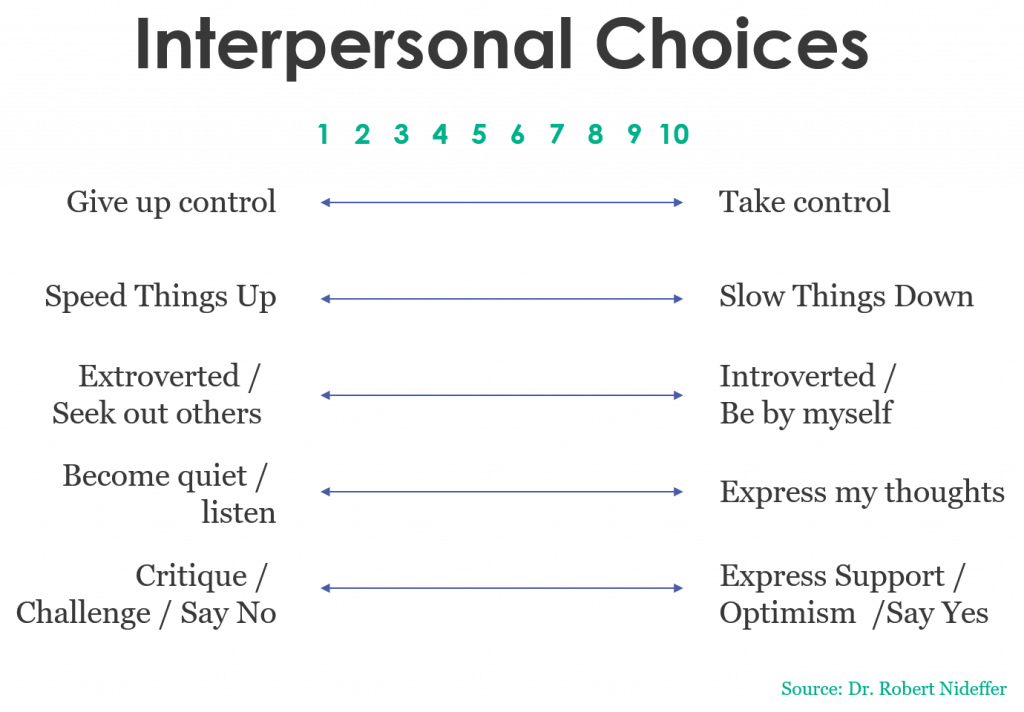
The next time you’re headed into a potentially high stakes conversations, use the five choices below to carry out a short 3-step preparation exercise:
1. Plot your default tendency on each of the five scales – given your past history, where are you most likely to fall?
2. Where would you ideally like to be as you head into this specific interaction?
3. What are the gaps between your ideal and default style? What actions will you take to ensure you are at your ideal?