
Meet our expert: Peggy Baumgartner, Chief Learning Officer

“How Do I Keep My Team Focused and Engaged When Change Won’t Stop And We Are at Capacity?”
Building, maintaining, and deepening relationships
The deeper your connection with your team, the greater your influence. That relationship is the pipeline through which all communication flows. If that pipeline is clogged or doesn’t exist, it means that when you need strong communication the most, it won’t happen. Which brings me to energy. We often frame the feeling of being overwhelmed as a time management problem. And so we ask ourselves: Where do I find additional time? But many leaders are already great at time management, and that question won’t get you far. The better question is: Where can I find the energy? Pay attention as you move through your day. When does time seem to fly? What fills you up? What are your strengths? You will have far more energy working on things you feel you do well, and it’s remarkable how much gets done when energy is high and how little when it’s depleted. And this isn’t just about you. A big part of your job right now is making sure your people have the energy to do what they need to do. They need to believe in themselves and believe they have the trust and relationship with the person who matters most to them: their leader. And finally, when things do get hard, here is the one habit worth picking up: Stop listening to yourself and start talking to yourself. During hard times, the inner critic gets loud. This is so hard. I’m not on top of things. I can’t do this. The best performers don’t silence that voice by ignoring it. They pause and ask: Is it true? Yes, work is often hard. But does hard mean you’re not good at it? No. It might mean a task is new or difficult. It might mean you’re doing something no one has figured out yet. Get clear on what’s actually true and lead from there.Sustainable leadership for the long haul
Leading through relentless change is genuinely hard. And somewhere in the middle of keeping your team focused, your strategy on track, and your organization moving, it is easy to forget that you are also a person who needs to take care of themselves. The most effective leaders right now are not the ones who have it all figured out. They are the ones who stay honest with themselves, invest in the relationships that matter, manage their energy with the same intention they bring to their calendar, and extend to themselves the same patience and encouragement they would offer anyone on their team. Change will keep coming. The question is not whether you can outrun it. The question is whether you are leading in a way that is sustainable for you and the people counting on you. Be kind to yourself. That is not soft advice. It is how you stay in the game.This question and answer are adapted from a webinar hosted by Queen’s Executive Education featuring a panel led by Dr. Laurence Ashworth (Chair of Queen’s Executive Education), and panelists Peggy Baumgartner (Chief Learning Officer, Third Factor), Dr. Julian Barling (Smith School of Business Professor and Borden Chair of Leadership), and Dr. Lobna Chérif (Royal Military College’s Chair in Resilience). To watch the full Queen’s Executive Education Webinar, click this link.
Key Takeaways:
-
Vulnerability is a leadership tool, not a weakness. When leaders model honesty about what they’re experiencing, they give their teams permission to do the same.
-
Overwhelm is an energy problem, not a time management problem. Ask where you can find energy, not where you can find more hours.
-
Relationships are your pipeline. The deeper your connection with your people, the more effectively communication flows when it matters most.
-
Stop listening to yourself and start talking to yourself. When the inner critic gets loud, pause and ask: is it true? Get clear on what’s actually true, and lead from there.
-
Sustainable leadership requires caring for yourself, not just your team. The leaders who last are the ones who manage their own energy with the same intention they bring to everything else.
Lesson #1: Perfect Conditions Are a Myth
One of the clearest lessons from Tokyo is that “perfect conditions” are largely an illusion. Athletes spend years preparing, yet competition is always uncertain. They never know exactly how their body will respond, how opponents will perform, or what the environment will deliver on the day that matters most. Tokyo made that impossible to ignore. There were no guarantees. No familiar routines. No comforting rituals. Daily COVID testing became part of life. Every morning meant spitting in a tube and waiting. Stories circulated of athletes testing positive and being sent to the “fever clinic.” Each time, the village would ripple with silent worry. And still, athletes showed up to compete. I remember one athlete in an individual event whose entire Olympic experience lasted nine minutes. One performance. First round. Done. This was not the Games she had imagined. Within 48 hours, she was on a plane home. When we spoke, she was heartbroken. Not just about the result, but about the experience she missed. She couldn’t explore Tokyo. She couldn’t soak up the atmosphere and carry it forward into the next four-year cycle. “I don’t want to go yet,” she said. “I still want to feel the Olympics.” That moment captured the emotional whiplash of Tokyo. Years of preparation compressed into minutes, followed by an abrupt exit from a city she barely saw. And yet, she stepped in knowing this might happen. That willingness to enter uncertainty is the essence of sport. It also mirrors leadership and business more than we wish to admit. At work, we try to control what we can: plans, timelines, strategies, forecasts. We design “ideal conditions” in our heads and on our slides. But at some point, courage becomes simpler than that. We need to ask: What is mine to control right now? Then commit to that fully, even when the picture is incomplete. The bar shifts from “I will only perform if conditions are perfect” to “I will perform under the conditions that actually exist.” Listen to Monique describe how perfect conditions are a myth:Lesson #2: Self-Awareness Is a Performance Skill
When the external environment changes, self-awareness becomes non-negotiable. It becomes a performance skill. Many athletes rely on specific conditions to bring out their best. Some feed off the energy of a crowd. Others depend on routines and rituals. Others draw strength from the presence of family or familiar faces. In Tokyo, much of that disappeared. Athletes were forced to ask new questions:- What actually fuels me?
- What drains me?
- How do my strengths show up when conditions shift?
- Which parts of my routine are essential – and which are habits I’ve never questioned?
- Do I spiral when I see this, or can I notice it and return to my routine?
- Do I absorb everyone else’s fear, or anchor to what I can control today – sleep, food, warm-up, mindset?
Lesson #3: Presence Calms the System
In Tokyo, just arriving felt like an achievement. Between testing protocols, travel restrictions, health concerns, and constant logistical hurdles, getting to the Games was a maze. For many athletes, coaches, and staff, stepping into the village carried real emotional weight. Thinking too far ahead—to medals, expectations, outcomes – only amplified anxiety. Presence became more than a mindset. It became a stabilizer. Staying anchored to the next task, the next decision, the next controllable action helped athletes manage fear, disappointment, and even success. Because even success was disorienting. Celebrations were brief. Support systems were limited. Within two days of competing, many athletes were back home, sitting on a familiar couch, trying to process an experience that ended almost as quickly as it began. Uncertainty didn’t end with competition. It followed them home. The parallel to today’s work environment is hard to miss. Markets shift. Plans change. AI is reshaping roles and workflows in ways we can see but not yet fully understand. Conditions are moving faster than our slide decks. The leaders who navigate this best aren’t the ones who eliminate uncertainty. They’re the ones who stay present inside it. Presence doesn’t mean pretending everything is fine. It means acknowledging what’s hard, then returning to a simple question: Given everything going on, what matters most right now? Listen to Monique describe how presence can help focus attention:Beyond Tokyo: Adapting When the Script Changes
The Tokyo Games offered a powerful reminder: resilience isn’t about grinding endlessly. It’s about adapting intelligently when the script changes. It starts with acceptance. Some conditions are out of your control. The first step is to separate what you can’t influence from what you can – and invest your energy there. It also requires honest self-recognition:- Where do you get your energy from?
- What causes you to lose it?
- Which boundaries protect your ability to perform under pressure?
- How might those answers change when conditions do?
Build Resilience In Your Organization
Bring the skills that elite athletes use to build resilience and perform under pressure to your organization. Contact us to learn more about our resilience programs.
01.
Start With Mindset. Then Respond.
02.
Prevent Isolation.
03.
Create A Culture Of Feedback.
01. Start With Mindset. Then Respond.
Nobel-prize-winning psychologist Daniel Kahneman observed something deeply human about surprise. When unexpected events occur, people tend to believe the lesson is that they now know what to do in similar circumstances in the future. We assume the mistake was a lack of information or insight. But this is the wrong conclusion. The real lesson is that the future is inherently surprising. No matter how prepared we are, some events will catch us off guard. That realization changes everything. When leaders shift from asking, “How did we miss this?” to saying, “Of course something unexpected happened,” they build resilience in their teams. They create space for response instead of reaction.Jocko Willink, a former U.S. Navy SEAL commander, trains his teams to respond to setbacks with a single word: “Good.” If a mission is delayed, good — there is more time to prepare. If resources are reduced, good — it forces simplification. “Good” is not meant to dismiss difficulty. It is meant to redirect energy toward action. Serial entrepreneur Brad Jacobs learned a similar lesson in his twenties. When he once presented his mentor, Ludwig Jesselson, with a long list of business problems, Jesselson responded bluntly: “If you want to succeed in business, you must get used to problems. That is what business is all about: solving problems.” Jacobs would later say that this advice shaped every leadership team he built. Still, mindset alone is not enough. Letting go of an outcome people were deeply invested in is not a purely intellectual act. It is emotional. Frustration, disappointment and fear surface quickly when plans unravel. That is why elite performers rely on ritual. Defensive backs in the NFL sometimes use a mental “20-second clock” to feel the impact of a play and then release it. NHL star Connor McDavid, after a difficult shift, removes his helmet, runs his fingers through his hair once, and resets. Performance psychologist Jim Loehr found that elite tennis players use the 25 seconds between points to perform deliberate physical and mental routines that lower their heart rates and restore focus. In business, the ritual will look different. But leaders who help their teams develop a deliberate reset — a clear transition from what just happened to what happens next — build resilience into their culture.“Over three decades of working in high-performance environments, I have learned that while we cannot control the waves, we can control how we respond to them.”
02. Prevent Isolation
When people struggle with change, they rarely announce it. More often, they withdraw. They stop asking questions. They avoid drawing attention to what they do not yet understand. They tell themselves they will figure it out before asking for help. Competent adults do not like feeling incompetent. When change triggers that feeling, the instinct is to work harder in private rather than admit their struggles in public.
Yet isolation slows learning. People move up learning curves faster when they receive feedback, hear about best practices and learn what to avoid. Progress accelerates when difficulties are shared.
A leader’s role, then, is not to rescue but to interrupt the silence.
When someone says, “I haven’t really started yet — there’s so much to learn,” the instinct may be to give them a pep talk. A better move is to ask, “Where could you start?”
That question helps identify a small, manageable step the individual could take. By breaking the overwhelming into bite-sized bits, something important will start to happen. Progress will become visible, and confidence will follow.
And confidence changes how people experience change itself.
Competent adults do not like feeling incompetent. When change triggers that feeling, the instinct is to work harder in private rather than admit their struggles in public.
Yet isolation slows learning. People move up learning curves faster when they receive feedback, hear about best practices and learn what to avoid. Progress accelerates when difficulties are shared.
A leader’s role, then, is not to rescue but to interrupt the silence.
When someone says, “I haven’t really started yet — there’s so much to learn,” the instinct may be to give them a pep talk. A better move is to ask, “Where could you start?”
That question helps identify a small, manageable step the individual could take. By breaking the overwhelming into bite-sized bits, something important will start to happen. Progress will become visible, and confidence will follow.
And confidence changes how people experience change itself.
03. Create A Culture Of Feedback
In The Culture Code, Daniel Coyle depicts one of the most remarkable examples of rapid team problem solving under pressure. On July 19, 1989, United Airlines Flight 232 suffered a catastrophic loss of hydraulic control over Iowa. The odds of that failure were estimated at one in a billion. There was no checklist for it. No training scenario had prepared the crew. The plane’s pilot, Captain Al Haynes, did something critical in that moment. He did not attempt to solve the problem on his own. First, he accepted help from an off-duty flight instructor who was a passenger. Then he asked his crew, “Does anyone have any ideas?” What followed was a real-time exchange of up to 60 pieces of information a minute among the crew – what was working, what was not, what they needed next – solving problem after problem to fly their dying aircraft to an airfield where they had a chance. Together, they crash-landed the aircraft in Sioux City. Of the plane’s 285 passengers, 185 survived. The accident could have been far worse if not for the crew’s actions. Later, experienced test pilots attempted to replicate the landing in simulators. None succeeded. The difference in the landing was not skill alone. It was communication. The crew members who survived weren’t more skilled than the test pilots. They had better information because they asked for it, shared it quickly with one another and integrated it into their operations.For leaders today, the lesson is clear. The familiar phrase, “Do not bring me problems; bring me solutions,” is largely obsolete. The challenges organizations face are too complex and too fast-moving for any one person to solve alone. The capability you need is already inside your team, your colleagues, your organization. As a leader, it’s your job to unlock it. Build a team where giving and receiving feedback is simply part of how work gets done – where people are comfortable bringing problems forward, knowing the group will help solve them.“The challenges organizations face are too complex and too fast-moving for any one person to solve alone.”
There’s only one certainty
We can be certain of one thing: the waves are not stopping. The shore will not always be close. Sometime over the next several months, something none of us anticipated will test our well-laid plans again. The question is not whether uncertainty will appear. It is whether we treat it as a temporary interruption or as the environment itself. Leadership in this era isn’t about having a better crystal ball. It’s about building habits that hold when predictions fail – the habit of coaching your team to reset quickly; helping your people to reach out instead of retreating; and building a culture where feedback and open idea exchange are the norm, not the exception. These practices do not eliminate uncertainty. But they change how we move through it. And sometimes that’s enough to keep us moving forward in turbulent seas.Key Takeaways:
-
Expect the unexpected. The lesson of surprise isn’t that we missed something. It’s that the future will always contain surprises. Build teams that respond quickly instead of searching for blame.
-
Shift to response mode. When plans break down, redirect attention to the next action. Progress starts the moment the team moves from reaction to response.
-
Reset quickly. Elite performers use small rituals to move on from mistakes. Leaders can help teams create deliberate resets that refocus attention on what happens next.
-
Interrupt isolation. Change often causes people to withdraw. Leaders accelerate learning by encouraging small starting points and open conversation.
-
Make feedback normal. Complex challenges require shared intelligence. Teams perform best when problems and ideas move quickly between people.
 John Wooden with Lew Alcindor, Lynn Shackelford, Kenny Heitz, and Lucius Allen; Los Angeles Times, CC BY 4.0, via Wikimedia Commons.
Wooden was coaching basketball, but he was also dispensing essential career advice. What he understood was that if you want to be future-proof, the steady refinement of one set of skills isn’t enough.
As Kelly Bradley, the CHRO of RBC, Canada’s largest bank, recently shared: “we talk about [acquiring new skills] as building range. Expanding skills and experiences gives individuals more options and the organization more flexibility. In a world where change is constant, range becomes a strategic advantage.”
John Wooden with Lew Alcindor, Lynn Shackelford, Kenny Heitz, and Lucius Allen; Los Angeles Times, CC BY 4.0, via Wikimedia Commons.
Wooden was coaching basketball, but he was also dispensing essential career advice. What he understood was that if you want to be future-proof, the steady refinement of one set of skills isn’t enough.
As Kelly Bradley, the CHRO of RBC, Canada’s largest bank, recently shared: “we talk about [acquiring new skills] as building range. Expanding skills and experiences gives individuals more options and the organization more flexibility. In a world where change is constant, range becomes a strategic advantage.”
“In a world where change is constant, range becomes a strategic advantage.”Now more than ever, a future-proof career hinges on the ability to acquire new skills that allow you to adapt to a new reality. So, can you get better at building range? Well, that’s where meta-skills come into play.
Skills and Meta-Skills in Action: The Pharmacist
Consider someone who has been a pharmacist for the past 20 years. They came out of University with a Chemistry degree and started working in a job that required two primary skills: chemistry to compound the medication and math to count pills and work the cash register. As technology advanced, the compounding and dispensing part of the role became more automated, and the role of pharmacists expanded greatly to include services like medicine reviews for Seniors, diabetic counseling, celiac counseling, flu shots, diagnosing and prescribing, and more. Suddenly, being a pharmacist also required customer service (or even sales) skills, and the process savvy to manage an automated dispensing process. Fast forward, and we can easily imagine the role evolving to require mental health counseling skills, tech savvy to perform diagnostics to deliver personalized medicine, and more.Figure 1 – A Pharmacist’s Journey: Skills vs. Meta-Skills
 These different sets of skills anchor execution at different points in time – but what enables our pharmacist to evolve from one set of skills to another and remain successful over time are meta-skills. These are the capabilities that allow someone to consistently and repeatedly let go of old skills that have anchored their success and acquire and learn new ones.
Getting Better at Building Range: Three Imperatives
The discipline of evolving and building range can be broken down into three imperatives: see clearly, move quickly, and stay the course.01.
See clearly Build self-awareness and empathy.
02.
Move quickly Strengthen flexibility, creativity, and learning capacity.
03.
Stay the course Cultivate resilience
01. See Clearly
Acquiring new skills starts with developing a great radar: Where am I strong? Where am I falling behind? What do I need to work on developing? Self-awareness is half of the battle, but an under-appreciated meta-skill is honing the ability to listen to critique with empathy rather than resistance. When someone points out a gap or limitation in your skill-set – instead of pushing back, consider “what are they seeing that I’m not? How could that help me identify a skill I need to build?”02. Move Quickly
Strengthening learning capacity is at the heart of moving more quickly to build range. The faster you can move up learning curves, the easier it is to acquire new skills. There are many great resources that can help you get better at learning – but one of my favourites (which also happens to be free) is the Learning How to Learn course taught by the wonderful Dr. Barbara Oakley.03. Stay the Course
Finally, the journey of evolution is not a straight line. Adults hate being at the bottom of learning curves, and the journey up those curves is fraught with pressure, discomfort and setbacks. It is much more comfortable to refine one skill set over time than it is to build range. One of the most effective ways to build resilience is to focus on relationships: who else is working towards the same goals as you? Who can you learn alongside? Who will push you, support you, and absolve you of the guilt we all feel from not being enough? Identifying 2-3 people who can be in your ‘training group’ can be a well-spring of resilience.Meta-Skills: Crystal Ball Optional
Jeff Bezos famously said that he built Amazon around the belief that at no point would people want to pay higher prices or have worse product selection. As he stated at the time: “I very frequently get the question: ‘What’s going to change in the next 10 years?’… I almost never get the question: ‘What’s not going to change in the next 10 years?’ And I submit to you that that second question is the more important of the two.” Meta-skills are that rare example of something that will not change. There is no crystal ball required to see that the future will be different than the present, success in that future will require new and different skills, and an ability to spot critical skills, rapidly learn, and stay the course through the learning curve will be an advantage.“Individuals who invest in strengthening their awareness, learning capacity and resilience can become irreplaceable”Investing in meta-skills will pay a guaranteed return for both organizations and individuals. Organizations that invest in building meta-skills at scale will be rewarded with a talent pool that can adapt to new requirements and deploy new capabilities with greater ease and speed. Individuals who invest in strengthening their awareness, learning capacity and resilience can become irreplaceable. It’s 2:15 pm, and a calendar notification pops up: “Check-in with Leo.” My heart immediately starts to beat faster. Leo is one of my top performers. He delivers great results and is seen as a future leader in the organization. But there’s a problem: Leo has a habit of shutting down his peers in meetings – dismissing ideas he thinks are weak and pushing back aggressively when challenged. I’ve tried to address the issue, but it always goes sideways – tempers flare, and we both leave frustrated without resolving anything. I’ve been walking on eggshells for the past two weeks, but I can’t avoid this conversation any longer. Am I even capable of getting through to him? What if I lose my cool in the process? Will he still respect me afterwards? It’s 2:30 pm. Time to brace for impact.
Confronting is a Coaching Conversation
Confronting is a coaching conversation. It doesn’t fit neatly with the popular notion that coaching is just about asking good questions, but watching Olympic coaches operate, as we have for 30 years, makes one thing very clear: having the courage to have a direct conversation when needed is vital to helping someone reach their highest potential. In fact, avoiding a difficult conversation about something that’s preventing a person’s success is the opposite of good coaching. That’s why confronting is one of the four core communication skills in our 3×4 Coaching model, and one that builds on the other three communication skills – questioning, listening, and feedback. It’s not the first or most frequent approach that coaches reach for, but it’s an important part of the overall coaching skill set. Knowing that you can navigate complex, high-stakes conversations is part of what underpins your confidence as a leader.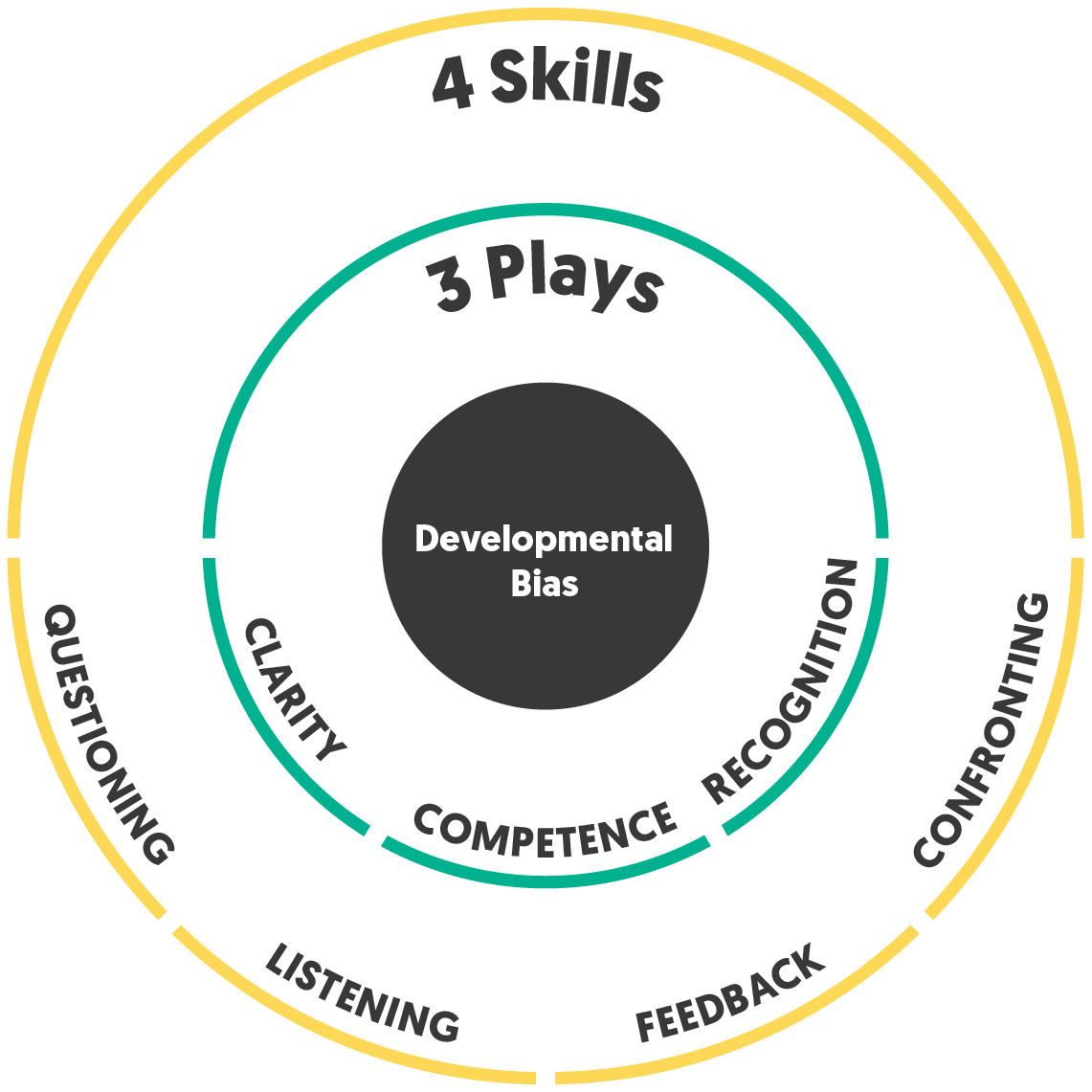
Choose Your Challenge
Having a confronting conversation with Leo is going to be challenging because I don’t want to damage our relationship. It doesn’t take tremendous courage to call up the airline after my flight was delayed and demand a refund because I only care about getting compensated, not my relationship with the customer service representative. But Leo is one of the strongest performers on my team and I want to have a good relationship after this conversation. It’s also going to be challenging because Leo has been resisting making this change and now it’s getting in the way of his success. This isn’t just a straightforward piece of feedback anymore. There are real stakes. If Leo’s behaviour continues, we could end up in the realm of more formal performance management channels.“When done effectively, these conversations can resolve the issue at hand, build the other person’s commitment to making progress, and strengthen the relationship.”It’s easy to see the threats in these conversations but there are also potential benefits. When done effectively, these conversations can resolve the issue at hand, build the other person’s commitment to making progress, and strengthen the relationship if they see you as someone who holds them to a high standard yet cares about them and respects them. So, I choose my challenge: I can avoid the conversation and deal with the fallout – Leo’s behaviour continues, our relationship becomes strained as my frustration seeps out, and I lose credibility with other people who see me allowing this behaviour to continue. Or I can face the discomfort of addressing the issue head-on and put my coaching skills to the test.
Connection Before Correction
Once I decide to address the issue, how do I have this conversation in a way that not only protects our relationship but gets Leo committed to making a change? It starts before I even enter the conversation. Often, we fall into the trap of thinking that we need to emotionally distance ourselves from the other person in order to be “tough” or objective. But it’s our relationship with the other person that’s the foundation for coaching them. I cannot coach Leo if I lose my connection to him. So rather than distancing myself, I start by strengthening my connection to Leo. I put myself in his shoes and explore the most generous, plausible story I can come up with for why he might be acting this way. Maybe he’s under a lot of pressure that is leaving him with little patience. Maybe I’m not aware of some underlying tension with his teammates. Or maybe Leo is so enthusiastic about his ideas that he doesn’t realize he’s shutting down other people. I choose the story that most strengthens my connection to Leo because it puts me in a mindset to engage in this conversation in a direct but caring way. I also need to get clear on the specific change I want to see – not all the ripple effects of Leo’s dismissive behaviour, or the fact that I’m also irritated because he was late for our team meeting yesterday – but the specific gap between what I need to see from him and what I’m currently getting.Open Strong
Next, I need to prepare my opening statement. This will set the tone and direction for the conversation. Without carefully crafting and practicing my opening, things can go sideways quickly. I could fall into the trap of starting with a sneak attack, “Well Leo, I guess you know why we’re having this conversation…” Or I might unleash my pent-up frustration and anger, leaving Leo like a deer in the headlights trying to respond. Or I might revert to the classic “feedback sandwich”, muddying my message and leaving Leo guessing at what I really mean. An effective opening is short – less than 60 seconds – and clearly articulates the specific behaviour that needs to change, the impact of that behaviour, what’s at stake if it doesn’t change, and my desire to work together to reach a resolution. “Leo, I want to talk to you about a pattern of dismissing input from your peers. For example, in yesterday’s meeting, Sarah raised a concern about the project timeline. You interrupted and said, ‘That’s not really an issue.’ I felt worried that you dismissed her question because I’ve noticed people hesitating to speak up in front of you. This can affect your ability to get the information needed to make good decisions and manage the concerns of staff. Advancing in this organization depends on your ability to build relationships and collaborate effectively. I haven’t been entirely clear on the importance of this, and that’s on me. I want to find a way to modify this behaviour. What are your thoughts?”Drop Your Agenda
After delivering my opening, it would be great if Leo said, “got it boss, no problem.” But that’s not what typically happens. I’m likely to get resistance – anger, excuses, deflection, or awkward silence. Counter-intuitively, that resistance is not something to fight against or try to “objection handle”; instead, I need to recognize that the path to a solution is through the resistance. So instead of defending my position, I drop my agenda and lean in to explore the resistance I’m getting from Leo. Questioning and listening are the critical coaching skills at this stage of the conversation. Questions to deepen and clarify my understanding of his story: Can you say more about that? Could you give me an example? What is significant about that? And active listening to draw the person out and check for understanding: So, what you’re saying is…, Let me see if I have this right… I stick with asking questions and listening until I can summarize what we call “the third story.” The third story represents all of what is true for me and what is true for Leo. It’s like I have a bucket, and I keep adding things into the bucket. I don’t take anything out and try to solve it yet. I just add things until we’ve collected all of what is true for both of us.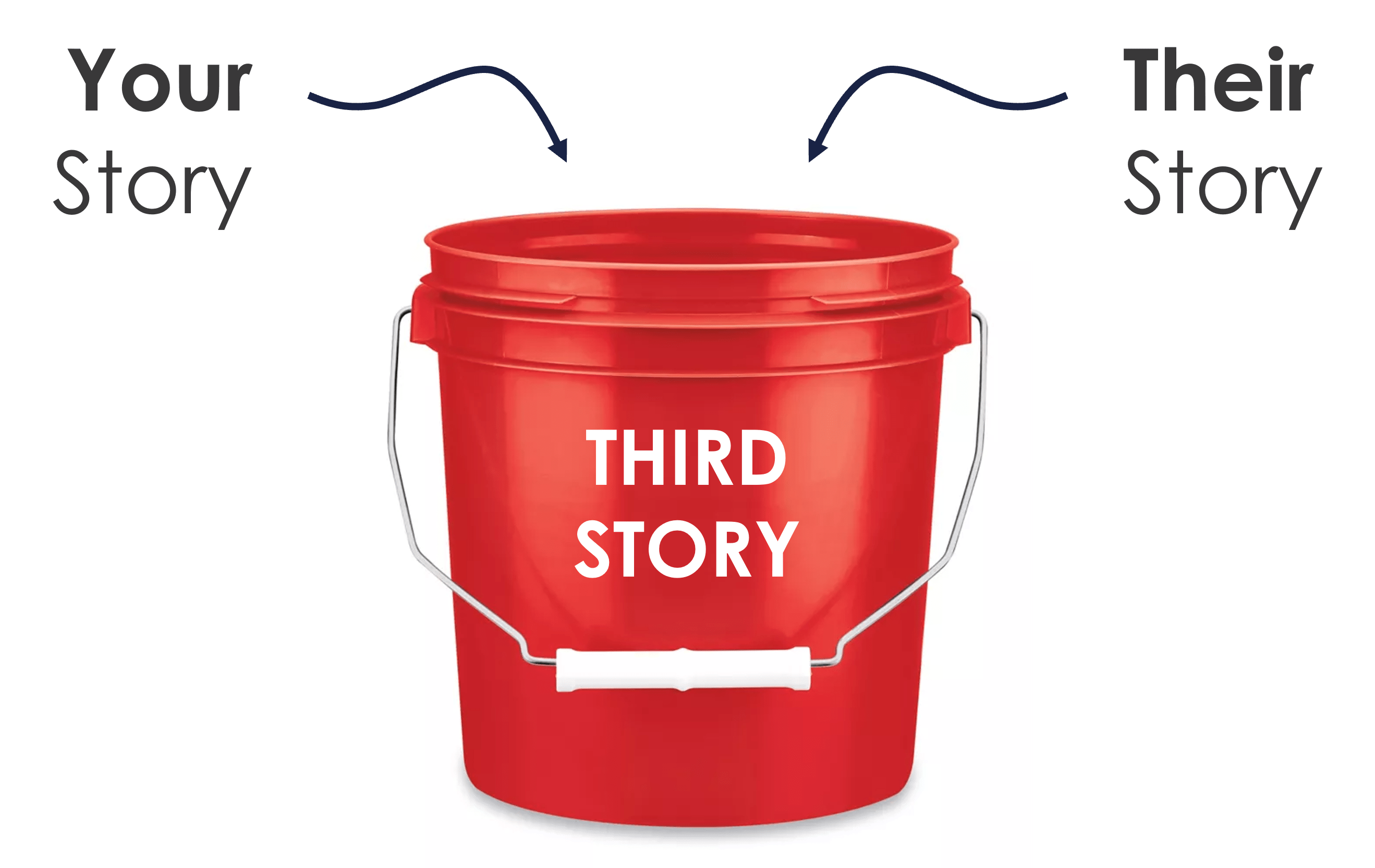 “So, to summarize, I need you to listen to the concerns and questions of your teammates and address them. It’s frustrating for you to have to consider other people’s concerns as you’ve already thought it all through. Further discussion is unnecessary, slows you down, and may interfere with you hitting your numbers. Do I have that right?”
I don’t necessarily have to agree with Leo’s perspective, but I need to get to a place where I understand him, where I can summarize his point of view in a way that he says, “yes, that’s it.” And if that’s not it, then I keep asking questions until we get to the core of the issue. It’s not until we reach that point that we can start problem solving.
It’s this final stage of the conversation that is often more comfortable and familiar – generating options and agreeing on a path forward. It’s best if most of the options come from Leo so that he owns how he wants to move forward but I can offer ideas as well. Together we can agree on a plan and next steps. Be sure to build in support and accountability. “What do you need from me to put this plan into action?” “Let’s schedule time to check-in and see how it’s going.”
“So, to summarize, I need you to listen to the concerns and questions of your teammates and address them. It’s frustrating for you to have to consider other people’s concerns as you’ve already thought it all through. Further discussion is unnecessary, slows you down, and may interfere with you hitting your numbers. Do I have that right?”
I don’t necessarily have to agree with Leo’s perspective, but I need to get to a place where I understand him, where I can summarize his point of view in a way that he says, “yes, that’s it.” And if that’s not it, then I keep asking questions until we get to the core of the issue. It’s not until we reach that point that we can start problem solving.
It’s this final stage of the conversation that is often more comfortable and familiar – generating options and agreeing on a path forward. It’s best if most of the options come from Leo so that he owns how he wants to move forward but I can offer ideas as well. Together we can agree on a plan and next steps. Be sure to build in support and accountability. “What do you need from me to put this plan into action?” “Let’s schedule time to check-in and see how it’s going.”
Manage Yourself
Now, is it ever that easy? Of course not. While it’s helpful to have a map for these conversations, no matter how prepared we are, it never goes exactly how we expect. People are complicated and will almost always throw a wrench into the conversation that we never saw coming. Or they’ll do something that seems perfectly designed to get under our skin – raise their voice, roll their eyes, or say that one thing that touches our most sensitive nerve And so, a big part of the discipline of these conversations is having a plan for how we will manage ourselves in the face of the triggers that could knock us off our game. First, we need to be aware that we’re triggered in the first place. Often, we become our irritation, or our anger. Instead, we need to notice it by tuning into our internal signals – I might notice myself thinking “here we go again with the excuses,” or that my breathing has accelerated, or that I’m starting to feel impatient. These signals are like lights on your car’s dashboard. When the “check engine” light comes on, you don’t smash the dashboard – you check under the hood. The same goes for triggers in tough conversations. Get curious about what the signal is telling you and take corrective action to get yourself back on track before you respond. If we don’t notice and manage our triggers, all sorts of unintended behaviours appear, and we can become the worst version of ourselves. Things start to escalate, or the other person withdraws, and we get further and further from a resolution.The Courage to Coach When it Matters Most
Being effective in these conversations requires the very best of us. It takes self-awareness and being a big person. But the 3×4 Coaching model provides everything we need to succeed. We need to enter the conversation with a generous mindset and clarity on our objective. We deliver a clear opening statement to get the conversation off on the right foot and then drop our agenda to explore the other person’s perspective before we jump into problem solving. It isn’t always comfortable, but the goal of coaching isn’t comfort. It’s about challenging someone to reach their highest potential. It requires the courage to speak up, the patience to wade through the discomfort, and the belief that the people you’re coaching are capable of more. As in many sports, when navigating uncertainty it helps to “look where you want to go.” In his latest article for HBR, Third Factor CEO, Dane Jensen, outlines a process for imagining a plausible, positive version of the future and taking steps to actually get there. Read the article at HBR.org. Editor’s note: This article was first published on April 14th, 2020, just a few weeks into the COVID-19 pandemic. While the context may have changed, your plays as a leader are still the same.In this article:
Four imperatives for leaders in times of uncertainty
- Invest in relationships. Try to find “30 seconds for every player, every day.”
- Think small. Annual plans are out – ensure your people are clear on what the work expectations are for today.
- Make a habit of catching people doing something right. Reinforcing feedback is vital to fostering engagement.
- Coach the whole person. With personal life and work life collapsing, now is the time to demonstrate empathy.
It’s all about the relationship
When people go through difficult times together, they can emerge more connected – but only if they’re conscious about it. Difficult times can also lead to fracture. As a leader, it’s your job to step back and really think about how you are building and deepening relationships with your people in this new environment. Take the time to check in with your people and listen to them. Take some time to step back and see what you’re going through as impartial observers and acknowledge that it’s hard. These are unprecedented times and the effort you make to stay connected with your people can make a huge difference. Coach Roy Rana of the Sacramento Kings spoke with us about how building relationships is intentional. There is an intention to communicate, to make the person feel connected, to ensure they know they have your attention. He talks about the little things that he does to accomplish this. In the video below, he lays out the wonderful challenge he sets for himself of “30 seconds every day for every player”: Rana’s Strategies are for basketball – not your environment. So what would work for you? What are the little ways you can connect with your people to communicate that you are thinking of them and you care?The game has changed
By now, every workplace has been impacted by COVID-19. The game has changed, and clarity needs to be re-established. Your team needs new skills and mindsets so that you can get through this together.“We can’t go back, only forward.”Ask yourself what your team needs for their new playbook. Do your people know what the work expectations are today? Timelines are different. Things change quickly so clarity is always evolving. Think short term and help them find focus. Do they know what other people need from them? Are they aware of how your goals have shifted? Especially if your team is working differently than they’re used to, over-communication is impossible when it comes to these things. Your team also needs clarity on what your organization’s values look like in this reality. Not just the vague, nice-sounding words – what they actually look like. If you value safety, how are you acting on that value? If you value team, how are you making sure that no one’s feeling isolated? Get together as a team to discuss your values and think through how you’re living up to them at this time. Through all of this, recognize that as a coach you need to meet your people where they’re at. Some team members might be juggling kids and other family constraints. They may even be caring for someone who is sick. Give them real clarity on how your team can work well together in a way that’s not going to make anyone feel criticized, judged or guilty. Have empathy for what they’re going through and use humour to help people feel at ease. Some team members (and perhaps even you) may be thinking they just need to hold on for a little bit longer until things get back to normal. That thinking will not serve them or the organization well. When companies face disruption, the ones who try to ignore it or find a way to hang on to their old ways of doing things don’t fare well – think Blockbuster. We can’t go back, only forward.
New plays for a new game
When the game changes, you can’t expect to get the same results from the same behaviours. As a coach, your goal is to help your people succeed in their new reality – and this means helping them get up to speed on the skills that will support the new expectations as well as discouraging the old behaviours that are no longer productive. This is all about consistent feedback and communication, and feedback is a challenge when you can’t see what people are doing. For the coachee, the lack of visibility can lead to frustration and unnecessary roadblocks that can harm engagement. Make a habit of checking in frequently with each team member to support their development. This isn’t about micromanaging or checking up on them; it’s about making sure they’re not sitting alone frustrated because something’s blocking their progress. If that sounds like a big job, that’s because it is. Coach Rana told us about how making time for each and every team member is a challenge even as a professional coach. And he offered this advice for keeping the connection alive even when it feels like you’re too busy.Out of sight, not out of mind
If what I’m doing can’t be seen, how do I know if it’s valued or appreciated? This is one of the challenges your people are facing as they transition to a new reality. People need to know that what they do has value, so giving appropriate recognition is more important now than ever. This doesn’t mean handing out awards and prizes. It’s about looking for the bright spots – things that are going well, little wins, positive behaviours – and acknowledging them. You might recognize a team member who creates a shared space for everyone to connect, or someone who volunteers to take on a task for another team member they see struggling. It’s also vital to recognize that people need to feel connected and not isolated. Make every conversation a coaching one. Even simple questions like “how are things going today” have value for a coach. As you explore the answer, you can uncover the information you need to find possibilities and build commitment to a solution. When people are worried, anxious or afraid they’re harder on themselves than ever. Having the coach remind them of who they are at their best brings tremendous energy.Be ready for the human element
Behind all this is a real humanitarian challenge. As time goes on, the people on your team may become sick, need time off to care for loved ones, or worse. Loss is going to look very different for different people – it can be loss of a loved one, income, or something else. As a coach you have a role to play in supporting your team members as they recover from whatever their loss may be. The temptation is to think that when someone is in pain over their loss that bringing it up will cause undue pain by reminding them of it. Just keep to your work and ignore it. And that’s like the monster under the bed for a little kid. As long as the kid believes there’s a monster under the bed it gets bigger and bigger. The longer it goes, the bigger it gets.“When loss isn’t acknowledged, it feels like it’s been dismissed.”This is true on both sides of the relationship. In Sheryl Sandberg’s book, Option B: Facing Adversity, Building Resilience, and Finding Joy, she talks about how the hardest part of going back to work after losing her husband was the silence. When loss isn’t acknowledged, it feels like it’s been dismissed. And a significant loss being dismissed feels really bad. You don’t need to be a counsellor or have all the answers, and there’s no secret formula for how to deal with these times. Your job as a coach is to bring things to the surface and give people permission to talk about it if and when they want.
Help people get better at whatever it is they do
We often define a coach’s core job as this: help people get better at whatever it is they do. We call this developmental bias, the idea that a coach is always biased toward developing their people no matter what the circumstance. As the “whatever it is they do” continues to change and evolve over the coming months, and probably years, you have an opportunity to help your people stay engaged and rise to the occasion. By maintaining and building relationships, building clarity around what’s expected, building competence in new ways of working, and recognizing the all of what is happening, you can show your people that you’re on their side and help your entire team emerge stronger for it.In this article:
Three imperatives for L&D during COVID-19
- Leverage technology to continue “regularly scheduled programming.” Lead by example to encourage resilience and agility.
- Build resilience when it matters most. Investing in resilience skills demonstrates empathy and can yield significant benefits even with virtual delivery.
- Use this opportunity to invest in 1:1 coaching. Foster self-awareness and personal development at scale without gathering groups.
“L&D teams can provide unique value and directly influence how the organization weathers the storm”Connecting pressure to personal growth is vital for resilience over the long haul. If, as a leader, I feel like the pressure is just a weight on my shoulders that I must endure, it will have a significantly more negative impact than if I see how rising to this challenge can help me become stronger and better. Growth gives meaning to pressure – and our ability to help people see this tough period as a growth experience is a significant imperative for maintaining engagement at work.
Growth gives meaning to pressure.
Taken together, this makes the coming months a time when L&D teams can provide unique value and directly influence how the organization weathers the storm. The coming months will undoubtedly be a period of great pressure – but how heavy that pressure sits, and how skillfully it is navigated, is within L&D’s circle of influence. By rising to meet this challenge, learning and development organizations can support their risk management teams, build esteem for the department among senior executives, show the ability of the department to deliver in critical moments, directly influence performance outcomes, and directly support an entire workforce through an extremely challenging time. So, how can L&D navigate the choppy waters of risk mitigation policies while seizing the moment to step up and shine? We see three major imperatives:1. Demonstrate agility + resilience – leverage technology to continue “regularly scheduled programing”
Personal growth and development is a major driver of satisfaction and engagement in the workplace. When other drivers of satisfaction and engagement are compromised, continuing to invest in learning is vital. And, as learning organizations – we want to model the behaviours we are asking leaders to engage in: resilience, adaptability and flexibility. If we are asking others in the organization to continue to do their jobs in the face of disruption – it’s up to us to do the same.“Think deliberately about a learning journey that is designed to sustain energy and support application”Depending on the measures in place in your organization, this may include continuing to run in-person programming in small-medium sized groups – perhaps modified to focus on local attendees. In many cases, however, policies will necessitate the conversion of regularly scheduled programming into virtual delivery. Speaking from the perspective of an organization focused entirely on the development of leadership, collaboration and resilience skills – there are two imperatives we see to getting this right:
Think Fortnite, not Netflix
There is a reason in-person, instructor-led training continues to deliver the best learning outcomes: it gives people a chance to engage directly with an expert, to learn from peers, and to debate, dialogue and practice. In short, it’s a participative experience. While it is tempting to replace in-person programming with self-paced programs and video libraries – think Netflix – when it comes to executive function skills like coaching, collaboration, and resilience, getting strong learning outcomes requires collaboration. This is the ‘Fortnite’ model: we’re in this together, working alongside each other, in constant communication, and working towards a common goal.
Think Fortnite, not Netflix – virtual learning should be interactive and participative.
Divide and conquer
With dates already reserved on learners’ calendars, it can seem logistically easy to replace a 1-day in-person program with a 1-day virtual session. Even the most expertly designed and facilitated virtual sessions begin to lose their energy, however, after the two-hour mark. Instead, take advantage of the luxury of dividing learning up into more manageable modules. Freed from the requirements of a group of 25-30 learners traveling to one location for a short period of time, virtual sessions give you the opportunity to think deliberately about a learning journey that is designed to sustain energy and support application. The best designs involve modules that don’t require prolonged periods of attention, include interactivity and discussions that invite participation and reduce the temptation of distraction, and close with a clearly actionable outcome that learners can practice prior to the next module (i.e. an action learning-oriented approach). Virtual instructor-led technology has come a long way in even the past 12 months. In the face of COVID-19 we’ve been working directly with many of our clients to use a technology stack focused on interactivity and collaboration to ‘convert’ their in-person experience into virtual ones – complete with breakout rooms, lively discussion, whiteboard sessions and polling. Take advantage of new technology to demonstrate resourcefulness.2. Build resilience in all corners of your organization
Ultimately, resilience is built in the troughs, not the peaks. And, not only is this a time in which resilience skills are vital – it’s also the perfect time to support your people in building resilience. In my forthcoming book, tentatively titled The Power of Pressure, I argue that the two key factors that ramp up pressure are importance (“this matters to me”) and uncertainty (“I don’t know how this will turn out”). The threat posed by COVID-19 delivers an unhealthy dose of both these ingredients.
Changing policies and sparsely populated offices are just two sources of uncertainty.
In the face of this pressure, learning and development teams have an opportunity to show that the organization cares not just about physical safety but also about people’s psychological wellbeing, and stands ready to help them learn the skills they need to not just survive but thrive through this period. There are two key imperatives here:Support physical resilience
Employee wellness programs have never been more important than they are right now. Sleep, nutrition and exercise are the basis of not just a healthy immune system but also a resilient individual. Now is the time to promote awareness of the programs available to your teams.Build inner resilience
Resilience isn’t a genetic gift – it’s a set of skills that can be learned and mastered. Often we assume that resilience will be built naturally as a by-product of tough times – but just like an athlete needs a good coach to reap the developmental benefits of sport, so too do individuals need support in learning how to channel pressure into growth.“In times of challenge, what’s often most challenging is that the old pressure doesn’t go away”In our Building Resilience program, we do this by giving participants an understanding of how uncertainty and pressure impact their performance and health, and then grow their awareness of the choices they have and skills they can use to enhance their resilience under pressure. I led a 90-minute virtual session on resilience for leaders at a major cruise line last week. As you can imagine, the pressure they are facing is immense. In our opening exercise, I asked them to identify the things that make this “interesting times” for them. Here is a random sample of the 46 responses I received:
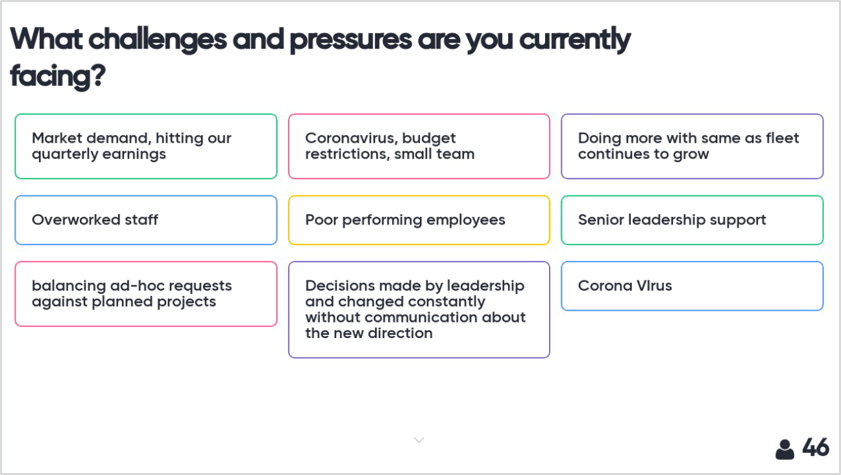 What’s most interesting to me is that the responses weren’t simply “coronavirus” 46 times. In times of challenge, what’s often most challenging is that the old pressure doesn’t go away – we simply add more to the pile, further compounding our already high-pressure lives.
In acute scenarios such as this one, people need to have a clear sense of:
What’s most interesting to me is that the responses weren’t simply “coronavirus” 46 times. In times of challenge, what’s often most challenging is that the old pressure doesn’t go away – we simply add more to the pile, further compounding our already high-pressure lives.
In acute scenarios such as this one, people need to have a clear sense of:
- What they can control – i.e. their perspective + their behaviours
- What they need to let go of – i.e. the situation + others’ responses

With the right tools, everyone can emerge knowing they were up to the challenge.
3. Give People the 1:1 Learning They Crave (Without Breaking the Bank)
“The next few months provide a real opportunity for learning organizations to invest in the 1:1 learning that people crave”All of the research into learning tells us that providing individualized, coaching is among the best ways to help people learn, achieve their goals, and feel satisfied with their progress. And yet, the cost of providing individualized coaching is often prohibitive at scale. The next few months provide a real opportunity for learning organizations to invest in the 1:1 learning that people crave. The travel challenges posed by the COVID-19 threat will mean a dramatic reduction in travel expenses, and 1:1 coaching is uniquely suited to virtual delivery. Taken together, this provides an opportunity to invest in personalized coaching for your high potential talent at a cost that’s similar to what you would spend on a per-person basis to bring people together for a workshop. Depending on how your organization calculates the overall cost-benefit of leadership development, reduced time away from the field for participants can also support your case for making this kind of investment. So, how do you do this effectively? Two ideas:
1 goal, 3 months
Unlike traditional executive coaching, which is often an open-ended partnership between a coachee and a coach, have people pick a meaningful goal in conjunction with their coach and give them 3 months of support to move towards it. Framing coaching around time-bounded outcomes makes for more deliberate, action-oriented partnerships, gives you a measuring stick for demonstrating ROI to the organization, and ensures that you don’t add on-going cost into your budget.Build self-awareness + self-responsibility
As we all know, adults don’t change because a coach tells them to. They do it because they develop the self-responsibility to change. In our experience, the best way to build self-responsibility in a short period of time is to kick off a coaching partnership with a strong self-assessment tool. We use a tool called The Interpersonal and Attentional Styles Inventory (TAIS) that lends itself perfectly to this kind of individualized development. The TAIS was originally developed for Olympic athletes to better understand their tendencies under pressure and make conscious strategic decisions about how to play to their strengths and compensate for their weaknesses. It was then adopted by the US Navy SEALS for the same purpose and is now very highly regarded in the business community as a tool for building self-awareness and high performance in the corporate environment. The TAIS looks at 18 different metrics to help people understand how they are most likely to behave under pressure and how their unique traits compare to their teammates and contemporaries. As an example, the TAIS results may show that someone has high needs for control – that is, they are less comfortable with uncertainty and like to have a clear view of what’s coming. In the current climate, this tendency has the potential to create significant additional strain for both the individual and anyone they lead as they attempt to exert control in a situation that is largely impossible to influence. Working with a TAIS coach in a one-on-one coaching call, the employee can gain a better understanding of how that tendency is likely to manifest and develop strategies for mitigating its impact. By combining the online TAIS assessment with one-on-one video coaching, you can create an opportunity for your high performing talent to gain a better understanding of themselves, adapt more readily to changes in their environment, and actually enhance their learning through the downturn rather than merely mitigate the impact.Team Canada Captain Hayley Wickenheiser shares her TAIS experience.
Want to Learn More?
Your opportunity to make an important contribution to your organization over the coming months is a brief one and you will need to move quickly to succeed. We are committed to supporting you in seizing this moment and readying the workforce for a period of disruption. If you want to get started right away, we have two turn-key ways for you to roll out 1:1 virtual coaching, and resilience skill-building. For your executive team, mid-senior leadership and high-potential employees, we offer TAIS self-assessments and coaching calls that can be scaled for teams of all sizes and begin delivering to participants in a matter of days. For teams and business units that are most affected by your organization’s COVID-19 response, we are offering an adapted version of our Building Resilience program, delivered entirely online and available in a modular format comprising 1 to 5 modules. Give us a shout if you’d like to know more. For further reading on some of the subjects discussed here, we have a few whitepapers that are especially relevant.- The Why, What and How of Self-Awareness introduces the concept of “active awareness”, a skill that helps you leverage self-awareness in the moment, and that has worked for the thousands of executives Third Factor has worked with.
- The Paradox Of Pressure explores what causes us to feel pressure, explores what happens to the human body and mind when we experience pressure, and looks at ways to transform pressure into growth.
- The Meta-Skilled Organization lays out a framework for individuals and organizations who want to direct their own evolution and claim an uncertain future.