Prior to now, hybrid working environments have never existed on a wide-scale basis. With few proven best practices to rely on, you need to work together with your team to create a new playbook for how to get the best out of the team and its individual members.
By necessity, this involves a lot of experimentation. To capture the lessons from these experiments, it will be essential that your people are willing to ask questions to gain clarity, share ideas on how to do things differently, and voice concerns when things aren’t on track. And this can only happen if your team members believe they are safe to do so.
Unfortunately, biology is not on your side. By default, people want to avoid looking ineffective or incapable to their leader. To foster psychological safety on your team, it’s not enough to encourage your people to speak up. You need to consistently demonstrate that it’s expected, appreciated, and rewarded.
Level the playing field
Like it or not, your people are hard-wired to view you as a threat. The amygdala, sometimes referred to as our “lizard brain,” is constantly scanning the environment for threats – and, according to Your Brain at Work author, Dr. David Rock, social threats like an imbalance of power are no exception. As much as you tell your people they can be honest with you, the amygdala will override the logical part of the brain until it has witnessed a pattern of behaviour consistently enough to convince it you’re not a threat.
“Telling people to speak their mind won’t yield any results if they haven’t seen a predictable pattern of behaviour from you that it’s safe to do so.”
In other words, telling people to speak their mind won’t yield any results if they haven’t seen a predictable pattern of behaviour from you that it’s safe to do so. You have to show them, over and over again, that the only thing that will result is a better work environment.
To sow the seeds of psychological safety, you need to set clear expectations with your team, ask for specific input on a regular basis, and practice responding positively – even when you don’t like what you hear, the timing is bad or the input is delivered in a way that triggers you.
Change the frame
People are unlikely to speak their mind when given a vague invitation for feedback. Consider the response you get when you ask someone “How are you?” Most of the time the reply is some version of “Busy but good.” or “Could be worse.”
Change the frame by explicitly stating that as the team adapts to a hybrid model, there will be much to learn and it is critical that everyone shares what is going on from their point of view. Emphasize that for the team to be successful, people need to speak up. Be clear that the expectation is that people will share ideas, ask questions, voice concerns, and admit mistakes.
“Be clear that the expectation is that people will share ideas, ask questions, challenge consensus, and admit mistakes.”
Walk the talk
After framing the expectation, reinforce it by consistently asking people for input. Instead of asking “any questions?”, which tends to garner nodding heads and silence, ask a variety of specific questions to surface where people are at.
- “Vikram, what do you see as the most challenging part of this?”
- “Alexis, you’ve been quiet, what are your thoughts on this approach?”
- “Jordan, how might this group support you in completing your task?”
Recognize the effort and impact
When people do voice their opinion, reinforce that behaviour by specifically describing what they’ve done right, illustrating the behaviour’s positive impact, and expressing appreciation for the effort. When it’s warranted, be sure to acknowledge the emotional component as well.
- “Natasha, asking for help kept the project on track and saved Peggy’s team from having to work late. Keep it up.”
- “Soheli, your idea led to a great discussion that got the whole team engaged. Keep them coming.”
- “Darren, it took a lot of courage to bring this to my attention and I really appreciate it. What can I do to help you move forward?”
Manage your outside voice
In some cases, encouraging this behaviour might be difficult. Suppose that you are just wrapping up a planning meeting at one of your in-person days in the office when Janelle excitedly suggests a new approach. Aside from the terrible timing, the idea itself raises huge red flags for you.
Internally you might be thinking “going that route would be a complete disaster!” But if your inside voice becomes your outside voice, you’ve just made the environment a little less safe for people to provide input.
To help you convey that input is welcome, even in moments when you’ve been triggered, a simple 3 step process can help.
- Pause: take a moment to breathe and ask yourself what the moment needs from you.
- Acknowledge: a simple thanks is often enough.
- Respond: in most cases you will need to get more clarity, provid clarity, or delay the matter and revisit later.
They’ll believe it when they see it
When people feel safe to share ideas, voice concerns, admit mistakes and ask questions, you have better access to the information you need to keep your team on a path to high performance. Foster psychological safety on your team by framing input as essential to success, asking for the input you need, and recognizing your people for doing the right thing.
Learn skills for leading in a hybrid world
Leaders who are able to leverage the advantages and mitigate the challenges of hybrid work will build high-performing teams at a time when engagement and commitment are at risk.
Learn practical skills for leading hybrid teams in our program, Leading in a Hybrid World.
How Leaders Enable High-Performing Hybrid Teams
The transition to a hybrid work model is replete with hazard and risk: Can our people adapt to yet another major change in the way we do business?
It also presents a unique opportunity to create new systems that work for companies and people – a culture of high performance in which people are truly committed. To capitalize on this opportunity, organizations need leaders who are motivated by a compelling vision of what’s possible and can adapt their skills to shape their environment.
In this webinar, Third Factor Principal Trainer,
Garry Watanabe, will uncover the opportunity present in the transition to hybrid work and showcase how leaders can get the most from it. The session will explore the challenges and advantages of hybrid work from a leader’s perspective, present an approach for building consensus and commitment in the face of novel problems, and introduce strategies to overcome some of hybrid work’s biggest challenges.
You’ll leave with an exciting vision for a high-performing hybrid culture, a clear understanding of your people leaders’ assets and challenges in a hybrid environment, and insight to how leadership competencies can be adapted for hybrid teams.
You should attend if:
- You’re responsible for maintaining employee engagement in the transition to a hybrid work environment
- You’re responsible for developing leadership competency for a hybrid model of work
- You’re a senior leader concerned about hybrid work’s impact on performance
- You want new ideas and practical tools for leading your own hybrid team
How Leaders Enable High-Performing Hybrid Teams
Sorry we missed you
This event has passed, but it won’t be the last. Be the first to know about future webinars from Third Factor by entering your information below.
 About the presenter:
Garry Watanabe
About the presenter:
Garry Watanabe is a lawyer, an instructor at the Smith School of Business at Queen’s University, an inspirational speaker, and holds a Masters Degree in Sport Psychology. Whether he’s on the pool deck, in the classroom, or at the lectern, Garry is the consummate coach.
Our company’s roots go back to the 1988 Olympic Games in Calgary, Alberta. Our founders, Peter Jensen and Sandra Stark, were mental performance coaches to Canada’s figure skating team – a team that won 3 out of Canada’s 5 medals on home soil. The business community took notice, and Peter and Sandra were soon working with organizations across the country to apply the principles they used in sport to a wide variety of other settings.
Fast forward to 2022 and Olympic Sport is still our top R&D lab. We work with athletes and coaches at the highest level to understand how they perform, collaborate and lead, and synthesize their best practices for use across disciplines – from business, to academia, industry, philanthropy and beyond.
We’ve had the privilege of working with dozens of athletes and coaches who are representing Canada at the Beijing Games. Here’s a roundup of who we’ll be cheering for this February.
The Canadian Ski Team
Ski Cross is one of the most exciting freestyle skiing events at the Games. We’ve been proud to work with the athletes and coaches on both the men’s and women’s teams to help them build self-awareness, leverage their strengths, and perform under pressure. We’ll be cheering them on in the Ski Cross events on February 17th & 18th.
Our work with Alpine Canada has also taken us to the downhill skiing events. We’ll be keeping a close eye on Team Canada at the men’s and women’s Slalom, Giant Slalom, and Super-G events.
Figure skaters from around the world
Brian Orser and Tracy Wilson are not just Olympic medallists, but widely regarded as the top coaches in the sport. They’ve shared their perspectives on performing in critical moments with us, and we’ll be cheering on their skaters as they compete for the podium in Beijing.
 Tracy Wilson is an Olympic Medallist and 7-time Canadian champion
The Canadian Women’s Hockey Teams
We’ll be staying up late to watch Team Canada battle to reclaim Gold. We’ll also be keeping our eye Marie-Philip Poulin who is not just one of the best pressure performers in the world, but the best hockey player in the world, full stop according to our co-founder Peter Jensen.
3×4 Coaching
As supply chain issues and staffing challenges continue to hammer organizations, there are two critical moments that determine whether people will stay committed and rise to the challenge: The crisis of engagement, when people realize their path forward is harder than they thought it would be; and the crisis of meaning, the emotional low that makes them question whether to continue.
To stay committed and see the journey through, people need three things from their leader: clarity on what they’re supposed to be doing and why it matters; the skills and abilities to be confident in their job; and a sense that they’re seen and appreciated.
In this webinar, Third Factor Principal Trainer,
Garry Watanabe, will synthesize our 30 years of experience working with world-class coaches and reveal a simple framework to give leaders the mindset, skills and tools to keep people committed – and ultimately drive results.
You’ll leave inspired with fresh ideas for addressing problems caused by the “great resignation” and other pandemic-related disruption, and a clear image of how you can use coaching at all levels of your organization to fight burnout and keep people engaged.
You should attend if:
- You’re responsible for maintaining employee engagement and retention despite serious disruption
- You’re an L&D practitioner frustrated by other coaching programs that deliver poor results
- You’re a senior leader looking to drive performance without sacrificing a positive culture
- You want a new approach for getting commitment and results from the people you lead
Coaching in Critical Moments
Sorry we missed you
This event has passed, but it won’t be the last. Be the first to know about future webinars from Third Factor by entering your information below.
About the presenter:
Garry Watanabe is a lawyer, an instructor at the Smith School of Business at Queen’s University, an inspirational speaker, and holds a Masters Degree in Sport Psychology. Whether he’s on the pool deck, in the classroom, or at the lectern, Garry is the consummate coach.
As people leave their jobs in record numbers, organizations are facing two urgent challenges: increase engagement to reduce churn; and prepare those who stay to adapt to the rapidly changing needs of the business.
The solution to both of these challenges is to invest in people and get them excited about their own growth and development. People are more likely to stay – and more resilient to changing demands – when they feel a sense of growth, contribution and connection. But with 40% of employees saying they’re likely to leave their job within 6 months1, time is running out.
Career Conversations is a highly interactive one-hour session that puts people leaders at the centre of a strategy for helping employees develop a clear and compelling view of their path forward in the organization. Leaders are introduced to the “why,” “what,” and “how” of career conversations, and begin engaging with their people before the hour is up. The program can be quickly implemented and scaled to the entire organization, effecting rapid, positive change.
In this 60-minute webinar, Third Factor Associate Trainer Rishi Behari will introduce the Career Conversations program and unpack the leader’s toolkit for holding effective developmental conversations with their people. You’ll leave with a compelling image of what effective career conversations look like, new skills for converting that image into action, and a plan for holding career conversations with clear goals and accountability built in.
You should attend if:
- You are in an HR role and have an urgent need to build employee engagement
- You are a senior leader looking for strategies to adapt to a rapidly changing workforce
- You are responsible for leadership development and need scalable ideas for creating a culture of development
- You want to build your own ability to hold effective career conversations with the people on your team
SORRY WE MISSED YOU
This event has passed, but it won’t be the last. Be the first to know about future webinars from Third Factor by entering your information below.
 About the presenter:
Rishi Behari is a professional coach, consultant, teacher, facilitator and speaker who has carved out an unlikely career path amidst adversity, pressure, and uncertainty, having grown up in an interracial family in the heart of the Canadian prairies.
Rishi has dedicated his professional life to helping others discover and realize their passions, dreams, and potential. He is known for injecting personality, humor, wit and infectious energy into his work and teaching. He draws from his and his students’ personal experiences in order to create an open, engaging and safe environment for leaders at all levels. His relentless desire to explore, innovate and challenge the status quo have made him a multidisciplinary force for igniting positive change in people and organizations.
Rishi comes to the Third Factor team with an impressive and eclectic background across industries, having worked with some of the top schools, businesses, and organizations in the world. His range of experiences include raising ten thousand dollars at the age of nineteen to fund his first entrepreneurial venture, appearing as a business expert on live international television, helping to establish the world’s first premier business program in artificial intelligence, sitting on the advisory board for Canada’s first student-run AI startup incubator, working in the not-for-profit sector to fight systemic inequality and discrimination, teaching in academia and over five years as the VP of a multinational consulting firm.
Rishi is a former university athlete in soccer, and an avid sports and travel enthusiast, having traveled to two World Cups of Soccer, the European Cup of soccer, and the Winter Olympics. His academic credentials include BAs in psychology and sociology and an MBA from the Smith School of Business at Queen’s University and IE Business School in Madrid, Spain.
1 Source: McKinsey Skilled workers across the country are making their position clear: they have no desire to go back to the way things were, and they’re willing to leave their job rather than return to the office.
From an organizational standpoint, however, it’s not so straightforward. There are arguments for and against bringing people back into the workplace. Attempting to transition to a hybrid model is sure to be fraught with challenges. And for some organizations, a return to working face to face is the only way forward.
To establish a post-pandemic model for work that prioritizes productivity, a plan for employee retention is imperative. Senior leaders must be able to clearly articulate the benefit of returning to in-person work and find ways to motivate individuals within the team to endure the change. To do so, organizations need to make full use of people leaders to ensure that understanding and motivation cascades to each individual contributor.
Give meaning to the change
While the value of returning to in-person work may be clear to the senior team, it’s unlikely that everyone in the organization will find it apparent.
In the absence of information, people tell themselves stories
In the absence of information, people tell themselves stories – and those stories are rarely positive. Without a clear understanding of the benefit of returning to work, people are likely to tell themselves that it’s because they’re not trusted to do their job while working remotely. Or, that it’s because of their leaders’ own discomfort with remote work.
To combat this, organizations need to be able to clearly articulate the value of why people are being asked to come back to the office, beyond “you get to keep your job.” People need to understand how it benefits the organization, how it benefits their team, and how it benefits them personally. A client I work with, League, provides a useful example of this in their communication to employees about their plans for a hybrid model. Their Chief People Officer, Kim Tabac, has promised their people to, “strike the balance between the ‘I’ and the ‘We’ by focusing on the intersection of the employees needs for meaningful work, and a continued focus on their mental health and wellness, with the company’s focus on high performance, innovation, and connection to our mission.”
In addition to helping motivate people who would rather continue to work remotely, being clear about the value of working in-person can help to ease the pain of change for everyone in the organization. A few months into the pandemic, we asked leaders about their challenges in the remote work environment and almost one in five said their biggest obstacle was others not being open to change. By giving the change meaning, organizations can reduce this friction point and accelerate the pace at which the benefit of the change begins to outweigh the discomfort of the change itself.
Ditch broad-reaching incentive programs in favour of personalized motivation
Skilled workers are leaving their jobs in droves because they don’t want to go back to the way things were. But it would be wrong to assume that people are most motivated by having flexibility in where and how they work. There are many different things that motivate people at an individual level, as diverse as the team itself. Organizations can drive performance, reduce turnover, and facilitate organizational change by discovering each contributor’s top motivator and connecting it with their work.
We recently ran a workshop with 220 leaders at a financial services company on the subject of how to hold more effective career conversations. When we asked the leaders what motivates them in their careers, there was no consensus. A top three did emerge (interesting work, money, and meaningful work, respectively), but none showed a clear majority and only 10% said they are motivated by all three.
What this tells us is that a broad-reaching program for this group focused on interesting work, money, and meaningful work would only be a perfect fit for one in ten leaders. What’s more, a program focused on improving work fit to life would only capture the attention of a little over one in three. To effectively motivate individuals through the return to in-person work, and beyond, organizations need to shift to an personalized approach.
Leverage people leaders to put plans into action
As the soccer coach John Herdman said, “People do things for people, not things.” For organizations to successfully communicate the value of returning to work and tap into what motivates individual contributors – and therefore retain skilled workers – people managers need to be at the centre of a culture shift that makes leadership their first job.
People do things for people, not things.
Too often, people leaders feel like managing their team is a “to do” along with the rest of their job. In fact, when we asked the same group of leaders what gets in their way of having career conversations with their people, 42% told us they don’t have the time. Organizations need to give leaders a clear expectation that helping their people grow and develop is their first job, rather than something to be fit in around other tasks. By investing in people and having these conversations, that’s how the work’s going to get done. It’s not the other way around.
As the plan is set in motion, focus on three priorities to enable leaders through the transition to in-person work:
1. Encourage leaders to build relationships with their people
At the heart of all this is emotion. Whether someone would rather quit than come back to the office or whether they’re motivated in their job, all comes down to how they feel about the situation.
In order to tap into the power within emotion, leaders need to build relationships with their people and earn permission to do so. And if they’re leading a team that’s distributed or working on a hybrid model, they need to pay close attention to their relationships with the people they don’t see in person on a daily basis.
2. Give leaders the skills to coach their people
Telling leaders to find out what motivates their people is about as helpful as a basketball coach telling you to shoot a three pointer. Leaders need to understand their role as a coach; they need questioning and listening skills to open and carry out effective conversations; they need the ability to give their people clarity on what “good work” looks like; and they need to be skilled at giving recognition in ways that’s going to motivate their people.
3. Make regular career conversations a formal part of performance management – and empower leaders to connect their people with what motivates them
With the relationships and skills in place, ask leaders to hold regular career conversations with their people. Make it every leader’s responsibility to understand what motivates each individual on their team and support them in using that information to create connection points between the work and what motivates them.
Avoid the “brain drain”
Enough companies have already learned their lesson the hard way – requiring an entire workforce to undergo a significant and rapid change can lead to a drop in engagement and a rapid “brain drain” if not handled carefully. To ease the transition and retain skilled workers, engage your leaders in a culture shift that puts leadership first, gives leaders the skills they need to motivate their people, and encourages them not just to have career conversations, but to create meaningful connections between what their team does and what motivates them. Over the past year I have worked with hundreds of leaders across a range of industries. And the most common question they have asked is “How do I sustain the energy levels of my people?”.
This year, more than any other in recent memory, has taxed the energy reserves of even the most resilient teams. Hugely disruptive changes, prolonged periods of uncertainty and the blurring of work and home have drained people’s batteries and made it difficult to recharge.
When leaders try to step in and fill the energy gap, it’s not long before they find themselves starting to run out of gas. The key is to take on the challenge, without trying to do it all on your own.
A team’s energy comes from within
A while back I was leading a Self-Aware Team program for the coaches and support staff of a team that was preparing to represent Canada at the Winter Games in Beijing. An important part the program is an exercise in which team members create “player cards” containing key insights they’ve learned about themselves through the program. The group then comes together in a Zoom call to share those insights and give and get feedback.
Like so many others, this group had been through an incredibly taxing year. Because of the pandemic, the team had to expend significantly more energy than it ordinarily would to create effective training opportunities for the athletes. Quarantines and “bubbling” rules had forced individuals to spend months at a time on the road, adapting to new routines and away from their families. And uncertainty over everything from health and testing to the potential fate of the games loomed over it all.
“The ways they brought energy were as diverse as the people themselves.”
As the group shared their player cards, it quickly came to light that a number of different members of this team had been significant “energy givers” through this difficult time. And the ways they brought energy were as diverse as the people themselves.
- One senior leader on the team created energy in the more traditional way that many leaders do: by envisioning a compelling opportunity, mapping out a plan to get there and leading the charge towards it.
- Another team member helped bring lightness to the daily grind by noticing and pointing out funny moments, breathtaking views, or interesting aspects of their surroundings. These moments created mini-breaks that relieved tension and reminded the team of the unique and special journey they were on together.
- Another contributor was celebrated for their “can-do attitude.” This individual had a “big personality” with a healthy dose of confidence who led by example and encouragement. Their jokes, positive energy and infectious smile helped the team forge ahead with a belief that they could prevail when they were hit with a setback or success seemed a long way off.
- Yet another had taken on the role of a confidante and created a safe, non-judgmental space for people to bounce ideas, vent frustrations and seek advice when they needed to gain perspective on a situation (or person) that was creating challenges.
Three energizing principles
In listening to the group share their feedback, I was struck by three things:
Energy is found in diversity. During the discussion I heard multiple different ways that multiple different people infused the group with energy. Some provided big boosts, other provided steady nudges. Some energized all team members. Others were more critical in sustaining a handful of specific individuals. Some were helpful at the start to get the flywheel moving forward. Others stepped in during negative moments to break tension and redirect focus when forward movement was stalled. Each team member’s contribution could stand on its own, but put together they added up to more than the sum of their parts.
Energizing the team is everyone’s responsibility. No single contributor can create enough energy on their own to sustain a team; the demands are simply too vast. Everyone on the team shares some responsibility for energizing their teammates. The team leader’s job is to create the conditions that allow it to happen.
Feedback is of key importance. In many cases, the “energy givers” were surprised to learn the value of what they provided. In fact, some had mistakenly believed that the very behaviors that others found energizing were irrelevant or a distraction. If not for the reinforcement they received during the session, many had been planning to curtail some of those behaviors moving forward. And, if that had taken place, then valuable sources of positive energy would have simply faded away because people were unaware.
Energize your team
Every leader needs to create an environment that enables their people to perform. And energy is a critical part of that environment. But it’s not the leader’s role to provide that energy all on their own. Instead, the best leaders create the conditions for “energy givers” to thrive.
“Create a clear image of what it looks like to be an energy giver.”
Start by setting the expectation that energy is a team responsibility. Work with your people to create a clear image of what it looks like to be an “energy giver” and what behaviors will move the team’s energy level in a positive direction.
Help your team surface the different ways “energy givers” sustain the team in tough moments. Make it a part of your regular check-ins to ask people what’s contributed to their energy over the past week and encourage open discussion when appropriate.
Finally, provide opportunities for regular feedback and recognition so that each “energy giver” knows what to keep doing. This feedback can come from you as a leader, but people should also hear from their peers. Effective feedback recognizes the behavior, communicates its impact, and encourages the person to continue.
With this approach, a leader can create more energy on their team than they could ever hope to do alone, while at the same time helping their people to stay engaged and motivated through whatever may come.
Energize your team as we move out of the pandemic with a series of three, one-hour virtual learning events.
The months ahead will present new challenges as business needs change, blended working environments begin to take shape, and leaders are once again forced to adjust to rapid change and uncertainty. Help ready your people to lead and perform through the next phase with a series of virtual learning events.
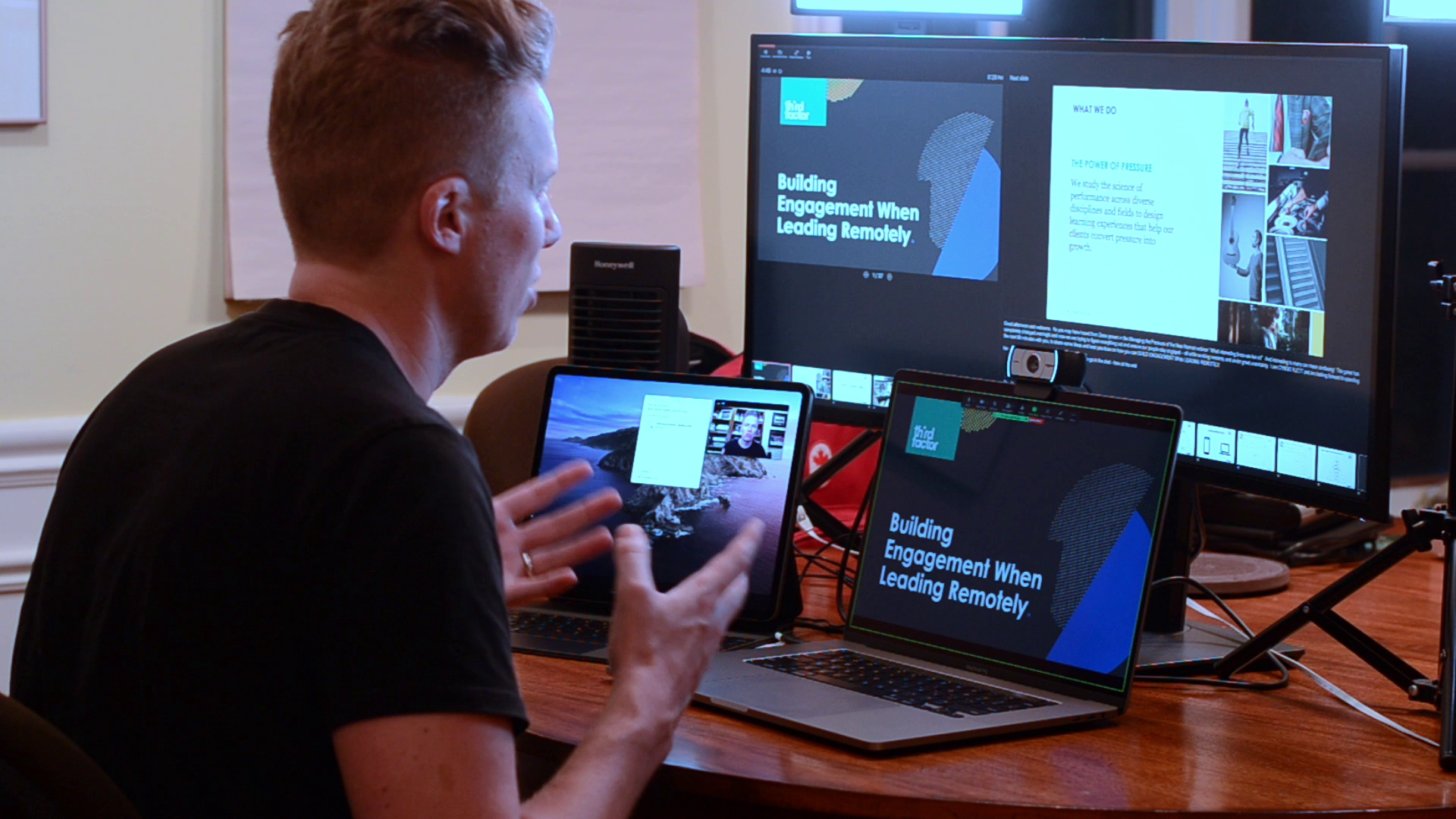
TWO TRACKS TO CHOOSE FROM
Develop your people in the areas that will benefit them most. Choose our leadership track to build your team’s coaching and collaboration capabilities, or choose our resilience track to build your team’s ability to perform under pressure.
LEADERSHIP TRACK
Develop high performing leaders.
-
Drawing on a wealth of experience from our 30+ years of working with the world’s top coaches, 3×4 Coaching introduces the 3 Plays and 4 Skills great coaches use to build commitment and get results.
Building High-Performing Teams
Basketball coach Roy Rana has built high performing teams at every level from high school to the NBA. Drawing on years of experience, he will share what he has learned about how to create an environment in which a team is more than the sum of its parts.-
Introduce participants to the relationship between their mindsets, behaviours and results, and take them on an interactive tour of how adopting new mindsets of curiosity and generosity can make those behaviours automatic.
RESILIENCE TRACK
Enhance performance under pressure.
-
High performance is not possible without pressure. The Building Resilience keynote introduces a personal resilience toolkit used by elite athletes to develop a relationship with stress and pressure that puts them in the driver’s seat.
-
When teams face challenging times, leaders have four allies to preserve motivation and fight the tide of disillusionment. This session brings these allies to life with stories from people who have used them under incredible pressure.
-
Drawing insights from his book, The Power of Pressure: Why Pressure isn’t the Problem, it’s the Solution, Dane Jensen’s new keynote address introduces three powerful strategies for using pressure as an advantage.
DELIVERED BY A WORLD-CLASS FACULTY
Our speakers teach at top business schools, have coached Olympic and professional athletes, been Olympic athletes, consulted at the highest level of business, and practiced law. Their strong personalities and unique personal experience draw audiences in and keep learners engaged.
LEARN MORE
Want to learn more about bringing our Summer Learning Series to your organization? Leave your contact information below and we’ll get in touch.