
Give meaning to the change
While the value of returning to in-person work may be clear to the senior team, it’s unlikely that everyone in the organization will find it apparent.In the absence of information, people tell themselves storiesIn the absence of information, people tell themselves stories – and those stories are rarely positive. Without a clear understanding of the benefit of returning to work, people are likely to tell themselves that it’s because they’re not trusted to do their job while working remotely. Or, that it’s because of their leaders’ own discomfort with remote work. To combat this, organizations need to be able to clearly articulate the value of why people are being asked to come back to the office, beyond “you get to keep your job.” People need to understand how it benefits the organization, how it benefits their team, and how it benefits them personally. A client I work with, League, provides a useful example of this in their communication to employees about their plans for a hybrid model. Their Chief People Officer, Kim Tabac, has promised their people to, “strike the balance between the ‘I’ and the ‘We’ by focusing on the intersection of the employees needs for meaningful work, and a continued focus on their mental health and wellness, with the company’s focus on high performance, innovation, and connection to our mission.” In addition to helping motivate people who would rather continue to work remotely, being clear about the value of working in-person can help to ease the pain of change for everyone in the organization. A few months into the pandemic, we asked leaders about their challenges in the remote work environment and almost one in five said their biggest obstacle was others not being open to change. By giving the change meaning, organizations can reduce this friction point and accelerate the pace at which the benefit of the change begins to outweigh the discomfort of the change itself.
Ditch broad-reaching incentive programs in favour of personalized motivation
Skilled workers are leaving their jobs in droves because they don’t want to go back to the way things were. But it would be wrong to assume that people are most motivated by having flexibility in where and how they work. There are many different things that motivate people at an individual level, as diverse as the team itself. Organizations can drive performance, reduce turnover, and facilitate organizational change by discovering each contributor’s top motivator and connecting it with their work. We recently ran a workshop with 220 leaders at a financial services company on the subject of how to hold more effective career conversations. When we asked the leaders what motivates them in their careers, there was no consensus. A top three did emerge (interesting work, money, and meaningful work, respectively), but none showed a clear majority and only 10% said they are motivated by all three. What this tells us is that a broad-reaching program for this group focused on interesting work, money, and meaningful work would only be a perfect fit for one in ten leaders. What’s more, a program focused on improving work fit to life would only capture the attention of a little over one in three. To effectively motivate individuals through the return to in-person work, and beyond, organizations need to shift to an personalized approach.Leverage people leaders to put plans into action
As the soccer coach John Herdman said, “People do things for people, not things.” For organizations to successfully communicate the value of returning to work and tap into what motivates individual contributors – and therefore retain skilled workers – people managers need to be at the centre of a culture shift that makes leadership their first job.People do things for people, not things.Too often, people leaders feel like managing their team is a “to do” along with the rest of their job. In fact, when we asked the same group of leaders what gets in their way of having career conversations with their people, 42% told us they don’t have the time. Organizations need to give leaders a clear expectation that helping their people grow and develop is their first job, rather than something to be fit in around other tasks. By investing in people and having these conversations, that’s how the work’s going to get done. It’s not the other way around. As the plan is set in motion, focus on three priorities to enable leaders through the transition to in-person work:
1. Encourage leaders to build relationships with their people
At the heart of all this is emotion. Whether someone would rather quit than come back to the office or whether they’re motivated in their job, all comes down to how they feel about the situation. In order to tap into the power within emotion, leaders need to build relationships with their people and earn permission to do so. And if they’re leading a team that’s distributed or working on a hybrid model, they need to pay close attention to their relationships with the people they don’t see in person on a daily basis.2. Give leaders the skills to coach their people
Telling leaders to find out what motivates their people is about as helpful as a basketball coach telling you to shoot a three pointer. Leaders need to understand their role as a coach; they need questioning and listening skills to open and carry out effective conversations; they need the ability to give their people clarity on what “good work” looks like; and they need to be skilled at giving recognition in ways that’s going to motivate their people.3. Make regular career conversations a formal part of performance management – and empower leaders to connect their people with what motivates them
With the relationships and skills in place, ask leaders to hold regular career conversations with their people. Make it every leader’s responsibility to understand what motivates each individual on their team and support them in using that information to create connection points between the work and what motivates them.Avoid the “brain drain”
Enough companies have already learned their lesson the hard way – requiring an entire workforce to undergo a significant and rapid change can lead to a drop in engagement and a rapid “brain drain” if not handled carefully. To ease the transition and retain skilled workers, engage your leaders in a culture shift that puts leadership first, gives leaders the skills they need to motivate their people, and encourages them not just to have career conversations, but to create meaningful connections between what their team does and what motivates them.Bring the Summer Learning Series to your team • Request a call • Send this page to your manager or HR team
Energize your team as we move out of the pandemic with a series of three, one-hour virtual learning events. The months ahead will present new challenges as business needs change, blended working environments begin to take shape, and leaders are once again forced to adjust to rapid change and uncertainty. Help ready your people to lead and perform through the next phase with a series of virtual learning events.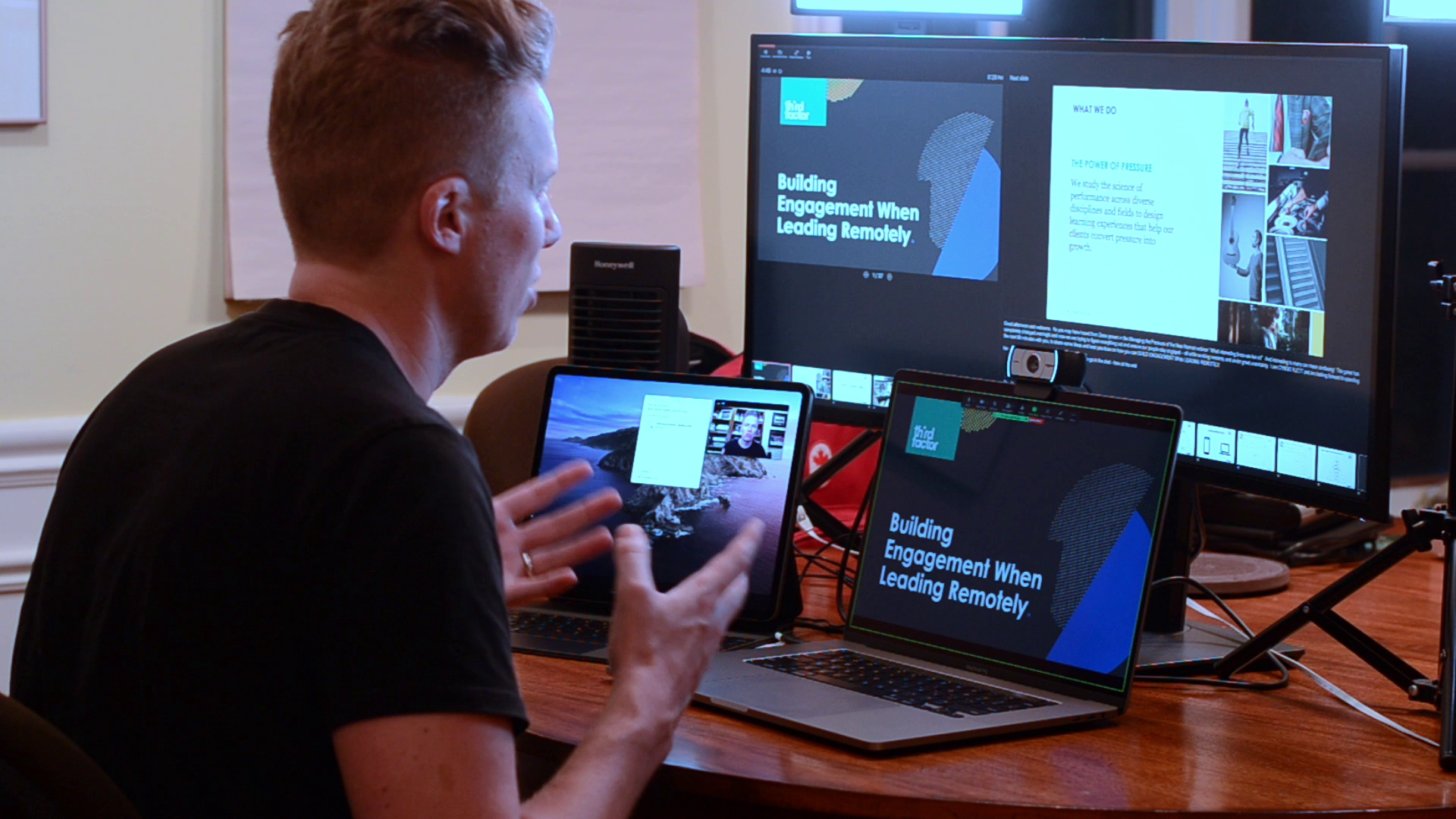
TWO TRACKS TO CHOOSE FROM
Develop your people in the areas that will benefit them most. Choose our leadership track to build your team’s coaching and collaboration capabilities, or choose our resilience track to build your team’s ability to perform under pressure.LEADERSHIP TRACK Develop high performing leaders.
3×4 Coaching
Drawing on a wealth of experience from our 30+ years of working with the world’s top coaches, 3×4 Coaching introduces the 3 Plays and 4 Skills great coaches use to build commitment and get results.Building High-Performing Teams
Basketball coach Roy Rana has built high performing teams at every level from high school to the NBA. Drawing on years of experience, he will share what he has learned about how to create an environment in which a team is more than the sum of its parts.Working With People You Don’t Understand
Introduce participants to the relationship between their mindsets, behaviours and results, and take them on an interactive tour of how adopting new mindsets of curiosity and generosity can make those behaviours automatic.
RESILIENCE TRACK Enhance performance under pressure.
Building Resilience
High performance is not possible without pressure. The Building Resilience keynote introduces a personal resilience toolkit used by elite athletes to develop a relationship with stress and pressure that puts them in the driver’s seat.Maintaining Team Motivation Through the Troughs
When teams face challenging times, leaders have four allies to preserve motivation and fight the tide of disillusionment. This session brings these allies to life with stories from people who have used them under incredible pressure.The Power of Pressure
Drawing insights from his book, The Power of Pressure: Why Pressure isn’t the Problem, it’s the Solution, Dane Jensen’s new keynote address introduces three powerful strategies for using pressure as an advantage.
DELIVERED BY A WORLD-CLASS FACULTY
Our speakers teach at top business schools, have coached Olympic and professional athletes, been Olympic athletes, consulted at the highest level of business, and practiced law. Their strong personalities and unique personal experience draw audiences in and keep learners engaged.






LEARN MORE
Want to learn more about bringing our Summer Learning Series to your organization? Leave your contact information below and we’ll get in touch.In this article
Explore our virtual leadership development options to meet your current needs.
One Size Doesn’t Fit All
Depending on your goals for virtual learning, different approaches are required. We’ve taken a ‘small / medium / large’ approach to our product development to meet the needs of a variety of scenarios:Large Group Experiences
Webinars or a-synchronous content to spark ideas and motivation for groups of any size.
Targeted Group Programs
Learning journeys that integrate video, synchronous learning, 1:1 coaching and application to build mastery for up to 49 people.
In-depth Cohort Programs
Half-day interactive instructor-led sessions for up to 18 people to build core skills.
Get the catalog
Download a full summary of our leadership development programs.
Timeless skills + the right tools for right now
Of course, we have a range of virtual options in our core competencies: coaching skills for managers, resilience skills for all, and self-awareness skills to enable more productive collaboration. And, we are continuously launching virtual programs that give learners the skills they need to be successful right now. Note that we are continuously developing new offers (and adapting our in-person programs to virtual delivery) so this list will be updated as new programs come online.Coaching skills for managers
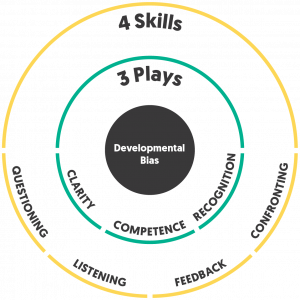
The 3×4 Coaching model explores the 3 plays and 4 skills consistently executed by world-leading coaches.
We have a full range of options for bringing our industry-leading 3×4 Coaching model to life virtually – with a specific eye to how to coach in a virtual environment.In-depth Cohort Programs
3×4 Coaching Virtual Learning Journey
Coaches are leaders who do all they can to help people improve and succeed. It is a way of thinking and interacting with people that communicates high expectations, respect and caring. In this 4 – 6 week (depending on your desired pace) virtual program, individuals learn the concepts and skills of a coaching style of management that builds commitment, drives employee engagement, gets results, and integrates this learning into the flow of their work.
Get a feel for the learning experience in this 3-minute video overview of the program.
Targeted Group Programs
Coaching Remotely 1/2-day Virtual Program
Coaches are leaders who do all they can to help people improve and succeed. It is a way of thinking and interacting with people that communicates high expectations, respect and caring. In this 4 – 6 week (depending on your desired pace) virtual program, individuals learn the concepts and skills of a coaching style of management that builds commitment, drives employee engagement, gets results, and integrates this learning into the flow of their work.
Having Challenging Conversations from a Distance 1/2-day Virtual Program
Our practical, 4-step map for challenging conversations is rooted in our 25 years of experience helping elite athletes manage emotions under intense pressure. Participants explore methods of preparing to confront, learn an effective format for an opening statement, practice managing reactivity and discuss how to close the conversation with accountability built-in.
Large Group Experiences
3×4 Coaching Overview Webinar
Learning coaching skills is the best way to dramatically increase your people’s commitment level and performance. This interactive 1-hour online session starts your powerful coaching journey.
3×4 Coaching Asynchronous Video Program
The 3×4 Coaching Video Program is a self-paced, asynchronous learning journey that unpacks the 3 plays and 4 skills of exceptional coaches. It provides learners with a powerful, easy-to-understand model for coaching people to higher levels of results and engagement.
Watch a brief sample of the 3×4 Coaching video program
Resilience skills for all
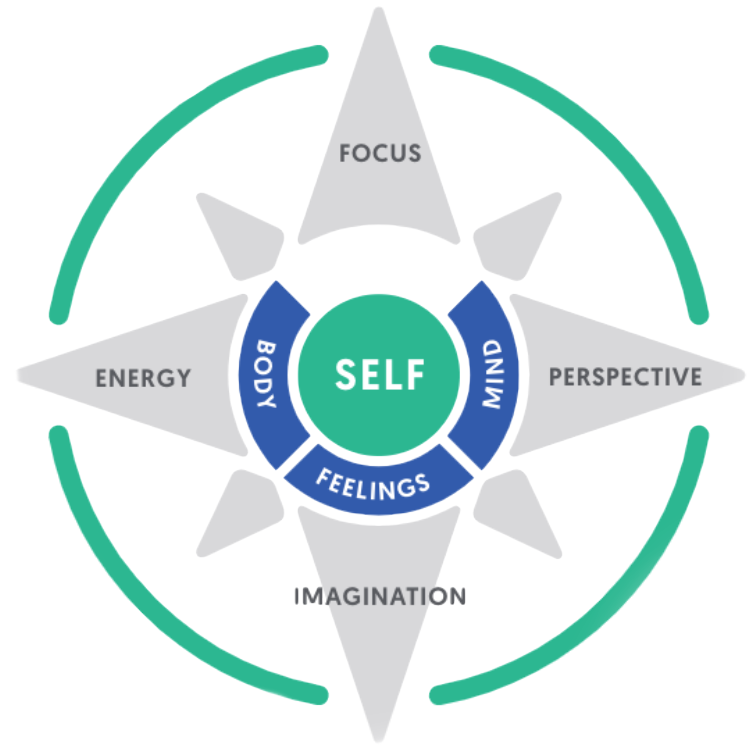
Building Resilience is aimed at giving participants a toolkit of inner skills to navigate their high pressure realities.
Rarely has resilience been as relevant as it is right now. We take our 30+ years of experience in resilience, and bring it to life in a way that gives people the insight and skills needed right now.In-depth Cohort Programs
Building Resilience Virtual Learning Journey
The virtual Building Resilience program synthesizes 30 years of science-backed and performance-proven strategies into a practical toolkit that participants can use to stay healthy under pressure and recover when they are thrown off balance. Our approach to resilience draws on work in elite sport, teaching and research in academia, and work with thousands of people in organizations of all sizes. Building Resilience is a transformative experience that allows participants to learn in the flow of work while changing the way they relate to pressure.
Targeted Group Programs
Building Resilience 1/2-day Virtual Program
A leader’s ability to stay resilient through setbacks and be predictable under pressure is the #1 indicator of how their team will weather the storm. Learn practical techniques for staying even-keeled when it matters most in this 1/2-day online workshop.
Large Group Experiences
Building Resilience Overview Webinar
This online session equips participants with an understanding of how uncertainty and pressure impact their performance and health, an awareness of the choices they have to enhance their resilience under pressure, and a guided, applied exercise that will specifically tackle how they are framing and taking direct action on the areas that will most impact their performance and resilience.
Topical skills leaders need right now
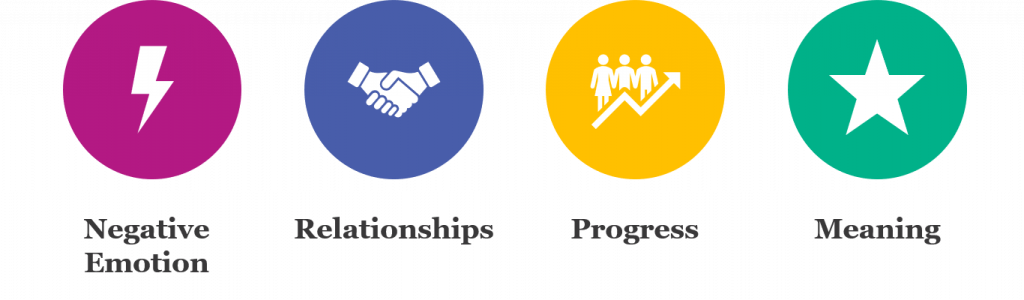
Our Maintaining Team Motivation Through The Troughs program teaches leaders four allies for fighting disillusionment.
A collection of fit-for-purpose programs that address hot button issues like motivation through prolonged periods of uncertainty, challenging conversations from a distance, and the imperative for agility and personal ownership over re-skilling.Targeted Group Programs
Maintaining Team Motivation Through the Troughs 1/2-day Virtual Program
As the pandemic drags on, maintaining motivation and engagement will become a primary challenge for leaders. Learn practical techniques to keep people energized, resilient and motivated, inspired by Olympic coaches and athletes, in this 1/2-day online workshop.
Large Group Experiences
The Meta-Skilled Organization
Meta-skills are the connective tissue that allow people and organizations to let go of the skills that have anchored their successful past and master and embrace new ways of working – in other words, to evolve. Packed with ideas on both how to foster the development of meta-skills for yourself, and how to build meta-skilled organizations as stewards of talent, this keynote lays out a framework for six key meta-skills that allow individuals and organizations to see clearly, move quickly, and stay the course.
Self-awareness & collaboration
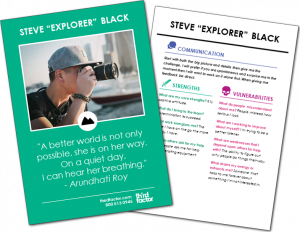
The “player’s card” is one of our favourite tools for helping learners translate self-awareness to communication and action.
Targeted Group Programs
The Self-Aware Leader Virtual Program
The Self-Aware Leader program combines the TAIS assessment, three one-on-one coaching sessions, the creation of a personal action plan to address a real business challenge, an ability to chart your progress and adjust your approach through the guidance of a coach. It will help leaders understand and leverage their strengths under pressure and identify what changes if made, would matter the most.
Large Group Experiences
TAIS Assessment + 1:1 Coaching
Whether you want to build self-awareness for a few executives or all of your people managers, the TAIS can help them identify environments and performance situations in which they will thrive and excel, when and how they are most likely to make mistakes and what they can do to ensure you will perform well under pressure. Participants receive an individual report detailing 18 personal styles as they relate to attention, information, leadership, social and communication and have the opportunity to build further clarity with a 1:1 coaching call.
Let’s talk!
If you’re interested in any the above – or anything that you don’t see here – let’s chat! You can get in touch at hello@thirdfactor.com.Download the catalog.
Get a complete overview of our coaching, collaboration and resilience programs.
In this article:
Three imperatives for L&D during COVID-19
- Leverage technology to continue “regularly scheduled programming.” Lead by example to encourage resilience and agility.
- Build resilience when it matters most. Investing in resilience skills demonstrates empathy and can yield significant benefits even with virtual delivery.
- Use this opportunity to invest in 1:1 coaching. Foster self-awareness and personal development at scale without gathering groups.
“L&D teams can provide unique value and directly influence how the organization weathers the storm”Connecting pressure to personal growth is vital for resilience over the long haul. If, as a leader, I feel like the pressure is just a weight on my shoulders that I must endure, it will have a significantly more negative impact than if I see how rising to this challenge can help me become stronger and better. Growth gives meaning to pressure – and our ability to help people see this tough period as a growth experience is a significant imperative for maintaining engagement at work.
Growth gives meaning to pressure.
Taken together, this makes the coming months a time when L&D teams can provide unique value and directly influence how the organization weathers the storm. The coming months will undoubtedly be a period of great pressure – but how heavy that pressure sits, and how skillfully it is navigated, is within L&D’s circle of influence. By rising to meet this challenge, learning and development organizations can support their risk management teams, build esteem for the department among senior executives, show the ability of the department to deliver in critical moments, directly influence performance outcomes, and directly support an entire workforce through an extremely challenging time. So, how can L&D navigate the choppy waters of risk mitigation policies while seizing the moment to step up and shine? We see three major imperatives:1. Demonstrate agility + resilience – leverage technology to continue “regularly scheduled programing”
Personal growth and development is a major driver of satisfaction and engagement in the workplace. When other drivers of satisfaction and engagement are compromised, continuing to invest in learning is vital. And, as learning organizations – we want to model the behaviours we are asking leaders to engage in: resilience, adaptability and flexibility. If we are asking others in the organization to continue to do their jobs in the face of disruption – it’s up to us to do the same.“Think deliberately about a learning journey that is designed to sustain energy and support application”Depending on the measures in place in your organization, this may include continuing to run in-person programming in small-medium sized groups – perhaps modified to focus on local attendees. In many cases, however, policies will necessitate the conversion of regularly scheduled programming into virtual delivery. Speaking from the perspective of an organization focused entirely on the development of leadership, collaboration and resilience skills – there are two imperatives we see to getting this right:
Think Fortnite, not Netflix
There is a reason in-person, instructor-led training continues to deliver the best learning outcomes: it gives people a chance to engage directly with an expert, to learn from peers, and to debate, dialogue and practice. In short, it’s a participative experience. While it is tempting to replace in-person programming with self-paced programs and video libraries – think Netflix – when it comes to executive function skills like coaching, collaboration, and resilience, getting strong learning outcomes requires collaboration. This is the ‘Fortnite’ model: we’re in this together, working alongside each other, in constant communication, and working towards a common goal.
Think Fortnite, not Netflix – virtual learning should be interactive and participative.
Divide and conquer
With dates already reserved on learners’ calendars, it can seem logistically easy to replace a 1-day in-person program with a 1-day virtual session. Even the most expertly designed and facilitated virtual sessions begin to lose their energy, however, after the two-hour mark. Instead, take advantage of the luxury of dividing learning up into more manageable modules. Freed from the requirements of a group of 25-30 learners traveling to one location for a short period of time, virtual sessions give you the opportunity to think deliberately about a learning journey that is designed to sustain energy and support application. The best designs involve modules that don’t require prolonged periods of attention, include interactivity and discussions that invite participation and reduce the temptation of distraction, and close with a clearly actionable outcome that learners can practice prior to the next module (i.e. an action learning-oriented approach). Virtual instructor-led technology has come a long way in even the past 12 months. In the face of COVID-19 we’ve been working directly with many of our clients to use a technology stack focused on interactivity and collaboration to ‘convert’ their in-person experience into virtual ones – complete with breakout rooms, lively discussion, whiteboard sessions and polling. Take advantage of new technology to demonstrate resourcefulness.2. Build resilience in all corners of your organization
Ultimately, resilience is built in the troughs, not the peaks. And, not only is this a time in which resilience skills are vital – it’s also the perfect time to support your people in building resilience. In my forthcoming book, tentatively titled The Power of Pressure, I argue that the two key factors that ramp up pressure are importance (“this matters to me”) and uncertainty (“I don’t know how this will turn out”). The threat posed by COVID-19 delivers an unhealthy dose of both these ingredients.
Changing policies and sparsely populated offices are just two sources of uncertainty.
In the face of this pressure, learning and development teams have an opportunity to show that the organization cares not just about physical safety but also about people’s psychological wellbeing, and stands ready to help them learn the skills they need to not just survive but thrive through this period. There are two key imperatives here:Support physical resilience
Employee wellness programs have never been more important than they are right now. Sleep, nutrition and exercise are the basis of not just a healthy immune system but also a resilient individual. Now is the time to promote awareness of the programs available to your teams.Build inner resilience
Resilience isn’t a genetic gift – it’s a set of skills that can be learned and mastered. Often we assume that resilience will be built naturally as a by-product of tough times – but just like an athlete needs a good coach to reap the developmental benefits of sport, so too do individuals need support in learning how to channel pressure into growth.“In times of challenge, what’s often most challenging is that the old pressure doesn’t go away”In our Building Resilience program, we do this by giving participants an understanding of how uncertainty and pressure impact their performance and health, and then grow their awareness of the choices they have and skills they can use to enhance their resilience under pressure. I led a 90-minute virtual session on resilience for leaders at a major cruise line last week. As you can imagine, the pressure they are facing is immense. In our opening exercise, I asked them to identify the things that make this “interesting times” for them. Here is a random sample of the 46 responses I received:
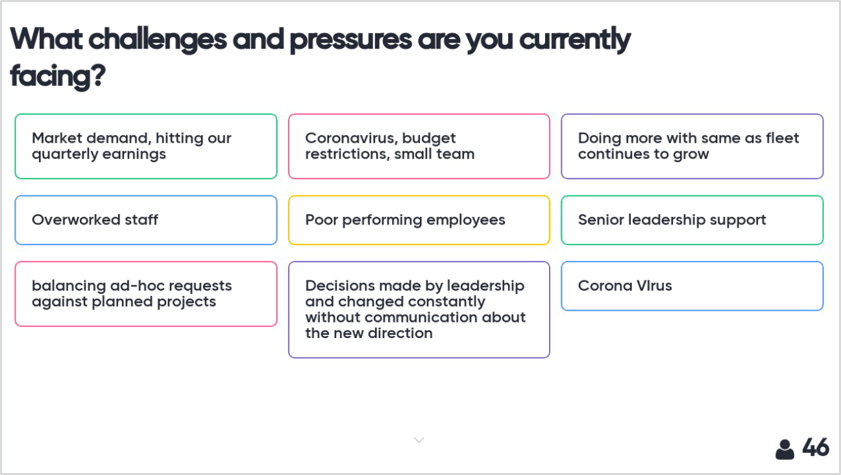 What’s most interesting to me is that the responses weren’t simply “coronavirus” 46 times. In times of challenge, what’s often most challenging is that the old pressure doesn’t go away – we simply add more to the pile, further compounding our already high-pressure lives.
In acute scenarios such as this one, people need to have a clear sense of:
What’s most interesting to me is that the responses weren’t simply “coronavirus” 46 times. In times of challenge, what’s often most challenging is that the old pressure doesn’t go away – we simply add more to the pile, further compounding our already high-pressure lives.
In acute scenarios such as this one, people need to have a clear sense of:
- What they can control – i.e. their perspective + their behaviours
- What they need to let go of – i.e. the situation + others’ responses

With the right tools, everyone can emerge knowing they were up to the challenge.
3. Give People the 1:1 Learning They Crave (Without Breaking the Bank)
“The next few months provide a real opportunity for learning organizations to invest in the 1:1 learning that people crave”All of the research into learning tells us that providing individualized, coaching is among the best ways to help people learn, achieve their goals, and feel satisfied with their progress. And yet, the cost of providing individualized coaching is often prohibitive at scale. The next few months provide a real opportunity for learning organizations to invest in the 1:1 learning that people crave. The travel challenges posed by the COVID-19 threat will mean a dramatic reduction in travel expenses, and 1:1 coaching is uniquely suited to virtual delivery. Taken together, this provides an opportunity to invest in personalized coaching for your high potential talent at a cost that’s similar to what you would spend on a per-person basis to bring people together for a workshop. Depending on how your organization calculates the overall cost-benefit of leadership development, reduced time away from the field for participants can also support your case for making this kind of investment. So, how do you do this effectively? Two ideas:
1 goal, 3 months
Unlike traditional executive coaching, which is often an open-ended partnership between a coachee and a coach, have people pick a meaningful goal in conjunction with their coach and give them 3 months of support to move towards it. Framing coaching around time-bounded outcomes makes for more deliberate, action-oriented partnerships, gives you a measuring stick for demonstrating ROI to the organization, and ensures that you don’t add on-going cost into your budget.Build self-awareness + self-responsibility
As we all know, adults don’t change because a coach tells them to. They do it because they develop the self-responsibility to change. In our experience, the best way to build self-responsibility in a short period of time is to kick off a coaching partnership with a strong self-assessment tool. We use a tool called The Interpersonal and Attentional Styles Inventory (TAIS) that lends itself perfectly to this kind of individualized development. The TAIS was originally developed for Olympic athletes to better understand their tendencies under pressure and make conscious strategic decisions about how to play to their strengths and compensate for their weaknesses. It was then adopted by the US Navy SEALS for the same purpose and is now very highly regarded in the business community as a tool for building self-awareness and high performance in the corporate environment. The TAIS looks at 18 different metrics to help people understand how they are most likely to behave under pressure and how their unique traits compare to their teammates and contemporaries. As an example, the TAIS results may show that someone has high needs for control – that is, they are less comfortable with uncertainty and like to have a clear view of what’s coming. In the current climate, this tendency has the potential to create significant additional strain for both the individual and anyone they lead as they attempt to exert control in a situation that is largely impossible to influence. Working with a TAIS coach in a one-on-one coaching call, the employee can gain a better understanding of how that tendency is likely to manifest and develop strategies for mitigating its impact. By combining the online TAIS assessment with one-on-one video coaching, you can create an opportunity for your high performing talent to gain a better understanding of themselves, adapt more readily to changes in their environment, and actually enhance their learning through the downturn rather than merely mitigate the impact.Team Canada Captain Hayley Wickenheiser shares her TAIS experience.
Want to Learn More?
Your opportunity to make an important contribution to your organization over the coming months is a brief one and you will need to move quickly to succeed. We are committed to supporting you in seizing this moment and readying the workforce for a period of disruption. If you want to get started right away, we have two turn-key ways for you to roll out 1:1 virtual coaching, and resilience skill-building. For your executive team, mid-senior leadership and high-potential employees, we offer TAIS self-assessments and coaching calls that can be scaled for teams of all sizes and begin delivering to participants in a matter of days. For teams and business units that are most affected by your organization’s COVID-19 response, we are offering an adapted version of our Building Resilience program, delivered entirely online and available in a modular format comprising 1 to 5 modules. Give us a shout if you’d like to know more. For further reading on some of the subjects discussed here, we have a few whitepapers that are especially relevant.- The Why, What and How of Self-Awareness introduces the concept of “active awareness”, a skill that helps you leverage self-awareness in the moment, and that has worked for the thousands of executives Third Factor has worked with.
- The Paradox Of Pressure explores what causes us to feel pressure, explores what happens to the human body and mind when we experience pressure, and looks at ways to transform pressure into growth.
- The Meta-Skilled Organization lays out a framework for individuals and organizations who want to direct their own evolution and claim an uncertain future.